


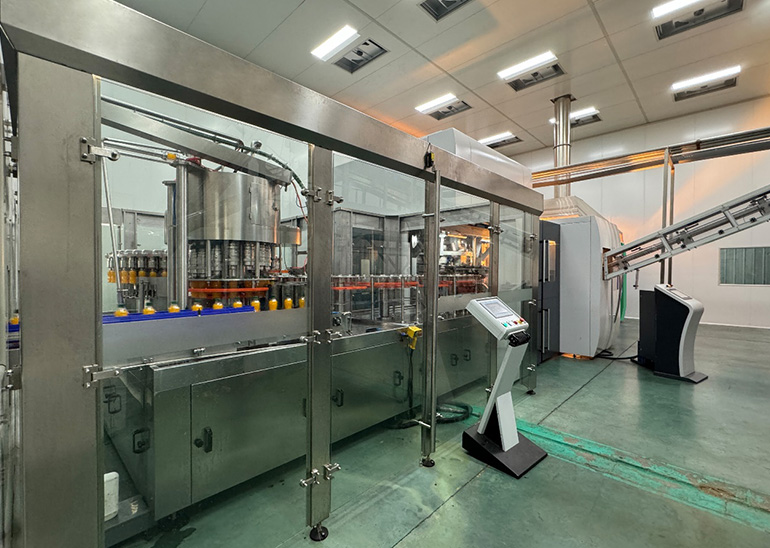
Selection Guide · Juice & Tea Hot-fill
Juice and Tea Hot-fill Machine Selection Guide — Capacity, Bottle Size and Valve Type
Three questions decide the machine: how many bottles per hour, what is in the bottle, and what the bottle is made of.
2,000–36,000
BPH hot-fill range
85–88 °C
Filling temperature
PET / Glass
Both formats supplied
444+
Lines delivered
ISO/CE
Certified · SGS audited
Short answer: Choose on three axes. Output sets the machine class across 2,000, 6,000, 12,000, 24,000 and 36,000 BPH. Product character sets the valve: gravity for clear juice and tea, volumetric for fine pulp, piston for coarse pulp and viscous product. Package sets bottle handling: heat-set PET needs crystallised necks and vacuum absorption, glass needs a gentler cooling profile. All routes fill at 85–88 °C.
🎯 Key takeaways
- Three axes decide the machine: output band, particle size and viscosity, and heat-set PET or glass
- Maximum particle size in millimetres is the most useful number in a juice enquiry — it selects the valve on its own
- Gravity to 36,000 BPH for clear product, volumetric 6,000–24,000 BPH for fine pulp, piston 2,000–12,000 BPH for coarse pulp
- Hot-fill needs product below pH 4.6; above that, heat and acidity together are not enough and the route changes
- Glass avoids the heat-set problem and replaces it with weight, breakage and a longer, gentler cooling tunnel
- Specify the valve against the hardest product you will ever run — a carousel cannot be converted to another principle
On this page
1. Three questions that decide the machine
A hot-fill juice or tea line is specified by answering three questions in the right order. Get them in the wrong order and the quotation is rebuilt at least once.
- How many bottles per hour, sustained? Not the peak week — the output the line has to hold across a normal production year.
- What is in the bottle? Clear juice, cloudy juice, juice with pulp, or ready-to-drink tea. Particle size and viscosity matter more than the name of the drink.
- What is the bottle? Heat-set PET or glass. This sets the blowing arrangement, the cooling profile and the closure system.
Everything else — valve count, carousel size, heat exchanger type, tunnel length, CIP scope — follows from those three answers. This guide works through each axis and ends with a decision matrix. The process itself, including heat-set bottle design, inverting and cooling, is described in combiblock for juice and tea, hot-fill configuration.
Hot-fill is a preservation route, not a machine preference. It works by combining heat with product acidity, so it suits acidified products below pH 4.6 — fruit juice, nectar, iced tea with acidulant, isotonic drinks. Low-acid products above pH 4.6 are not made shelf-stable by hot-fill and need a different preservation approach entirely. Confirm your product pH before anything else in this guide applies.
2. Axis one — output band
Output decides the machine class before it decides anything else. The bands below are the practical steps in the range, and the jump between them is a change of machine rather than a change of setting.
| Output band | Typical machine class | Bottle sizes | Suits |
|---|---|---|---|
| 2,000 – 6,000 BPH | Piston filler or small standalone hot-fill filler | 0.2 – 2 L PET, or glass | Start-up producers, premium small-batch juice, high-pulp product, many SKUs |
| 6,000 – 12,000 BPH | Standalone hot-fill filler, or volumetric hot-fill block | 0.2 – 2 L | Regional brands with two or three formats and steady demand |
| 12,000 – 24,000 BPH | Volumetric hot-fill combiblock | 0.2 – 2 L | National distribution, mixed clear and pulpy portfolio |
| 24,000 – 36,000 BPH | Mechanical hot-fill combiblock | 0.2 – 2 L | Large clear-juice and tea volumes on few formats |
| Glass, from 2,000 BPH | Mechanical or volumetric hot-fill glass filler | 200 – 750 ml | Premium juice and tea, returnable formats, export gifting |
2.1 Why the top band is mechanical
Above roughly 24,000 BPH the fill cycle has to be short, and a gravity valve with a level stop is the fastest way to fill a bottle with hot, low-viscosity product. That is why the high-output configurations are mechanical and why they suit clear juice and tea rather than pulpy product. Pushing pulp through a high-speed mechanical valve does not fail gracefully; it blocks.
2.2 Why juice sizing differs from water sizing
Juice demand is more seasonal and more SKU-heavy than water. A line sized for the peak runs at part load for most of the year, and every hour of changeover on a multi-SKU portfolio costs more than it does on a single-format water line. Size for the annual average, then check that the peak can be covered with additional shifts before adding capacity. Band-by-band method is in combiblock capacity selection.
3. Axis two — product character
The single most useful number in a juice enquiry is maximum particle size in millimetres, followed by pulp percentage and viscosity at filling temperature. Those three figures select the valve. The name of the drink does not.
| Product type | Typical character | Filling consequence |
|---|---|---|
| Clear juice | Filtered apple, grape, clarified citrus; low viscosity, no particles | Fastest to fill; gravity valve suitable; plate heat exchanger acceptable |
| Cloudy juice and nectar | Homogenised orange, mango, peach; moderate viscosity, fine haze | Gravity or volumetric valve; watch foaming from entrained air |
| Juice with pulp | Citrus sacs, fibre, cell wall material at 2–10 mm | Volumetric with enlarged flow path, or a piston filler; tubular heat exchanger |
| High-pulp and viscous | Smoothie-type, aloe pieces, thick nectar | Piston filler; output limited by the dosing stroke, not by the carousel |
| RTD tea | Very low viscosity, oxygen sensitive, colour sensitive | Gravity valve; deaeration ahead of heating protects colour and taste |
3.1 Particle size decides the valve
Narrow valve passages shear fibre and block on particles. As a working rule: no visible particles goes to a mechanical gravity valve; fine pulp below roughly 2 mm goes to a volumetric valve with an enlarged orifice; anything coarser, fibrous or above roughly 10% pulp goes to a piston filler with a clear product path. Between those points, ask for a trial with your own product rather than accepting a rule of thumb.
3.2 Viscosity at filling temperature, not at ambient
Product is thinner at 85 °C than in a laboratory sample at 20 °C, which sometimes makes a marginal product fillable on a faster valve than the cold measurement suggests. It also means fill accuracy on a level-based valve changes with temperature. Give your supplier viscosity at fill temperature and state the measurement method.
3.3 Level fill or metered volume
A mechanical valve fills to a level, so bottle-to-bottle volume variation appears as weight variation. A volumetric valve meters a volume, so the variation appears as fill height. A piston filler doses a stroke, which is the most repeatable of the three on difficult product. Decide which variation your label declaration and your market can live with. The principle-by-principle comparison is in filling valve types compared.
4. Axis three — PET or glass
| Heat-set PET | Glass | |
|---|---|---|
| Bottle preparation | Blown in-house on heat-set moulds, or bought blown | Bought in, rinsed before filling |
| Temperature handling | Needs heat-set walls, crystallised neck, vacuum absorption | Tolerates fill temperature directly |
| Closure | Plastic screw cap on a crystallised neck finish | Lug or twist-off metal closure, or crown |
| Cooling profile | Spray tunnel in stages to roughly 35–40 °C | Gentler staged cooling to stay well inside the thermal shock limit |
| Typical output | Up to 36,000 BPH | From 2,000 BPH, lower ceiling |
| Unit weight and freight | Light; low freight cost per litre | Heavy; freight and handling cost per litre significantly higher |
| Breakage handling | Not applicable | Glass breakage procedure, guarding and line clearing rules required |
| Positioning | Mainstream retail, large formats, export volume | Premium, gifting, returnable and on-trade formats |
| Matching product references | P004, P005, P018, P021 | P025, P026 |
4.1 What heat-set PET costs you
A heat-set bottle is heavier than a cold-fill bottle of the same size, because the crystallised neck, the vacuum panels and the heat-set wall all add grams. It is blown in a mould running hot rather than chilled, which lengthens the cycle. Both facts are permanent and both belong in the business case. Do not target the bottle weight you achieve on water; the comparison is not valid.
4.2 What glass costs you
Glass removes the heat-set problem and replaces it with thermal shock management, weight and breakage. Cooling has to be staged gently — keep each stage well inside the accepted thermal shock margin rather than at it — which makes the tunnel longer for a given output. Add bottle rinsing, a glass-handling conveyor system and a documented breakage procedure. Against that, glass takes the fill temperature without any special container engineering at all.
5. Valve options compared
| Valve / machine | Output band | Product fit | Choose it when |
|---|---|---|---|
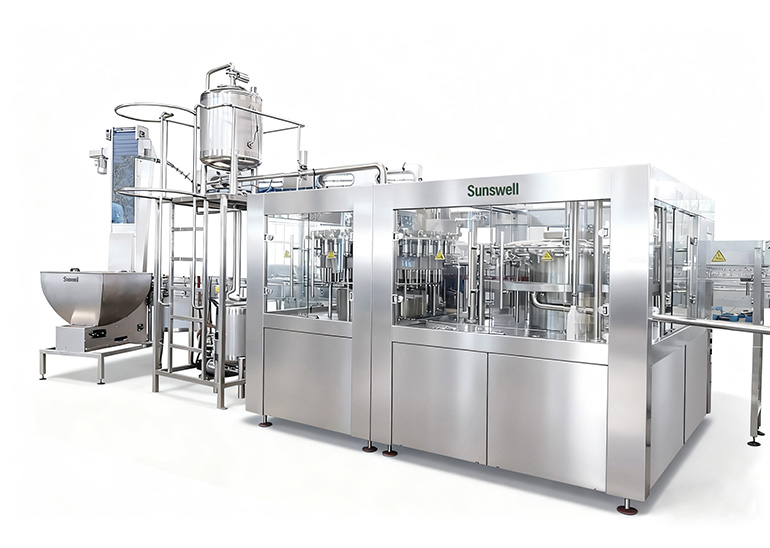
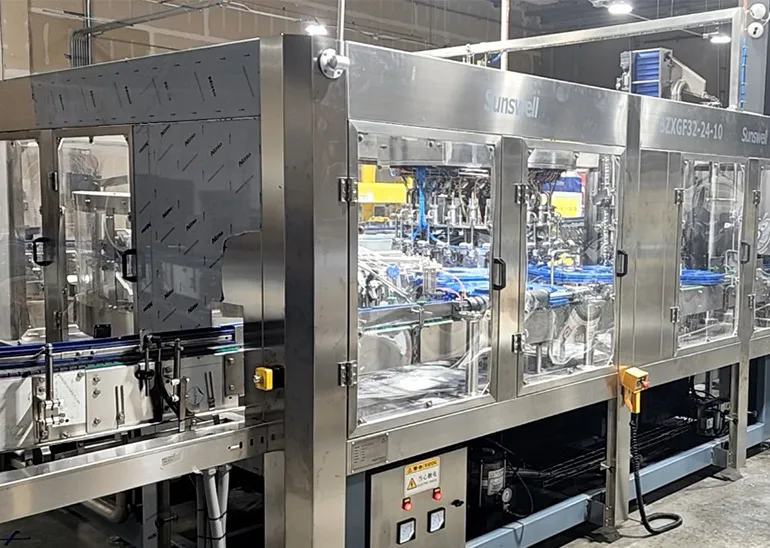
| Mechanical hot-fill filler | Up to 36,000 BPH, 0.2–2 L | Clear juice, nectar without fibre, iced tea | Output is the priority, a level fill is acceptable and the product has no particles |
| Volumetric hot-fill filler | 6,000 – 24,000 BPH | Cloudy juice, fine pulp, mixed portfolio | Declared volume must be exact, or several recipes share one machine |
| Piston filler | 2,000 – 12,000 BPH | Coarse pulp, fibre, cubes, viscous nectar | Particle size or viscosity defeats a gravity or flowmeter valve |
| Standalone hot-fill filler | 6,000 – 24,000 BPH, 0.2–2 L | Any of the above | The blow moulder already exists, or blowing and filling must be in separate rooms |
| Mechanical hot-fill glass filler | From 2,000 BPH, 200–750 ml | Clear juice and tea in glass | Premium or returnable glass formats |
| Volumetric hot-fill glass filler | From 2,000 BPH, 200–750 ml | Juice and tea in glass with tight fill control | Fill accuracy around ±0.5% is required on a glass format |
One point that saves money later: the valve is chosen for the hardest product you intend to run, not the easiest. A plant that buys a mechanical filler for clear apple juice and adds an orange product with sacs in year two has bought the wrong machine, and the carousel cannot be converted.
6. What sits around the filler
The filler is a minority of the capital on a hot-fill line. The following are all in scope somewhere, and the question is only whose quotation they appear in.
- Blending and dosing. Sugar dissolving, concentrate dilution, acid, vitamin and flavour dosing.
- Deaeration. Vacuum deaerator ahead of the heater; important for tea and for any product carrying added vitamin C.
- Pasteuriser. A plate heat exchanger for clear product, a tubular exchanger where pulp or fibre is present, because plates block.
- Holding tube. Sized for the required hold at roughly 92–95 °C, with temperature recording and a flow diversion valve.
- Regenerative cooling. Back to the 85–88 °C filling window, recovering heat into incoming product.
- Hot buffer tank. Jacketed and agitated, holding fill temperature and keeping pulp in suspension.
- Filler and capper. Capping hot is part of the process, not a downstream step.
- Inverter. Rotary or conveyor type, holding the bottle over for 15–30 seconds.
- Cooling tunnel. Staged spray cooling, leaving bottles at roughly 35–40 °C, followed by an air knife.
- CIP system. Skid, chemical tanks, bunding and return lines with fall.
6.1 The two items that change the building
The cooling tunnel and the CIP skid. A tunnel for a mid-capacity line is a long machine, it is wet, and it cannot be squeezed in after the walls are up. The CIP skid needs floor area near the filler, chemical storage with bunding, and drains with the right fall. Both belong in the first layout drawing. Layout method is covered in plant layout and footprint planning.
6.2 Heat exchanger choice is a product decision
Plate exchangers are compact and thermally efficient and they block on fibre. Tubular exchangers cost more floor length and handle particles. If there is any prospect of a pulpy product on the line, specify tubular from the start; converting later means re-piping the process room while the plant is running.
7. Decision matrix
Work down the list. The first condition that matches usually fixes the configuration.
- If product pH is above 4.6, then stop — hot-fill alone will not deliver shelf stability and the whole line specification changes.
- If maximum particle size is above roughly 5 mm or pulp exceeds roughly 10%, then specify a piston filler at 2,000–12,000 BPH and accept the output ceiling.
- If the product carries fine pulp below roughly 2 mm and volume declaration must be exact, then specify a volumetric hot-fill filler at 6,000–24,000 BPH.
- If the portfolio is clear juice and tea only and sustained demand exceeds 24,000 BPH, then a mechanical hot-fill combiblock to 36,000 BPH is the lowest cost per bottle.
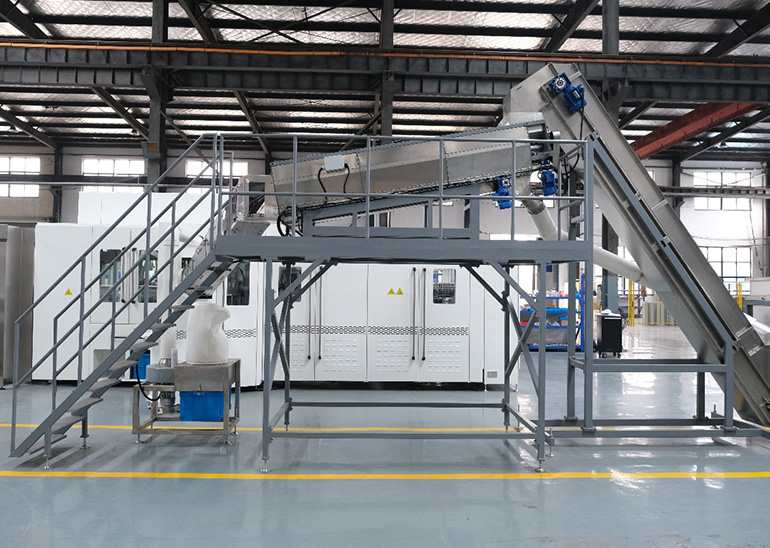
- If you already run a serviceable blow moulder, then price a standalone hot-fill filler before a block; you may not need to buy blowing twice.
- If the format is glass, then the choice narrows to mechanical or volumetric glass fillers and the cooling tunnel is sized for a gentler profile.
- If tea shares the line with juice, then add deaeration and set the CIP schedule from the pulpy product, not the tea.
- If the bottle drawing does not exist yet, then settle it before the machine order; heat-set moulds, panel geometry and neck finish are all bottle-led.
State the worst case, not the launch product. Suppliers quote what they are told. A specification written around clear apple juice at 12,000 BPH produces a machine that cannot run the mango nectar with sacs that marketing adds in year two. List every product family you expect to run over the machine's life, with pulp percentage and particle size for each, and have the valve chosen against the hardest one on the list.
8. Where selections go wrong
- Describing pulp qualitatively. “A little pulp” is not a specification. Give percentage and maximum particle size in millimetres; 8% at 2 mm and 8% at 6 mm are different machines.
- Ordering the machine before the bottle. Heat-set mould design, vacuum panel geometry and neck finish all depend on the bottle drawing, and the filler format parts depend on the bottle.
- Using an amorphous neck finish to save money on preforms. It softens at fill temperature and the closure leaks. This is the most common false economy on hot-fill projects.
- Specifying a plate heat exchanger for a portfolio that will include pulp. Plates block; tubular exchangers exist for that reason and cost floor length, not performance.
- Forgetting the cooling tunnel in the layout. It is long, it is wet, and moving other machines to fit it later is far more expensive than drawing it in first.
- Sizing for the seasonal peak. Juice demand is seasonal. Check whether extra shifts cover the peak before buying capacity that idles for eight months.
- Comparing a hot-fill quotation with a water line quotation. The pasteuriser, buffer tank, inverter and cooling tunnel are real machines that a water line does not have.
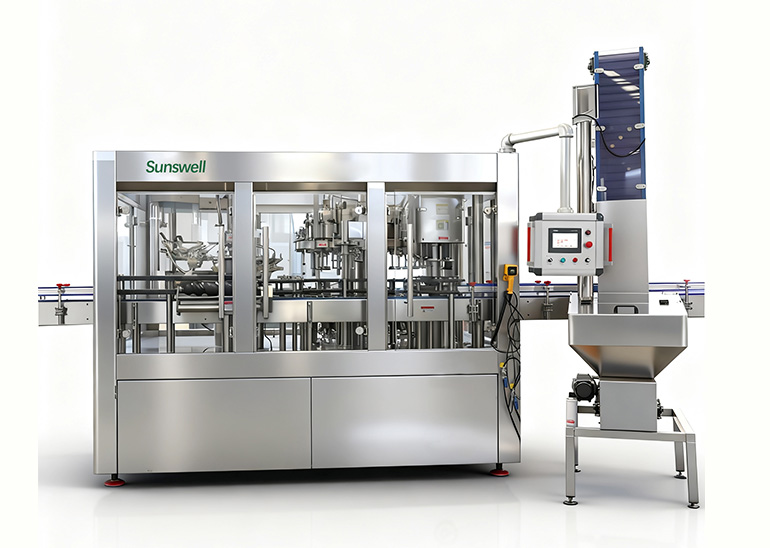
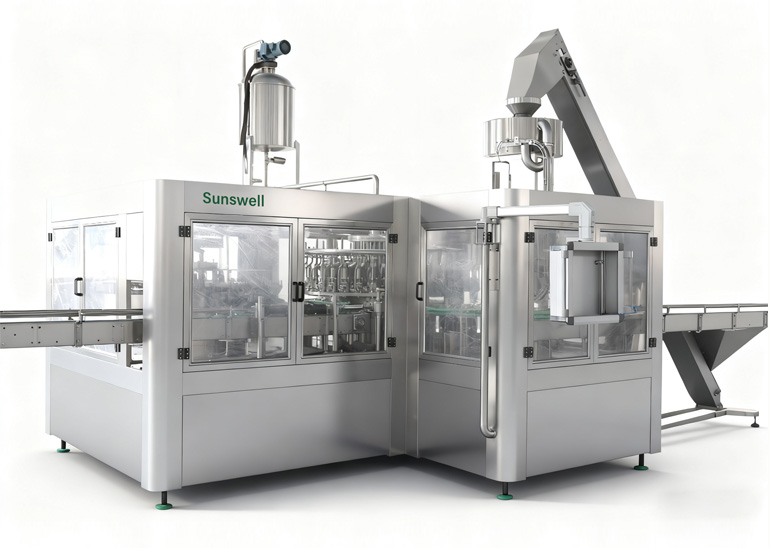
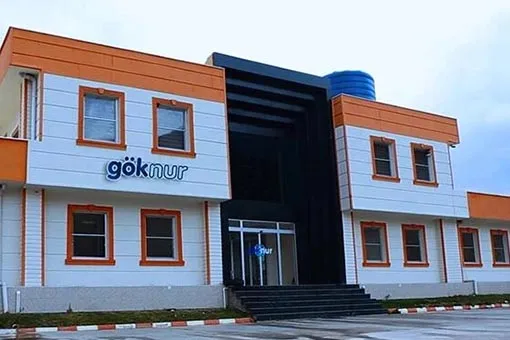
Sunswell has supplied hot-fill juice capacity into demanding markets, including two 18,000 BPH juice lines for Goknur in Turkey, and builds hot-fill fillers and blocks across the 2,000–36,000 BPH range in PET and glass. Configuration tiers and running costs are compared in juice and tea configurations and price levels, and the common questions are answered in the juice and tea hot-fill FAQ.
Frequently asked questions
How do I choose a juice and tea hot-fill machine?
Three variables decide it: required output in BPH, product character (clear, cloudy, pulpy or tea) and package (heat-set PET or glass). Output sets the machine class, particle size and viscosity set the valve, and the package sets the bottle handling and the cooling regime. Fix all three before comparing quotations.
What filling temperature does hot-fill use?
Product is heated to roughly 92–95 °C in a holding tube, cooled back and filled at 85–88 °C. The bottle is capped hot, inverted so the product wets the closure and neck, then cooled in a spray tunnel. Filling below that window weakens the closure treatment; filling above it stresses the bottle.
Which valve should I use for juice with pulp?
Clear and lightly clouded juice runs on a mechanical gravity valve. Fine pulp up to a few millimetres runs on a volumetric valve with an enlarged flow path. Coarse sacs, fibre, cubes or high viscosity need a piston filler, which is slower but has a clear, unobstructed product path. Declare percentage and particle size, not just “with pulp”.
What output should a first juice line be?
Common bands are 2,000, 6,000, 12,000, 24,000 and 36,000 BPH. Size for annual average demand plus growth and cover the seasonal peak with shifts. Juice demand is more seasonal than water, so the case for buying peak capacity is usually weaker than it first appears.
Can the same line run juice and tea?
Usually yes, and it is common. Tea needs deaeration ahead of heating to protect colour and taste, and a flavour change forces a full clean. If tea and pulpy juice share a line, the valve must be chosen for the pulp and the CIP schedule for the tea.
Glass or PET for hot-fill juice?
PET is lighter, cheaper to freight and reaches higher speeds, but it needs heat-set moulds, a crystallised neck and vacuum absorption. Glass tolerates the fill temperature without any of that and suits premium and returnable positioning, at the cost of weight, breakage and a gentler, longer cooling profile.
Do I need a blow-fill-cap block or a standalone filler?
A block is the better answer when you are buying blowing and filling together and want one frame with neck-handling transfer. A standalone hot-fill filler is correct when you already run a serviceable blow moulder, when you fill glass, or when the blowing and filling rooms must be separated for layout reasons.
How long does a hot-fill project take to specify properly?
Longer than a water line, because the bottle drawing, the heat-set mould, the neck finish and the valve are interdependent. Settle the product specification and the bottle first. Machines quoted against a guessed bottle are always re-quoted, and the second price is the real one.
About the author
Written by the Sunswell engineering team — led by Howie SUN, Founder & CEO, with 14 years in filling and blow-moulding equipment R&D and turnkey project delivery across 71+ countries.
Last reviewed: 2026-08-07 · Reviewed by Sunswell engineering team
Ask our engineering team →Recommend Products
Have a specific project in mind?
Tell us product, target BPH, bottle sizes and market. We reply with a draft layout, equipment list and lead time estimate.
Fill the inquiry form ↑