


Application Guide · Combiblock Series
Combiblock for Juice and Tea — Hot-fill Configuration
Filling at 85–88 °C on the same frame that blows the bottle — what changes, and what it costs.
85–88 °C
Filling temperature
2,000–36,000
BPH, 0.2–2 L
15–30 s
Inverting hold time
444+
Lines delivered
ISO/CE
Certified · SGS audited
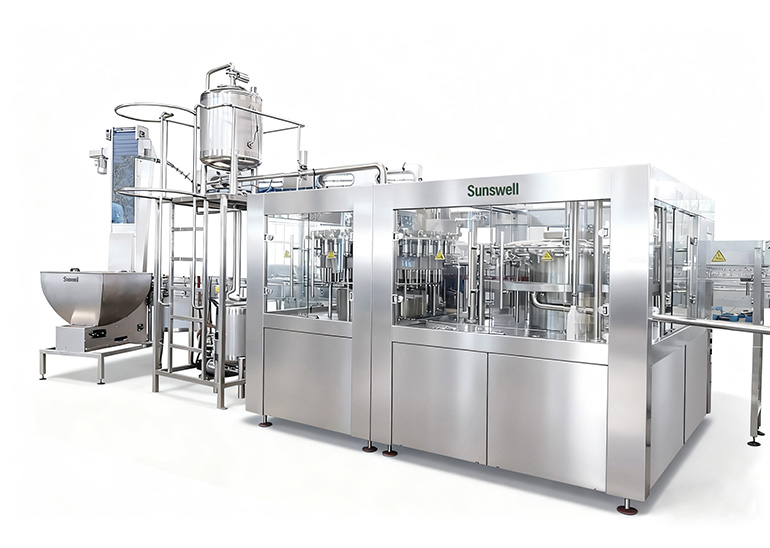
Short answer: Yes — a hot-fill combiblock blows a heat-set PET bottle, fills it at 85–88 °C and caps it on one frame. It needs moulds running at 120–160 °C, a crystallised neck finish, vacuum panels or a vacuum-absorbing base, plus an inverter and a spray cooling tunnel downstream. Sunswell builds mechanical hot-fill to 36,000 BPH, volumetric to 24,000 BPH and piston fillers for pulp at 2,000–12,000 BPH.
🎯 Key takeaways
- Fill at 85–88 °C after pasteurising at 92–95 °C; a cold-fill block cannot be converted by turning up the temperature
- The bottle changes, not just the filler — heat-set moulds at 120–160 °C, crystallised neck finish, vacuum panels or an absorbing base
- Cooling contraction is about 3% of product volume, which is what the vacuum panels exist to absorb
- Pulp decides the valve: mechanical to 36,000 BPH for clear product, volumetric to 24,000 BPH with pulp, piston filler 2,000–12,000 BPH for high pulp
- Two extra machines — an inverter and a spray cooling tunnel — must be in the layout and the budget from day one
- Hot-fill suits products below pH 4.6; low-acid drinks need a different preservation route and a different line
On this page
1. What a hot-fill combiblock has to solve
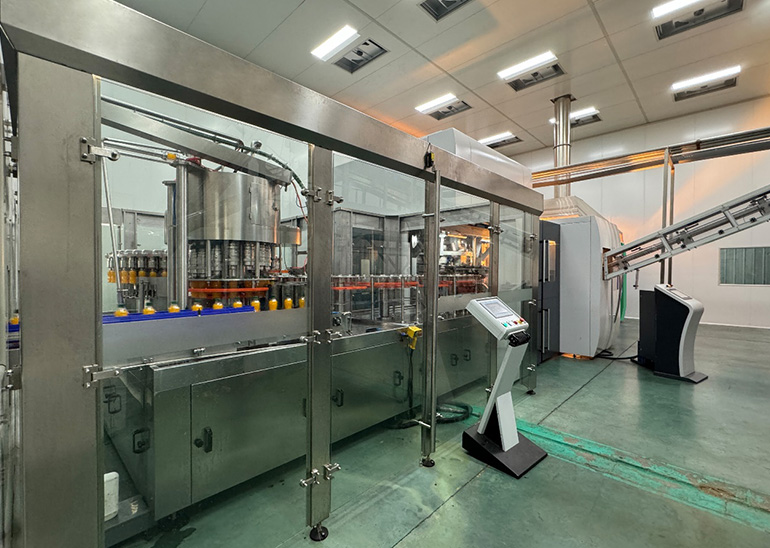
A hot-fill blow-fill-cap block blows the PET bottle, fills it with product at 85–88 °C and caps it on a single frame, with neck-handling transfer between stations. The engineering problem is that the two halves of the machine want opposite conditions. Blowing wants a hot preform and a controlled mould; the finished bottle then has to survive contact with near-boiling product minutes later, without shrinking, distorting or losing its neck geometry.
That single conflict drives almost every difference between a hot-fill block and a cold-fill one. The bottle changes, the mould changes, the preform neck changes, the filler changes and the downstream equipment grows by two machines that a water line does not have. Buyers who price a hot-fill line against a water line and find it more expensive are not being over-quoted; they are buying a different machine.
- Heat-set blowing — hot moulds and extended in-mould time to raise crystallinity
- Crystallised neck finish — the opaque white neck that resists deformation at fill temperature
- Vacuum absorption — panels or a moving base to take up cooling contraction
- Temperature-holding filler — jacketed bowl, recirculation, no cold dead legs
- Inverting and cooling — closure sanitising by hot product, then a spray tunnel
2. The bottle has to be built for the heat
An ordinary PET bottle blown in a chilled mould has a crystallinity of roughly 22–25% and begins to relax well below 85 °C. Fill it hot and it shrinks visibly. Heat-set blowing raises crystallinity to around 30–35% by holding the bottle against a mould running at roughly 120–160 °C instead of the 8–15 °C used for cold-fill work.
2.1 Mould temperature and cycle time
Hot moulds cost cycle time. The bottle has to stay in the cavity long enough for the polymer to set, and it leaves the mould warm rather than cold. Two consequences follow: a heat-set block runs slower per cavity than a cold-fill block of the same cavity count, and the mould needs its own oil or pressurised water heating circuit rather than the chilled water loop. Both belong in the utility calculation, not the machine specification alone.
2.2 The neck finish
The neck is the part that fails first. A standard amorphous neck softens at fill temperature, the sealing surface distorts and the closure leaks. Hot-fill preforms therefore use a thermally crystallised neck — recognisable by its opaque white appearance — which holds its dimensions through filling and capping. This is a preform purchasing decision as much as a machine decision, and it has to be settled before the mould is cut. Neck standards and their consequences are covered in preform selection and neck finish standards.
2.3 Vacuum panels and the alternative
As the product cools from 85 °C to ambient it loses roughly 3% of its volume, and the sealed headspace contracts with it. Something has to give. Conventional hot-fill bottles carry recessed vacuum panels on the body that flex inward and absorb the change. The alternative is a panel-less design with a vacuum-absorbing base diaphragm, which gives a cleaner label surface but needs a stiffer, heavier base and tighter process control.
A heat-set hot-fill bottle is heavier than its cold-fill equivalent, and it should be. Panels, a crystallised neck and heat-set wall thickness all add grams. Do not chase the bottle weight you achieve on water. If your business plan depends on the lighter figure, the honest answer is that hot-fill is not the cheap route — it is the route that gives shelf stability without preservatives.
3. Upstream: heating, holding and the buffer tank
The block fills what the process room gives it. On a hot-fill line the process room is not an accessory — it decides product quality and it decides whether the filler can hold temperature.
- Blending and dissolving. Sugar dissolving, concentrate dilution, acid and flavour dosing, in a batch or continuous blender.
- Deaeration. A vacuum deaerator ahead of the heater removes dissolved oxygen. For tea and for any product carrying added vitamin C this step protects colour and taste directly.
- Heating. A plate heat exchanger for clear product; a tubular heat exchanger where pulp or fibre is present, because plates block.
- Holding. A holding tube sized for the required time at roughly 92–95 °C, with temperature recording and a flow diversion valve.
- Flash cooling. Regenerative cooling back to the 85–88 °C filling window, recovering heat into the incoming product.
- Hot buffer tank. Jacketed and agitated, holding the filler supply at temperature and keeping pulp in suspension.
The buffer tank is where hot-fill lines most often lose consistency. If the tank is undersized, product residence time swings with line stoppages; if it is unjacketed, the fill temperature drifts down during slow periods and the closure sanitising effect drifts with it. Specify the tank, its jacket and its agitator alongside the block rather than afterwards.
4. Valve choice for juice and tea
Three valve families cover hot-fill work, and the deciding variable is almost always pulp, not capacity.
| Valve type | Capacity band | Product fit | Choose it when |
|---|---|---|---|
| Mechanical hot-fill | Up to 36,000 BPH, 0.2–2 L | Clear juice, nectar without fibre, iced tea | Highest output, level fill acceptable, lowest capital cost per valve |
| Volumetric hot-fill | 6,000–24,000 BPH | Juice with pulp, mixed portfolio | Declared volume must be exact, or several recipes run on one machine |
| Piston filler | 2,000–12,000 BPH | High pulp, fibre, viscous nectar and smoothie-type product | Pulp content or particle size defeats a gravity or flowmeter valve |
| Standalone hot-fill filler | 6,000–24,000 BPH, 0.2–2 L | Any of the above | You already own a serviceable blow moulder and only need the filling block |
Two practical notes. First, a mechanical valve gives a level fill, so bottle volume variation shows up as weight variation; a volumetric valve gives a metered volume, so the variation shows up as fill height. Decide which one your market and your label declaration care about. Second, pulp is specified by both percentage and particle size — 8% pulp at 2 mm and 8% pulp at 6 mm are different filling problems. The full comparison is in load cell vs volumetric vs mechanical filling valve, and product-specific selection in the juice and tea selection guide.
5. After the valve: capping, inverting and cooling
5.1 Cap the bottle hot
The closure has to go on while the product is still at temperature. That is what heats the headspace and, once the bottle is inverted, the inside of the cap. A capper that runs slow or a transfer that lets the bottle stand and cool defeats the whole method.
5.2 Inverting
After capping the bottle is tipped and held on its side or upside down for 15–30 seconds, either on a rotary inverter or on an inverting conveyor section. The hot product wets the closure liner, the neck thread and the headspace — the surfaces the heat exchanger never touched. Hold time is set by the product and the closure and should be verified during commissioning, not assumed.
5.3 The cooling tunnel
Bottles then pass through a spray cooling tunnel, normally in three temperature stages so the bottle is not thermally shocked, leaving at roughly 35–40 °C. Two design points matter to the buyer:
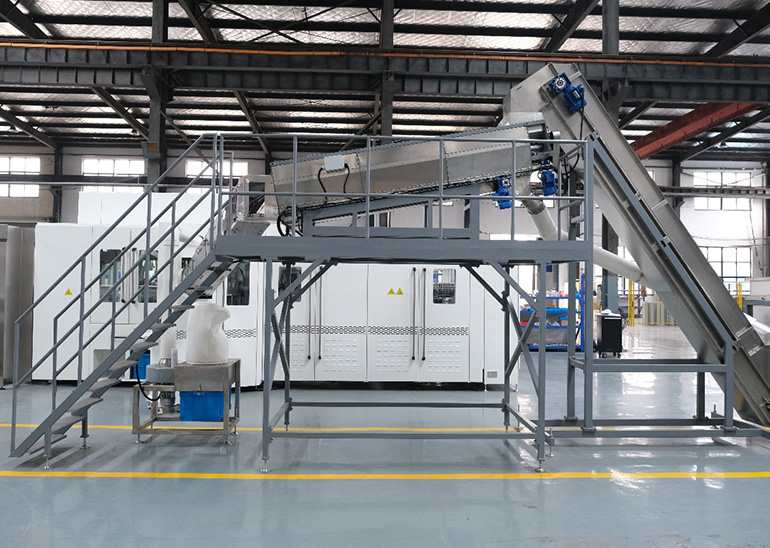
- Length is footprint. A cooling tunnel for a mid-capacity line is a long machine. It must be in the layout drawing from the start, not added when the building is already built.
- Cooling water is a hygiene item. The water is recirculated and it touches the closed bottle, so it needs its own treatment and monitoring regime.
- Bottles must leave dry. An air knife after the tunnel is not optional if you are applying wrap-around or self-adhesive labels.
Budget the two extra machines. An inverter and a cooling tunnel are specific to hot-fill and they consume floor length, cooling capacity and water. Buyers who compare a hot-fill quotation against a water line quotation without them are comparing two different scopes.
6. CIP, SIP and the hygiene routine
Hot-fill gives shelf stability through heat and product acidity. That only holds if the product path is clean when production starts and stays clean while it runs.
| Step | Typical condition | Purpose |
|---|---|---|
| Pre-rinse | Ambient or warm water | Push out product residue before chemicals |
| Caustic circulation | 1.5–2% at 75–85 °C | Remove organic soil, sugar film and pulp deposits |
| Intermediate rinse | Treated water | Remove caustic |
| Acid circulation | 1–1.5% | Remove mineral scale left by hot water and by the product |
| Final rinse | Treated water to specification | Remove chemical residue |
| SIP before production | Hot water circulation, 90–95 °C, 20–30 min | Bring the product path up to temperature and condition it before the first bottle |
Frequency is set by product and by result. Clear tea can often run longer between cleans than pulpy juice; a flavour change forces a clean regardless of hours run. Set the interval from your own swab and shelf-life testing. System design detail is in CIP and SIP systems explained.
One layout consequence: the CIP skid, its chemical tanks and its bunding need floor area near the block, and the return lines need fall. Retrofitting a CIP skid into a room that was laid out without one is a recurring and avoidable expense.
7. Where hot-fill stops being the right answer
Hot-fill is a preservation route, not a machine preference. It works when heat and acidity together deliver shelf stability, and it stops working when either half is missing.
| Product | Hot-fill fit | Comment |
|---|---|---|
| Fruit juice and nectar, pH below 4.6 | Good | The classic application; acidity does half the work |
| Iced tea with acidulant | Good | Deaerate ahead of heating to protect colour and taste |
| Isotonic and sports drinks | Good | Widely produced this way |
| Heat-sensitive premium juice | Marginal | Heat load affects flavour; weigh against the cost of the alternatives |
| Low-acid drinks above pH 4.6 | Not suitable | Heat plus acidity is not enough; needs a different preservation route entirely |
| Carbonated drinks | Not applicable | Filled cold under counter-pressure; see the CSD configuration |
The cost side of the boundary is just as concrete. Hot-fill asks for a heavier bottle, a heat-set mould set, an inverter, a cooling tunnel and the energy to heat and then cool every litre you produce. Against that it removes the need for chemical preservatives and gives ambient distribution. If your product is above pH 4.6, or if flavour damage is unacceptable, raise it early — the answer changes the line, not just a setting.
8. Mistakes that show up after commissioning
- Ordering the block before the bottle drawing exists. Heat-set moulds, panel geometry and neck finish are all bottle-led. A block quoted against a guessed bottle will be re-quoted.
- Using an amorphous neck finish. It is cheaper per preform and it leaks at 85 °C. This is the single most common false economy on hot-fill projects.
- Leaving the cooling tunnel out of the layout. It is long, it is wet and it cannot be squeezed in later without moving other machines.
- Specifying a plate heat exchanger for pulpy product. Plates block. Tubular exchangers exist for exactly this reason.
- Under-declaring pulp. Quoting on "a little pulp" and then running 12% at 5 mm particle size means the wrong valve was bought.
- Ignoring the buffer tank jacket. Fill temperature drifts during slow running and the inverting step stops doing its job.
- Treating cooling-tunnel water as utility water. It contacts the sealed bottle and needs a monitored treatment regime.
- Testing at the factory with generic bottles. Send your own preforms, closures and, where possible, your own product to the Factory Acceptance Test — see the FAT process.
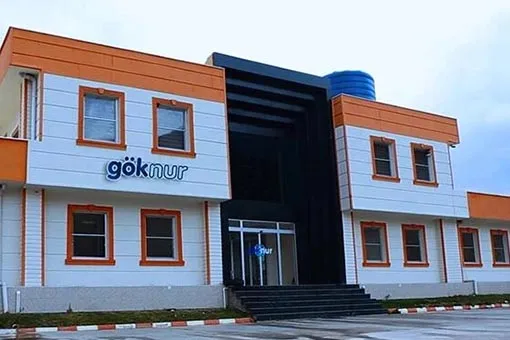
Sunswell has supplied hot-fill juice capacity into demanding markets, including two 18,000 BPH juice lines for Goknur in Turkey, and builds hot-fill blocks and standalone hot-fill fillers across the 2,000–36,000 BPH range. Capacity selection method across the whole range is set out in combiblock capacity selection, and configuration and price levels in juice and tea configuration comparison.
Frequently asked questions
Can you hot fill juice with a combiblock?
Yes, provided the block is built for it. The bottle must be blown on heat-set moulds with a crystallised neck finish, the filler must hold 85–88 °C, and the line needs an inverter and a cooling tunnel after capping. A standard cold-fill block cannot be converted by raising the product temperature.
What filling temperature is used for hot-fill juice and tea?
The product is pasteurised at roughly 92–95 °C in a holding tube, flash-cooled and filled at 85–88 °C. The bottle is capped hot, inverted for 15–30 seconds so the hot product wets the closure and neck, then cooled in a spray tunnel to around 35–40 °C.
Why does a hot-fill bottle need vacuum panels?
Because the product contracts as it cools. Between 85 °C and 20 °C the liquid loses roughly 3% of its volume, and the sealed headspace contracts as well. Without vacuum panels or a vacuum-absorbing base, that negative pressure pulls the bottle out of shape and the label wrinkles.
Which valve should I use for juice with pulp?
Above roughly 10% pulp, or with fibre longer than a few millimetres, a volumetric valve with a large orifice or a piston filler is the safer choice. Mechanical gravity valves suit clear juice, nectars without fibre and tea. Confirm the pulp specification — particle size and percentage — before the valve is selected.
What capacity is available for a hot-fill juice combiblock?
Mechanical hot-fill configurations reach up to 36,000 BPH for 0.2–2 L. Volumetric configurations for pulpy product run 6,000–24,000 BPH, and piston fillers for high-pulp and viscous product run 2,000–12,000 BPH. Final capacity is confirmed after the bottle drawing and product specification are reviewed.
How often does a hot-fill line need CIP?
Typically at the end of every production run, and at least every 8–12 hours of continuous running on juice. Pulpy product and flavour changes shorten that interval. Tea with no pulp can often run longer between cleans, but the schedule should be set from your own microbiological results, not from a supplier default.
Is hot-fill suitable for every drink?
No. Hot-fill relies on heat plus product acidity, so it suits acidified products below pH 4.6 — fruit juice, nectar, iced tea with acidulant, isotonic drinks. Low-acid products such as dairy-based drinks and some vegetable beverages are not made shelf-stable by hot-fill alone and need a different preservation route.
Can one block run both hot-fill and cold-fill products?
Sometimes, if the bottle is a heat-set design and the filler is specified for the higher temperature. You then carry a heavier bottle on the cold-fill product, which costs resin on every unit. Declare both product families at quotation stage so the trade-off is priced rather than discovered later.
About the author
Written by the Sunswell engineering team — led by Howie SUN, Founder & CEO, with 14 years in filling and blow-moulding equipment R&D and turnkey project delivery across 71+ countries.
Last reviewed: 2026-08-07 · Reviewed by Sunswell engineering team
Ask our engineering team →Recommend Products
Have a specific project in mind?
Tell us product, target BPH, bottle sizes and market. We reply with a draft layout, equipment list and lead time estimate.
Fill the inquiry form ↑