


Country Guide · Kazakhstan Carbonated
CSD and Sparkling Water Line for Kazakhstan
Two carbonated categories, one isobaric block — and a chilling system sized for a Kazakh July.
4–8 °C
Typical filling temperature
8,000–48,000
BPH, carbonated blocks
2.0–4.2
Carbonation volumes covered
EAC
EAEU machinery conformity
444+
Lines delivered
Short answer: A carbonated line for Kazakhstan is built around isobaric counter-pressure filling: the bottle is pressurised with CO2 before product enters, and the product is held at 4–8 °C so the gas stays in solution. Size chilling on peak summer ambient, pick the valve by speed band — mechanical to about 12,000 BPH, semi-electric above it, blow-fill-cap above 24,000 BPH — and settle EAC conformity plus Russian and Kazakh labelling at contract stage.
🎯 Key takeaways
- Sparkling water and flavoured soft drinks share a block but not a specification — declare the full carbonation range, about 2.0–4.2 volumes, before quoting
- Product temperature at the filler decides everything: 4–8 °C is the working window, and chilling must be sized on peak summer ambient
- Snift in stages — single-step decompression is the most common cause of foam-over, level variation and a sticky machine
- The mixer sets product consistency: ratio accuracy around ±0.1–0.2% and Brix within ±0.05–0.1 °Bx are the numbers to contract
- Valve choice follows speed band: mechanical to ~12,000 BPH, semi-electric 12,000–30,000, blow-fill-cap 24,000–48,000
- CO2 supply is a project item — bulk tank, winter-capable vaporiser, beverage-grade certificate per delivery, and gas detection
- EAC covers the machine; TR CU 021 and 022 cover the drink and the label, in Russian and Kazakh
On this page
1. Two products that share one block
Kazakhstan buys two carbonated categories from what looks like the same machine. Cola-type and flavoured soft drinks sit at high carbonation with sugar or sweetener, acid and colour. Carbonated mineral water sits lower, carries no sugar, and is sold on the strength of the source rather than the recipe. Both are filled isobarically, but they load the line differently. A plant that intends to sell both should say so before the block is quoted, because the carbonation range affects the mixer, the gas line sizing and the decompression sequence.
Three market characteristics that change the specification:
- Summer peaks are steep. Carbonated demand tracks temperature more closely than still water does, and the southern regions run hot. The line has to serve July, not the annual mean.
- SKU counts grow fast. Local brands rarely stay on one flavour. Four to eight SKUs across two or three bottle sizes is normal within a couple of years, and every added SKU is changeover time.
- PET and cans coexist. Multi-serve PET for home consumption, small PET and cans for immediate consumption. Lay the plant out so a canning line can be added later without rebuilding the syrup room.
Fix the format family early. Keeping 0.5 L and 1 L on one neck finish, and 1.5 L and 2 L on another, holds the number of change parts down. Introducing a third neck finish afterwards means new gripper sets, new capping chucks and new blow moulds, and it is the most common unbudgeted cost in the second year of a carbonated plant.
Rated speed is not annual output. Flavour changeover with a cleaning cycle in between is measured in hours, not minutes. A plant running eight SKUs through one block usually loses more available time to changeover than to mechanical faults. Put the changeover matrix into the capacity model before deciding whether the block is big enough.
2. Isobaric filling and why temperature decides the design
Carbon dioxide dissolves in proportion to the pressure above the liquid and in inverse proportion to its temperature. That single relationship shapes the whole line: the product is carbonated cold, kept cold, filled under counter-pressure, and then released from pressure in stages.
2.1 The temperature window
| Product temperature at the filler | Behaviour | Consequence |
|---|---|---|
| 2–4 °C | Highest solubility, most stable filling | More chilling load; condensation and icing on cold surfaces need managing |
| 4–8 °C | Normal operating window for PET carbonated products | Stable fill levels across the carbonation range |
| 8–12 °C | Workable at low carbonation and reduced speed | More foaming, more product loss, slower valve cycles |
| Above 12 °C | High-carbonation product cannot be held in solution | Fobbing, overflow, wide level variation, gas loss into the room |
Chilling is therefore sized against peak summer ambient, not against a comfortable spring day. A glycol system that holds 5 °C in April and 11 °C in July has effectively de-rated the filler for the season the plant exists to serve. Include the buffer tank, the recirculation loop and the pipe insulation in that calculation, because heat pick-up between the carbonator and the filler bowl is real and is frequently ignored.
2.2 What happens inside the valve
- The bottle is lifted and sealed against the filling valve.
- CO2 from the bowl headspace pressurises the bottle until it is at, or slightly above, the saturation pressure of the product.
- The liquid valve opens and product flows under gravity and the small differential, while displaced gas returns to the bowl through the vent tube.
- Filling stops when liquid reaches the vent tube, which sets the level mechanically.
- The liquid valve closes and the bottle is decompressed in stages — the snift.
- The bottle is released and transferred to the capper with as little agitation as the transfer geometry allows.
Snift in stages, not in one step. Fast single-stage decompression drops the pressure below the point where the dissolved gas stays in solution, the product foams out of the neck, and you lose both fill level accuracy and a clean machine. Staged snift costs a fraction of a second per cycle and pays for itself in level consistency and hygiene.
2.3 The real cost of foam
Foam is not only lost product. Foam over the neck wets the bottle shoulder and the transfer star, which then transfers sugar syrup onto every bottle that follows. Sticky machines attract build-up, cappers misfeed, and cleaning frequency rises. Where a carbonated line underperforms its rating, the chain more often starts at product temperature or snift timing than at the mechanical condition of the valve.
3. The syrup room and the mixer decide product consistency
Buyers routinely spend their attention on the filler and accept whatever mixer is offered. That is the wrong way round. The filler puts a set volume into a bottle; the mixer decides whether the drink in that bottle matches the one filled an hour earlier.
3.1 Syrup room
- Sugar dissolving, either hot with subsequent cooling or cold with high-shear mixing, sized on the largest batch in the recipe book.
- Filtration after dissolving — bag or cartridge — because crystalline sugar carries insoluble matter that ends up in the valve seats.
- Separate preparation and holding tanks so a batch can be made while another is in use.
- Dosing of acid, colour, flavour and preservative with recorded weights, not estimated scoops.
- Cleaning circuits designed in from the start; a syrup room that cannot be cleaned in place will not be cleaned often enough.
3.2 Mixer targets worth writing into the contract
| Parameter | Typical target (indicative) | Why it matters |
|---|---|---|
| Syrup-to-water ratio accuracy | ±0.1–0.2% | Sugar is the largest ingredient cost; drift is money and taste |
| Finished product Brix | Within ±0.05–0.1 °Bx of target | Consistency between batches and against the declared value |
| Dissolved oxygen after deaeration | Low; set the figure with the mixer supplier | Oxygen degrades flavour and colour and competes with carbonation |
| Carbonation, sparkling water | About 2.0–3.0 volumes | Category expectation; lower gas is easier to fill |
| Carbonation, flavoured soft drinks | About 3.5–4.2 volumes | Drives bowl pressure, valve design and snift staging |
| Product temperature to the filler | 4–8 °C | Keeps gas in solution through the valve cycle |
| CO2 quality | Beverage grade with certificate of analysis | Off-odours in the gas transfer directly into the product |
3.3 Cleaning between flavours
Colour and flavour carry-over between SKUs is a quality complaint waiting to happen. Plan the production sequence from light to dark and from low to high flavour intensity, and keep the full cleaning cycle for the point where you have to go the other way. The cleaning skid, the return pump and the drainage all need to be sized at design stage; retrofitting a cleaning circuit into a finished syrup room is expensive and always compromised.
4. CO2 supply is a project item, not a purchase order
A carbonated plant stops without gas. In a country with long distances between industrial centres, gas logistics deserve the same planning as raw materials.
- Bulk versus cylinders. Cylinder packs are workable for trials and very small lines. From roughly 6,000–8,000 BPH upward, a bulk liquid tank with a vaporiser is the practical answer; cylinder handling at that consumption becomes a full-time job and a supply risk.
- Consumption is more than what dissolves. Counter-pressure, purging and snift losses mean total plant consumption typically runs well above the gas that ends up in the product. Ask the machine supplier for the expected figure for the specific snift design rather than assuming the theoretical number.
- Winter vaporiser capacity. Ambient vaporisers rely on air temperature to boil liquid CO2. At deep-winter temperatures their output falls and they ice up. Specify sufficient surface area, a duty-standby arrangement, or electric or heated units.
- Safety. CO2 is heavier than air and collects in pits, cellars and enclosed rooms. Gas detection, ventilation and a clear procedure belong in the design, and they will be looked at during inspection.
- Purity documentation. Beverage-grade gas with a certificate of analysis per delivery. Gas from a source with a hydrocarbon or sulphur trace will taint every bottle it touches, and it is very hard to diagnose from the product backwards.
5. Choosing the block by speed band
Carbonated blocks divide by valve technology and by whether blowing sits inside the block. The bands below overlap, and the overlap is where the decision actually gets made.
| Configuration | Reference | Typical band | Choose it when |
|---|---|---|---|
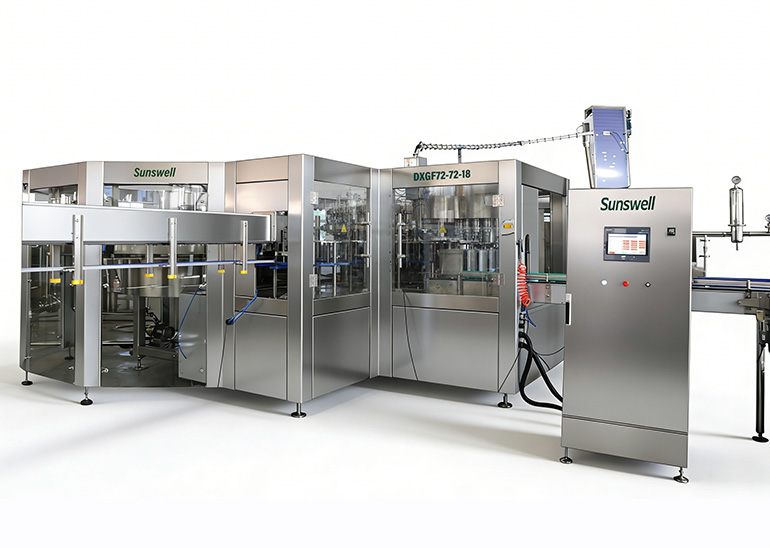
| Mechanical isobaric combiblock | P007 | 8,000–12,000 BPH | Lowest unit capital cost, few SKUs, stable formats, maintenance skills held locally |
| Semi-electric isobaric combiblock | P006 | 12,000–30,000 BPH, 0.25–2 L | Several SKUs and bottle sizes, tighter level control, shorter changeover |
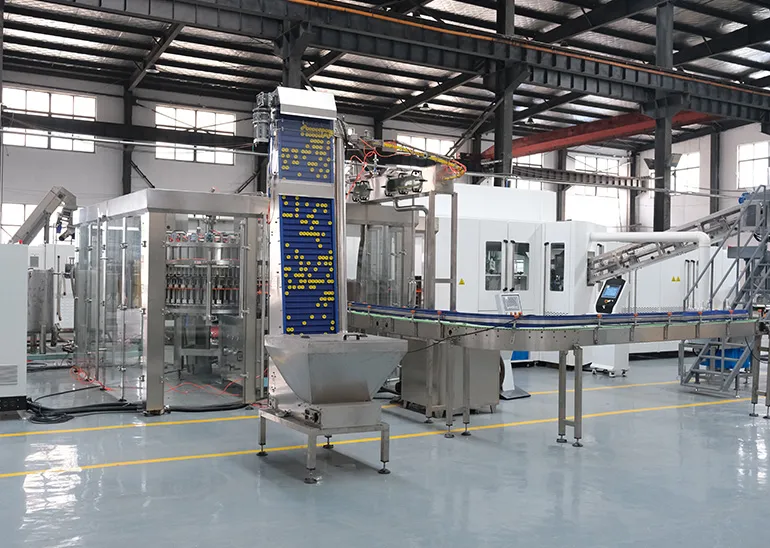
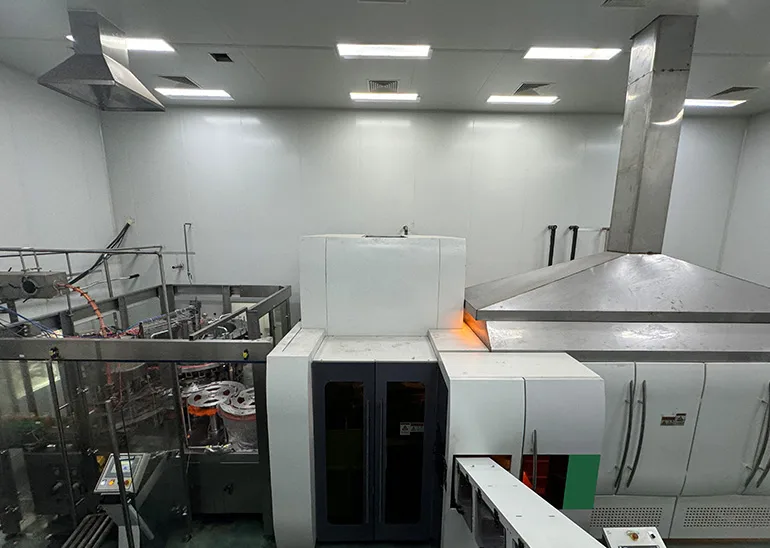
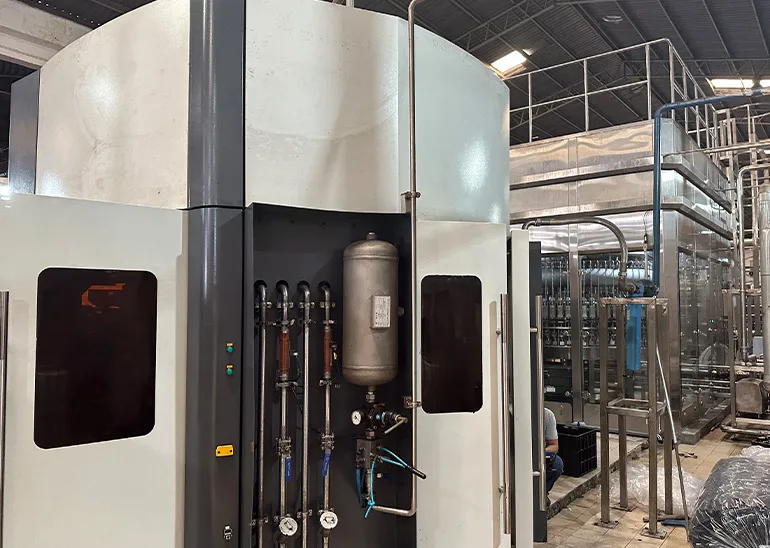
| Blow-fill-cap carbonated combiblock | P008 | 24,000–48,000 BPH | National distribution, one dominant format, continuous shift pattern, strong air system |
| Rinser-filler-capper monoblock | P016 | 24,000 BPH PET | Bottles blown separately or bought in; you want a proven mid-to-high speed triblock |
| Standalone isobaric filler | P017 | Matched to an existing blower | Replacing a filler, or you need to sell or store empty bottles |
Decision rules, in the order they usually matter:
- If peak-month demand converts to under about 12,000 BPH and you run one or two flavours, then a mechanical isobaric block is normally the correct spend.
- If you already know you will run four or more SKUs across two bottle sizes, then semi-electric valves pay back in changeover time and level consistency rather than in speed.
- If sustained demand is above 24,000 BPH with one dominant format, then a blow-fill-cap block removes the air conveyor, the empty-bottle handling and one set of operators.
- If you must sell empty bottles, supply a second plant, or you already own a blower, then keep blowing and filling separate and buy the filler alone.
- If the product is only sparkling mineral water at moderate speed, then the mechanical option is usually sufficient and the money is better placed in the mixer and the chilling system.
- If juice or tea is on the roadmap, then do not attempt to run hot product through a carbonated block. That is a separate line; see juice and tea bottling for Kazakhstan.
The same selection logic in more detail, including bottle size effects on rated speed, is in the carbonated machine selection guide, and the mechanics of counter-pressure filling in a single block are covered in combiblock for carbonated drinks and sparkling water.
6. Conformity, labels and language
Two separate compliance streams run in parallel and are often confused with each other.
| Stream | Applies to | Practical action |
|---|---|---|
| EAC conformity under EAEU technical regulations | The machinery | Agreed at contract stage; manufacturer supplies the technical file |
| TR CU 021 food safety | The drink and the plant | Process design, water quality, cleaning regime, records |
| TR CU 022 labelling | The label artwork | Composition, nutrition, volume, dates, storage, manufacturer details |
| State language requirements | The label and the manual | Russian and Kazakh text on the pack; Russian documentation and HMI for the line |
On the product side, the label carries the ingredient list, nutrition information including sugars, net volume, date of manufacture, shelf life, storage conditions and manufacturer identification. Sweeteners, acidity regulators, preservatives and colours must come from the permitted lists, and a reformulation to cut sugar changes both the additive question and the declared nutrition. Confirm the current requirements with your certification body before artwork goes to print — the machinery side is covered in EAC certification for beverage machinery.
Label artwork is a machine specification input. Bilingual text makes labels longer. A label that grew to carry Russian and Kazakh copy may no longer fit the wrap window on the bottle you already chose, and the labeller, the reel width and the coder position all follow from the final artwork. Freeze the pack design before the labeller is built, not after.
7. What the Kazakh projects show
Sunswell has carbonated experience in this market rather than a general export record only:
- Vizit — a 12,000 BPH 1 L carbonated soft drink combiblock line in Kazakhstan.
- Rauan — 8 sets of bottling and canning lines in the 12,000–24,000 range, covering PET and cans.
Two things are worth reading from that pattern. First, 12,000 BPH at 1 L is a realistic entry point for a brand with regional or national ambitions here; it is large enough to supply a distribution network and small enough to be financed by a growing business. Second, programmes in this market tend to be built in stages rather than in one purchase, which argues for leaving physical space and utility headroom for the next line at the first layout review. Broader import and setup context sits in the Kazakhstan equipment import guide and, for the water side of a mixed plant, setting up a bottled water plant in Kazakhstan.
8. Mistakes that cost output on carbonated lines here
- Sizing chilling on a mild day. The filler is rated at a product temperature. If the glycol system cannot hold it in July, the line is de-rated exactly when it matters.
- Economising on the mixer after buying a good filler. Carbonation stability and Brix consistency come from the mixer; the filler can only pass on what it receives.
- Treating CO2 as a consumable to arrange later. Contract the supply, size the vaporiser for winter, and hold a buffer against road disruption.
- Omitting the bottle warmer and dryer. Cold bottles condense moisture in a warm hall, and wet bottles reject labels. On a carbonated line this is not an optional module.
- Ignoring capping torque on carbonated PET. Marginal capping does not fail at the machine; it fails weeks later in the trade as flat product and returned stock. Set torque limits and check them on a schedule.
- Planning changeover as an afterthought. Sequence flavours light to dark, and count cleaning time as production time lost.
- Leaving conformity and artwork to the end. Both have manufacturing consequences and both are slow to fix retrospectively.
Frequently asked questions
What equipment does a carbonated drink line in Kazakhstan need?
Water treatment, a syrup room, a mixer with deaeration and carbonation, product chilling, an isobaric filler or a blow-fill-cap combiblock, capping, a bottle warmer and dryer, labelling, coding and packing. Utilities are compressed air with drying, glycol chilling and a beverage-grade CO2 supply with a vaporiser sized for winter ambient temperatures.
Why is carbonated product filled cold?
Because CO2 solubility falls as temperature rises. Product at 4–8 °C holds its gas during the pressure changes inside the valve; the same product at 15 °C releases gas, foams over the vent tube and gives inconsistent fill levels. Chilling capacity is therefore part of the filling specification, not a separate utility decision.
Can one line fill both cola-type soft drinks and carbonated mineral water?
Yes, provided the carbonation range and the bottle formats are declared before the block is configured. Sparkling water typically sits around 2.0–3.0 volumes and flavoured soft drinks around 3.5–4.2 volumes. The mixer, the CO2 line sizing and the snift sequence all have to cover the wider range.
Which filler suits a 12,000 BPH carbonated line?
At 8,000–12,000 BPH with a small SKU count, a mechanical isobaric combiblock gives the lowest unit capital cost. Above roughly 12,000 BPH, or with frequent format changes, semi-electric valves earn their premium. Above 24,000 BPH a blow-fill-cap block is normally the right structure.
Where does CO2 come from for a plant in Kazakhstan?
Beverage-grade liquid CO2 is sourced from industrial gas suppliers and delivered into a bulk tank with a vaporiser. Ask for a certificate of analysis with each delivery, contract the supply rather than buying spot, and size the vaporiser for winter conditions where ambient units lose output.
What certification applies to a carbonated line and its products?
The machinery needs EAC conformity documentation under Eurasian Economic Union technical regulations. The finished drink falls under the Union food safety and labelling regulations, TR CU 021 and TR CU 022, with label text in Russian and Kazakh. Settle both before artwork and before shipment.
How much space should we plan for?
Work from the layout drawing rather than a rule of thumb. As an indicative starting point, a 12,000 BPH block with its conveyors, labeller and packer runs 40–60 m of line length, and you then add a separate syrup room, a treated-water room, a compressor and chiller room, and finished-goods storage sized for summer stock build.
Do you have carbonated line references in Kazakhstan?
Yes. Vizit runs a 12,000 BPH 1 L carbonated soft drink combiblock line in Kazakhstan, and Rauan has taken 8 sets of bottling and canning lines in the 12,000–24,000 range covering both PET and cans. Reference contacts can be provided during evaluation.
About the author
Written by the Sunswell engineering team — led by Howie SUN, Founder & CEO, with 14 years in filling and blow-moulding equipment R&D and turnkey project delivery across 71+ countries.
Last reviewed: 2026-08-07 · Reviewed by Sunswell engineering team
Ask our engineering team →Recommend Products
Project references
-

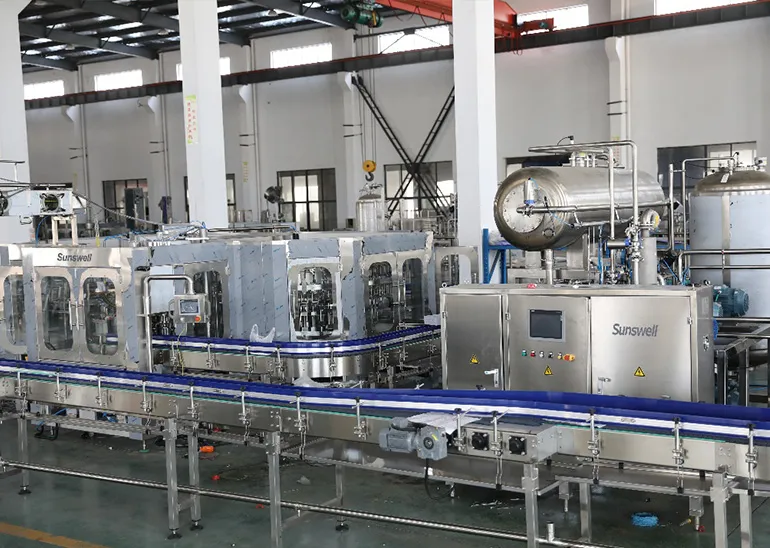
Vizit, 12,000BPH 1L Bottling Line with Combiblock for CSD, Kazakhstan
Country: Kazakhstan
Product: PET Bottled Carbonated Soft Drinks
Capacity: 12000BPH (1L)
Solution:Carbonated Drinks Production Line
Read More + -
Rauan, 8 Sets of Bottlingand Canning Lines from 12,000-24,000BPH for Water, CSD and Juice, Kazakhstan
Country:Kazakhstan
Product: PET Bottled Sparkling Water, Canned Soft Drink, Canned Tea
Capacity: 25000CPH (250ml)
Solution:Three Lines,7000BPH(1.5L), 15000CPH(330ml),15000CPH(450ml)
Read More +
Have a specific project in mind?
Tell us product, target BPH, bottle sizes and market. We reply with a draft layout, equipment list and lead time estimate.
Fill the inquiry form ↑