


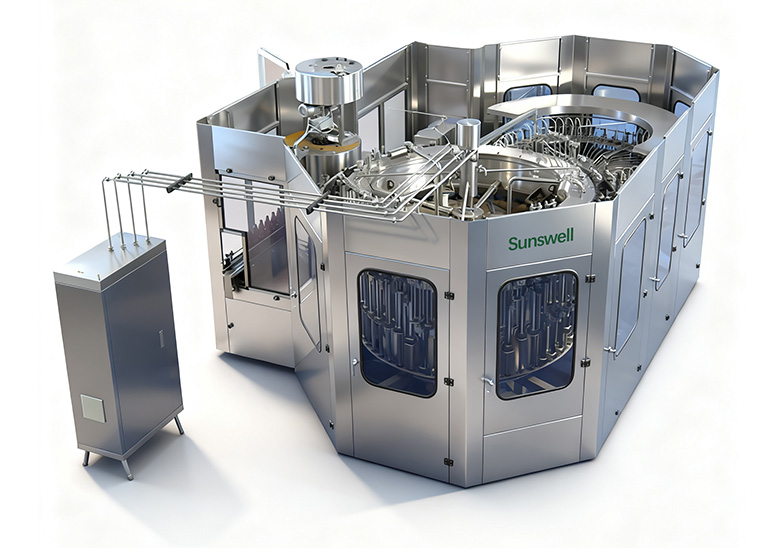
Comparison · Glass Bottle
Glass Bottle Filling — Comparing Machine Configurations and Price Levels
Three tiers, one product decision — compare valve family, capper and total cost on a normalised scope.
3
Configuration tiers
2,000–18,000
BPH range
4
Closure types: crown/screw/ROPP/cork
444+
Lines delivered
71+
Countries exported
Short answer: Glass filling lines fall into economy, mainstream and high-speed tiers that are set by output and automation, not by quality. The valve family is fixed by the product — gravity or mechanical for still, isobaric for beer and CSD, hot-fill for juice and tea — while the capper, set by closure, is often the larger price driver. Compare quotations on a normalised scope and on total cost, not on the sticker price, because missing CIP, cap feeder or commissioning scope is the usual source of apparent savings.
🎯 Key takeaways
- Three tiers, not three qualities — economy, mainstream, high-speed by output and automation
- Valve family fixed by product; compare count and control within it
- The capper often costs more than the filler difference — crown / screw / ROPP / cork
- Compare on normalised scope — missing CIP, cap feeder or commissioning hides price gaps
- TCO beats sticker price — utilities, wear parts and changeover recur for line life
- Specify every format and closure now — change parts handle the rest, turret does not
On this page
1. Why compare configurations
Glass filling machines look similar from the outside and diverge sharply in what they cost and what they can run. The differences are in the valve family, the valve count, the capper, the rinse grade and the downstream automation. Comparing them on a normalised scope prevents paying for capability the product will never use — or buying below what the volume requires and discovering it at the worst moment, during a seasonal peak.
The selection logic that fixes the valve family is in the glass bottle selection guide; this page compares the tiers once that choice is made. Read the selection guide first if the product, bottle format or closure are not yet fixed, because comparing tiers before the valve family is decided compares the wrong thing.
2. Three configuration tiers
Most glass lines fall into three tiers. They are not quality grades — each is the right answer for a different output and automation expectation, and a craft line that is happy at 4,000 BPH gains nothing from a 40-valve turret it cannot feed.
| Tier | Valve | Output | Capper | Best for |
|---|---|---|---|---|
| Economy | Gravity or mechanical | 2,000–6,000 BPH | Crown or screw, simpler feeder | Craft beer, wine, small batch |
| Mainstream | Mechanical or isobaric | 6,000–12,000 BPH | Crown / screw / ROPP, paced | Regional beer, CSD, juice |
| High-speed | Isobaric or hot-fill | 12,000–18,000+ BPH | Matched high-rate capper | Mainstream beer and CSD at scale |
A hot-fill tier sits across these bands for juice and tea: the valve is hot-fill rated and the bottle path is temperature capable, but the output band follows the same valve-count rule as any other family. Do not read 'hot-fill' as 'high-speed' — a small-batch hot-fill juice line is an economy-tier machine with a heat-rated valve, not a high-speed one.
3. Valve family and what it changes
The valve family is fixed by the product, so the comparison here is about count and control level within that family. Isobaric and hot-fill valves cost more per station than gravity valves because they manage pressure or temperature as well as volume, and that extra instrumentation is real cost whether or not you use it at full rate.
| Valve family | Relative station cost | Adds | Needed for |
|---|---|---|---|
| Gravity / mechanical | Lowest | Level control only | Still water, wine |
| Isobaric counter-pressure | Higher | CO₂ management, foam control | Beer, CSD |
| Hot-fill (85–88 °C) | Higher | Heat-rated path, snift | Juice, tea shelf-stable |
| Volumetric / load cell | Higher | Measured dosing | Exact declared volume, large jars |
Within a family, control level is the second cost lever. A mechanical valve is cheaper than a semi-electric or volumetric version of the same principle, and the difference shows up in changeover time and repeatability rather than in whether the bottle fills. Buy the control level the product tolerance demands, not the highest available.
4. The capper is a separate cost centre
Closure type drives capper cost and changeover more than the filler does. A crown capper is simple and fast; a roll-on aluminium (ROPP) capper adds a threading head and torque control; a wine cork line adds a corking head and a different infeed. Two quotations that look close can hide very different cappers, and the cap feeder and torque verification are where the cost quietly lands.
| Closure | Capper type | Relative cost | Note |
|---|---|---|---|
| Crown | Crown capper | Lowest | Standard for beer and CSD |
| Screw (28/38 mm) | Screw capper | Low–moderate | Common for water and juice |
| ROPP | Roll-on capper | Moderate | Aluminium, tamper-evident |
| Cork | Corker | Moderate–high | Wine, slower, gentler handling |
If you run more than one closure, the changeover between cappers is a project in its own right — often larger than the filler changeover. State every closure at quotation and ask for the change time between them, because that downtime recurs for the life of the line.
Capper cost also scales with validation. A closure that must meet a tamper-evidence or torque standard needs verification equipment and a documented setting procedure, which a simple crown line does not. Where the destination market specifies the closure, that requirement should reach the quotation before the capper is specified, not as a retrofit after the line is built.
5. Comparing on total cost, not sticker price
Two lines at the same headline price rarely cost the same to own. Evaluate on normalised scope and on the items below, treating all figures as indicative and configuration-dependent. The cheapest line on paper is often the most expensive to run once missing scope and higher downtime are counted.
| Cost element | What to check | Typical effect |
|---|---|---|
| Scope included | Rinser grade, CIP, labeller, packer | Largest source of price gaps |
| Valve count vs need | Valves sized to sustained output | Idle valves waste capex |
| Changeover time | Format and closure parts | Downtime on multi-SKU lines |
| Utilities | Air, power, water per 1,000 bottles | Recurs every shift |
| Wear parts | Seals, gaskets, capper parts | Repeats for line life |
| Service access | Local support, spares lead time | Hidden cost of downtime |
Normalise the scope before comparing prices. Send one scope list to every supplier and require each to answer it line by line, including exclusions. Most apparent savings are a missing CIP circuit, cap feeder or commissioning scope.
A second TCO trap is the commissioning spare part set. A line quoted without it looks cheaper until the first worn seal stops production and the part is a lead time away. The set is small relative to the machine but large relative to a day of downtime, so confirm it is included and that long-lead items are identified at handover rather than discovered during the first fault.
6. Downstream automation
The filler is rarely the end of the line. A labeller, a packer and a palletiser sit downstream, and their automation level is a separate cost and a separate source of downtime. An economy line often pairs with semi-automatic packing handled by operators; a high-speed line assumes fully automatic pack and palletise to keep the filler fed and avoid a manual bottleneck that wastes the speed you paid for.
Vision inspection belongs in this discussion. Empty-bottle inspection at the rinser and filled-bottle inspection for fill level, cap and label catch defects before they reach the case. On a high-speed line the inspection pays for itself in rejected-product and recall risk; on a craft line it may be optional. Match the inspection scope to the speed and the brand risk, not to a default setting.
When glass is one of several formats, the downstream equipment is shared where possible — a labeller that handles round and non-round, a packer with format parts — so the investment is not duplicated per format. State the full format list to the supplier so the downstream scope is specified once, correctly, rather than patched later.
Connectivity is worth a line in the scope. A line that reports output, rejects, downtime reason and OEE by shift turns commissioning data into a management tool rather than a spreadsheet someone fills in by hand. It costs little at build and is expensive to retrofit, so specify the data interface with the line, especially on a high-speed tier where the difference between rated and actual speed is the number that decides payback.
7. Common comparison mistakes
Five errors recur in glass-line quotations and are worth ruling out before you sign:
- Comparing different scopes. One quote includes CIP and a cap feeder, the other omits them; the gap is not a saving.
- Rating on the smallest bottle. A line quoted at 12,000 BPH on 330 ml may not hold it on your 750 ml; confirm on your main format.
- Underspecifying the capper. The filler is paced to the capper; a slow capper makes a fast filler pointless.
- Ignoring changeover. Multi-SKU plants lose more time to changeover than to speed; check it.
- Buying a valve family for a product you do not run. Hot-fill or isobaric capability you will not use is silent capex.
8. Which tier to specify
Match the tier to sustained output and automation, not to ambition:
- Craft or pilot: economy tier, gravity or mechanical valve, crown or screw.
- Regional brand: mainstream tier, isobaric for beer/CSD or hot-fill for juice.
- Scale producer: high-speed tier with a matched capper and full downstream automation.
- Multi-product: specify every format and closure now; change parts, not turret, handle the rest.
Where glass is part of a wider packaging mix, the filler range is in glass bottle filling machines, and complete lines are scoped in beer and juice production line solutions. Common questions are answered in the glass bottle FAQ.
Buy the tier your volume justifies. An economy line over-specifies nothing and a high-speed line under-used is capital parked on the floor; both waste money in different directions.
Lead time and payment terms are part of the comparison even though they are not in the price. A high-speed line from a busy builder may carry a longer slot than an economy line from a smaller shop, and the difference can matter more than the tier if your market window is fixed. Put the delivery date and the payment milestone schedule on the table alongside the configuration, because a cheaper line that arrives after the season is the expensive one.
Frequently asked questions
What is the cheapest glass filling configuration?
A gravity or mechanical valve rinser-filler-capper at modest output, with manual or semi-automatic packing. It is right for craft beer, wine and small batches where capex dominates and speed is not the constraint. The limit is accuracy and automation, not reliability.
When does a hot-fill configuration pay off?
When the product is shelf-stable juice or tea that must be filled hot at 85–88 °C for ambient shelf life. Hot-fill needs a heat-rated filler, a snift and a bottle rated for the temperature. If your product is not hot-fill, buying the capability is wasted capex.
Is a higher valve count always better?
No. More valves raise rated speed only if your bottle and product can use it. A 50-valve turret on a 6,000 BPH craft line is idle capacity. Size the valve count to your sustained output at your main format.
Does the capper affect price more than the filler?
Often yes. Crown, screw, ROPP and cork cappers differ sharply in cost and changeover, and the cap feeder and torque control add up. Clarify the closure before comparing quotations, because two lines that look similar can carry very different cappers.
What is usually excluded from a low quotation?
Bottle rinser grade, CIP circuit, cap feeder, labeller, packer, palletiser, format parts for additional sizes, installation and commissioning, and a commissioning spare part set. Normalise scope across suppliers before comparing prices.
Can I add a second format later?
Change parts yes; valve count and turret no. A line built for one bottle family runs others with format parts and capper change parts, but you cannot add valves to a turret. If a second family is real, specify it now or plan a second line.
About the author
Written by the Sunswell engineering team — led by Howie SUN, Founder & CEO, with 14 years in filling and blow-moulding equipment R&D and turnkey project delivery across 71+ countries.
Last reviewed: 2026-08-10 · Reviewed by Sunswell engineering team
Ask our engineering team →Recommend Products
Project references
-

Goknur, 2 Sets of 18,000BPH Bottling Lines for Juice, Turkey
Country: Turkey
Product: Glass and PET Bottled Juice
Capacity: 20000BPH(330ml) Glass Bottle; 4000BPH(3L) PET Bottle
Solution:Juice Production Line
Read More + -
Dahman, 24,000CPH Canning Line for CSD, Syria
Country: Syria
Product: Aluminum Canned Carbonated Soft Drinks
Capacity: 24000CPH (250ml)
Solution:Carbonated Drinks Production Line
Read More +
Have a specific project in mind?
Tell us product, target BPH, bottle sizes and market. We reply with a draft layout, equipment list and lead time estimate.
Fill the inquiry form ↑