

| Where it fits | Still water, RO water, mineral water |
| Valve type | Gravity or volumetric valve |
| Capacity | 5,000-48,000 BPH at 500 ml |
| Container range | 200 ml to 16 L, by configuration |
| Material | SUS 304 product contact, CIP-ready |
| Line scope | Treatment, blowing, filling, capping, labelling, packing |
Gravity filling holds a level in a rigid bottle and costs least per valve. Volumetric filling doses a fixed volume into a chamber, so it holds accuracy across 3 L, 5 L and 10 L formats without changing the head. Isobaric filling is for carbonated product only, because it keeps CO2 in solution under counter-pressure. A still water line never needs it.
The heart of the line is a 40-40-15 triblock monobloc: 40 rinsing heads, 40 filling heads, and 15 capping heads, handling the entire process from empty bottle rinsing through precise filling to capping in one continuous flow.
Mineral water is defined by its source and its mineral profile, so treatment is limited to what the label claim allows. Purified water starts from any feed and is built up to a specification. The filling machine is the same; the treatment train and the legal claim are not.
| Filling principle | Best for | Watch out for |
|---|---|---|
| Gravity | Still water, one rigid bottle size | Thin-wall bottles deform under head pressure |
| Volumetric valve | 3-15 L and mixed formats | Valve wear shows as slow drift, not a sudden error |
| Isobaric | Carbonated water only | Needs counter-pressure, so slower per valve |
| Load cell | Oil and high-value liquid | Slower cycle, higher cost per valve |
A different bottle format means a different unit; see the Blow-fill-cap Combibloc for Still Water.
A small line gives up automation, not quality. Manual or semi-automatic packing, fewer accumulation buffers, and a simpler CIP usually follow. What it should not give up is the filling valve and the capping head, because those two decide whether the product is saleable.
Valve count, utility schedule and footprint sit on the Gravity Filling Machine for Still Water page.
A monoblock carries the rinser, the filler and the capper on one frame with one drive. It removes two transfers, the floor space between them and the bottle handling at each. Three separate machines are easier to replace one at a time and easier to run at different rates.
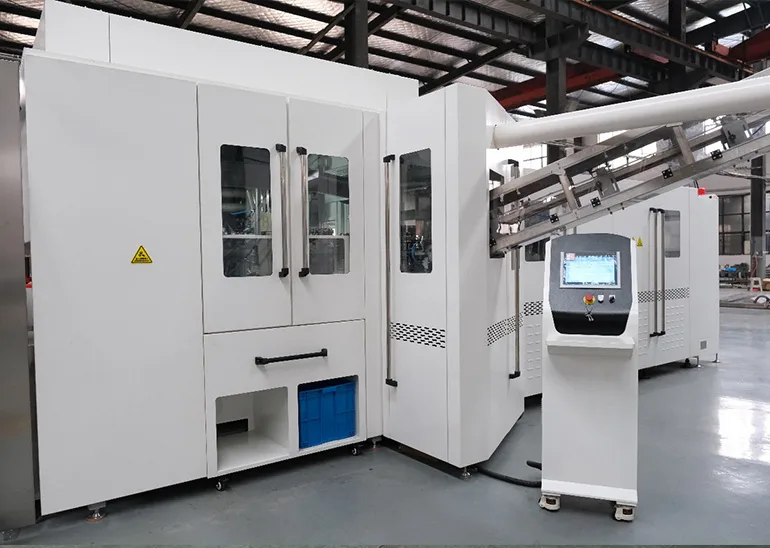
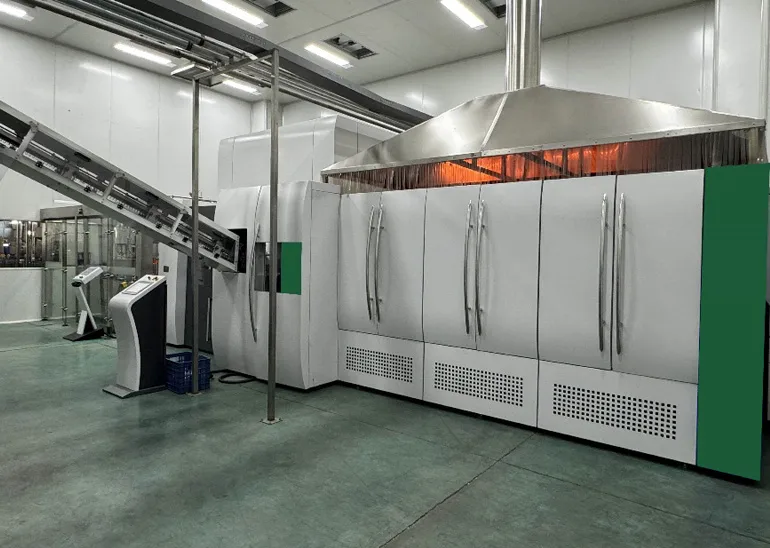
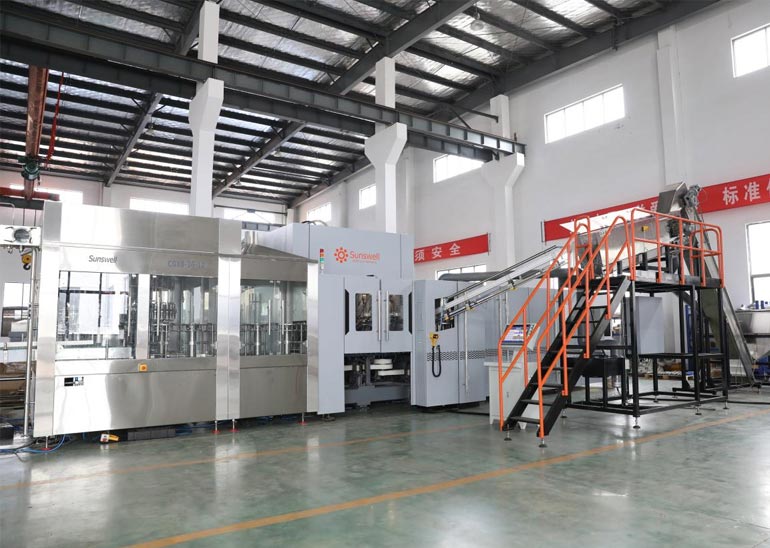
Sunswell recently completed the full line connection and assembly of a 24,000 BPH automatic bottled water line at its new facility in Dongjiu International Industrial Park, Zhangjiagang.
The same question is worked through from another angle in Water Saving Technologies for Sustainable Bottling Operations.
200 bottles per minute. Divide BPH by 60. A 24,000 BPH line runs at 400 bottles per minute, which is why filler and packer have to be matched rather than bought separately.
Gravity holds a fill level, so accuracy depends on bottle geometry. A volumetric filler measures a chamber volume, which keeps it accurate when the format changes. For one rigid bottle size, gravity is enough; for 3-10 L or mixed formats, volumetric is safer.
For a complete line with blowing, filling, labelling and packing, plan several weeks on site after arrival, plus operator training. Civil work and utility readiness are the usual delay, not the machinery.
Not on the same filler. Carbonation needs isobaric valves, a CO2 dosing and mixing unit, and a different bowl. A combiblock can carry both valve sets, but they are separate specifications, not a field conversion.


Country: Maldives
Product: PET Bottled Mineralized Water
Capacity: 24,000BPH (500ml); 2 Lines
Solution:Water Production Line
Country:Kazakhstan
Product: PET Bottled Sparkling Water, Canned Soft Drink, Canned Tea
Capacity: 25000CPH (250ml)
Solution:Three Lines,7000BPH(1.5L), 15000CPH(330ml),15000CPH(450ml)



 +86 13921964455
 [email protected]

A2 Dongjiu Industrial Park, 30 East Jintang Road, Tangshi, Zhangjiagang, Jiangsu 215600, China


