


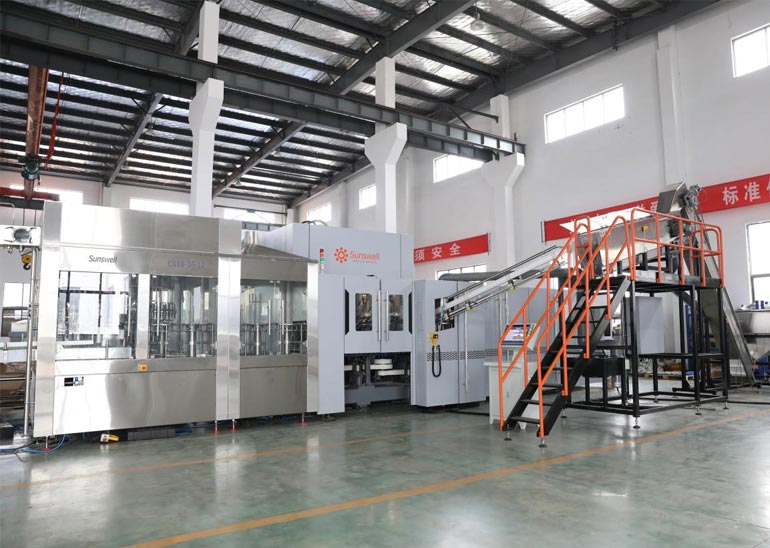
Selection Guide · Still & Mineral Water
Still & Mineral Water Machine Selection Guide — Capacity, Bottle Size and Valve Type
Three axes, one cross-selection table, and the two questions every water project still has to answer.
2,000–48,000
BPH selection range
0.2–16
L bottle formats
444+
Lines delivered
71+
Countries exported
ISO/CE
Certified · SGS audited
Short answer: Choose a still water machine on three axes. Capacity sets the machine family: 2,000–6,000 BPH standalone fillers, 6,000–12,000 BPH semi-electric combiblocks, 24,000–48,000 BPH blow-fill-cap combiblocks. Bottle format splits the project in two: 0.2–2 L and 3–16 L are separate machine families. Valve type follows the accuracy and changeover requirement — gravity and mechanical for plain water, volumetric for exact volume, load cell above 5 L.
🎯 Key takeaways
- Capacity, bottle format and valve type are three axes — a quotation needs all three, not just bottles per hour
- 0.2–2 L and 3–16 L are different machine families: different moulds, grippers, fill times and cap diameters
- Indicative sizing: 600–900 BPH per filling valve and 1,500–2,000 BPH per blowing cavity at 0.5 L
- Combiblock wins above roughly 12,000 BPH on standard formats; separate machines win below 8,000 BPH or where you sell empty bottles
- Natural mineral water cannot use RO, softening or remineralisation — treatment is limited to physical separation plus permitted disinfection
- Volumetric filling pays for itself on changeover when formats change more than twice a week, before any accuracy argument
On this page
1. Three axes decide a water machine — and they interact
Most still water enquiries arrive as a single number: bottles per hour. That number on its own cannot be quoted. Two plants asking for the same 12,000 BPH can need machines that share almost no parts, because output is only one of three axes that define a water filling machine.
- Capacity band — the sustained hourly output at a named reference bottle, not the peak figure on a datasheet.
- Bottle format — small format 0.2–2 L and large format 3–16 L are two different machine families, not two settings of one machine.
- Filling principle — gravity, mechanical, semi-electric, volumetric or load cell, each with a different accuracy, cost and changeover behaviour.
The three axes are not independent in practice. Format constrains output far more than output constrains format: a carousel rated at 24,000 BPH on 0.5 L will not produce 24,000 5 L bottles per hour, and not because it is slow — the mould, the clamping unit and the bottle gripper are different hardware. Similarly, the valve principle limits how fast you can change between formats, which decides whether a multi-size plant runs profitably or spends its week on changeovers.
This guide works through each axis, then crosses them into one selection table, then resolves the two remaining questions every water project has to answer: combiblock or separate machines, and what water treatment sits upstream. Configuration and price tiers are compared separately in still and mineral water machine configurations compared.
2. Axis 1 — capacity band
Nameplate output is quoted against a reference bottle, normally 0.5 L still water at a defined fill height with the downstream line running without stoppage. Two numbers matter more than the nameplate: the output on your largest bottle, and the output the line holds over a full shift including changeovers, cap jams and downstream stops. Ask for both, in writing, before comparing quotations.
| Output band | Typical machine family | Indicative filling valves | Indicative blowing cavities | Where it belongs |
|---|---|---|---|---|
| 2,000 – 4,000 BPH | Standalone filler with separate blowing (P012, P013, P015) | 6 – 10 | 1 – 2 | First plant, large formats, or a niche product |
| 6,000 BPH | Combiblock semi-electric (P010) or separate blower plus rinser-filler-capper | 10 – 16 | 3 – 4 | Regional supply, single or two formats |
| 12,000 BPH | Combiblock semi-electric or volumetric (P010, P011) | 16 – 24 | 6 – 8 | Established regional brand, two to three shifts |
| 24,000 BPH | BFC combiblock (P009) or volumetric filler line (P014) | 28 – 40 | 12 – 16 | National distribution, stable formats |
| 36,000 BPH | BFC combiblock (P009), volumetric filling (P014) | 40 – 60 | 18 – 24 | High-volume commodity water |
| 48,000 BPH | BFC combiblock (P009) | 54 – 80 | 24 – 32 | Large-scale single-format production |
2.1 Where the valve and cavity counts come from
Valve count follows from throughput per valve. A still water filling valve delivers roughly 600–900 bottles per hour at 0.5 L, falling as fill volume rises because the liquid simply takes longer to enter the bottle. Blowing cavity count follows the same logic: 1,500–2,000 bottles per hour per cavity at 0.5 L, dropping to around 900–1,300 at 1.5 L as cooling time increases. Both figures are indicative and are confirmed once preform and bottle drawings are reviewed — they are given here so you can sanity-check a quotation, not so you can specify from them.
2.2 Sizing against the market rather than the ambition
The most expensive sizing error in bottled water is buying two bands too high. An over-sized line idles, and idle capacity is not free: it carries the same installed power, the same footprint, a larger spare part inventory and higher unit prices on wear parts that you consume slowly. Size for the volume you can sell within roughly two years, and confirm the machine family can be extended — adding valves or cavities inside an existing carousel is rarely possible, but adding a second line to a layout planned for it is straightforward.
State the size mix, not just the peak size. A plant running 70% 0.5 L and 30% 1.5 L has a weighted average output well below the 0.5 L nameplate. If you budget production hours on the nameplate figure you will be short of stock in your first peak season, and the machine will not be the reason.
3. Axis 2 — bottle format
The single largest fork in a water project is small format against large format. These are not two configurations of one machine; they are two machine families with different physics.
| Small format 0.2 – 2 L | Large format 3 – 16 L | |
|---|---|---|
| Output envelope | 6,000 – 48,000 BPH | 3,000 – 12,000 BPH at 3–7 L; 2,000 – 6,000 BPH at 7–16 L |
| Bottle handling | Neck-ring gripping throughout | Body or handle support — the neck alone cannot carry a filled 15 L bottle |
| Blow moulding | Rotary, high cavity count, short cycle | Low cavity count, long cooling, higher clamping force |
| Filling time per bottle | Roughly 1.5 – 4 s | Roughly 12 – 40 s |
| Usual valve principle | Gravity, mechanical, semi-electric or volumetric | Volumetric or load cell |
| Closure | Commonly 28 – 30 mm lightweight neck | Commonly 38 – 48 mm, frequently with a moulded handle |
| Changeover between sizes | Mould set plus format parts | Mould set, gripper set and often conveyor guides |
| Reference products | P009, P010, P011, P014, P015 | P002, P003, P012, P013 |
Two consequences follow. First, a plant that intends to sell both single-serve and home-and-office formats is buying two lines, and should plan the building for both from day one rather than discovering later that the large-format line has nowhere to go. Second, the large-format line is where filling accuracy starts to earn its cost: a 1% overfill on 0.5 L is 5 ml, but on 15 L it is 150 ml given away on every container.
Large-format machines are covered in detail in combiblock for 5 L and large-format bottles; small-format block configuration is in combiblock for still and mineral water.
4. Axis 3 — filling principle
Water is the product family where the cheapest valve is most often the correct one. The question is not which valve is best in the abstract, but which error the valve has to eliminate for your product and your market.
| Principle | How it stops filling | Indicative accuracy | Relative capex | Choose it when |
|---|---|---|---|---|
| Gravity (P015) | Liquid reaches a vent tube; static head drives the fill | Level-based, sensitive to bottle volume scatter | Lowest | Plain water sold by nominal volume, appearance of a consistent level matters most |
| Mechanical (P012) | Mechanical valve geometry sets the level | Level-based | Lowest | Large-format water where capex dominates and maintenance depth is limited |
| Semi-electric (P010) | Electronically controlled valve opening and closing | Better repeatability than pure level filling | Low to moderate | 6,000–12,000 BPH plants wanting tighter control without full electronic dosing |
| Volumetric (P011, P013, P014) | Flow meter counts a target volume | Typically ±0.5% of target volume | Moderate | Declared volume must be exact, or several sizes run on recipe change |
| Load cell (P002) | Load cell reaches a target net weight | Typically ±0.1–0.2% | Highest | 5–15 L containers, where a small percentage error is a large absolute quantity |
4.1 What each principle is actually blind to
- Gravity and mechanical are blind to bottle volume scatter. Preform weight variation and blowing variation change the internal volume, so a constant level is not a constant quantity.
- Semi-electric improves the repeatability of the stop signal but does not measure quantity, so it inherits the same bottle sensitivity in a reduced form.
- Volumetric is blind to density. For water at stable temperature this is irrelevant; it becomes relevant only if you later run the same line on juice or syrup.
- Load cell measures the delivered quantity directly and is blind to nothing, which is why it costs the most and why it is hard to justify below 5 L on commodity margins.
The full cross-product comparison, including how to calculate whether accuracy pays for itself, is in load cell vs volumetric vs mechanical filling valve.
Changeover time is a valve decision, not a scheduling decision. On a level-based carousel every valve is adjusted mechanically when the fill height changes. On a volumetric carousel the target is a recipe entry. Across 24 valves and four format changes a week, that difference is measured in shifts per month — which is why a multi-format plant can justify volumetric filling on changeover alone, before any accuracy argument is made.
5. The three axes crossed
Reading the three axes together gives one table. Find your output band on the left and your bottle family across the top; the cell is the configuration that normally applies.
| Output band | 0.2 – 2 L | 3 – 7 L | 7 – 16 L |
|---|---|---|---|
| 2,000 – 4,000 BPH | Separate blower plus gravity or mechanical filler (P015) | Mechanical or volumetric filler (P012, P013) | Mechanical or volumetric filler, semi-automatic packing (P012, P013) |
| 6,000 BPH | Combiblock semi-electric (P010) | Volumetric filler (P013) or 5 L combiblock (P003) | Volumetric or load cell combiblock (P002, P003) — upper limit of the band |
| 12,000 BPH | Combiblock semi-electric or volumetric (P010, P011) | 5 L combiblock, volumetric or load cell (P002, P003) | Not normally available |
| 24,000 BPH | BFC combiblock (P009) or volumetric filler line (P014) | Not normally available | Not normally available |
| 36,000 BPH | BFC combiblock (P009) or volumetric filler line (P014) | Not normally available | Not normally available |
| 48,000 BPH | BFC combiblock (P009) | Not normally available | Not normally available |
The blank cells are not a catalogue gap. Filling a 10 L bottle takes tens of seconds, so 24,000 of them per hour would require a carousel with several hundred valves. The economic answer at that volume is multiple large-format lines, which is how high-volume home-and-office producers are configured.
6. Combiblock or separate machines
Once capacity, format and valve are fixed, one architectural decision remains: a blow-fill-cap block, or a separate blow moulder feeding a rinser-filler-capper across an air conveyor.
| Combiblock (P009, P010, P011) | Separate blowing plus rinser-filler-capper (P014, P015) | |
|---|---|---|
| Bottle transfer | Neck-handled inside the block, no air conveyor | Air conveyor between machines |
| Bottle weight | Lower — no stiffness margin for conveyor travel | Higher — the bottle must survive the conveyor |
| Floor area | One footprint | Two machines plus the conveyor run |
| Operators at the filling stage | One | Typically two |
| Can sell empty bottles | No — the block fills what it blows | Yes |
| Buffering during a fault | None — a stop is a whole-block stop | Blower continues into a bottle buffer |
| Format flexibility | Mould plus format parts, planned changeovers | Higher — the filler is independent of the blower |
| Best fit | 12,000 BPH and above, standard formats, stable size mix | Below roughly 8,000 BPH, unusual bottle shapes, or an existing serviceable blower |
6.1 Where the dividing line actually falls
Two variables move the line, and they move it in the same direction. The higher the output, the more resin saving and operator saving the block returns per year. The more standard the bottle, the fewer format parts and moulds it needs, so integration costs less to exercise. A plant at 24,000 BPH running two standard formats is a clear block case. A plant at 6,000 BPH running six shaped bottles for different customers is a clear separate-machine case. Between those, run the arithmetic on your own resin price and payroll rather than accepting a general claim.
The detailed trade-off, including the resilience argument for separate machines, is in combiblock vs separate blowing and filling line.
7. Water treatment upstream — and why mineral water is different
The filling machine is the visible half of a water plant. The treatment train upstream decides product taste, regulatory compliance and how long your valve seats and rinser nozzles last. It is almost always a separate scope, priced from a laboratory analysis of your source water, and it is the item most often missing from a first-time budget.
7.1 Purified water and natural mineral water are regulated differently
Purified or prepared drinking water may be treated by any method that produces safe, consistent water. Natural mineral water, in most regulatory systems, must reach the bottle with the mineral composition it had at source. That single rule removes several treatment options and reshapes the plant.
| Treatment step | Purified / prepared water | Natural mineral water |
|---|---|---|
| Multimedia or sand filtration | Standard | Permitted — physical separation only |
| Activated carbon | Standard, for chlorine and taste | Restricted — may alter composition |
| Softening / ion exchange | Common where hardness is high | Not permitted — changes mineral content |
| Reverse osmosis (RO) | The usual backbone; removes most dissolved solids | Not permitted — strips the minerals that define the product |
| Ultrafiltration (UF) / microfiltration | Optional polishing step | The main microbiological barrier, typically 0.01–0.1 µm |
| Remineralisation dosing | Common, to restore taste after RO | Not applicable |
| Ozone disinfection | Common; residual maintained to the filler | Permitted in many markets, subject to local rules on bromate |
| UV disinfection | Common as a final barrier | Common as a final barrier |
7.2 Ozone and UV in practice
Ozone is dosed into a contact tank and carried as a residual into the filler so the bottle and headspace are disinfected after capping; the residual then decays over the following hours. Typical practice is a low residual at the filling valve with several minutes of contact time upstream. Two engineering consequences follow. Ozonated water attacks ordinary elastomers, so seals, gaskets and O-rings in the ozone contact path must be specified for it, and stainless steel grade matters more than on a plain water line. And if the source water contains bromide, ozonation can form bromate, which is regulated in most markets — this must be checked against the water analysis before the dose is set, not after the first laboratory result comes back.
UV at 254 nm is the other common final barrier. It leaves no residual, so it disinfects the water passing through the chamber but does nothing for the bottle headspace. Most water plants run both: UV as a continuous barrier and ozone where a residual is wanted at the point of fill.
Get the water analysis before the machine specification, not after. Hardness, iron, manganese, bromide, total dissolved solids and microbiological load all change the treatment train, and the treatment train changes the budget more than the choice between two filling valves does. A supplier who quotes treatment without seeing an analysis is quoting a generic skid that may not suit your borehole.
8. Decision matrix and the mistakes that repeat
Working the axes in order, these conditions settle most water projects:
- If your bottles are 3 L or larger, then you are in the large-format family: 2,000–12,000 BPH, volumetric or load cell filling, and a separate line from any small-format production.
- If you run 0.2–2 L below roughly 8,000 BPH, then separate blowing plus a rinser-filler-capper is normally the better buy, with gravity or semi-electric filling.
- If you run 0.2–2 L at 12,000 BPH or above with two or three stable formats, then a combiblock returns its premium through bottle weight, floor area and operator count.
- If you change format more than twice a week, then choose volumetric filling regardless of accuracy needs — changeover time alone justifies it.
- If you sell empty bottles or blow for a third party, then do not buy a block; the block fills what it blows.
- If your product is natural mineral water, then remove RO, softening and remineralisation from the treatment scope and build the barrier around filtration plus permitted disinfection.
- If your source water is a borehole with variable quality, then budget for a treatment train sized on the worst analysis of the year, not the average.
- If the plant will run one shift for the first year, then size one band lower and plan the layout for a second line rather than buying idle capacity now.
8.1 Five mistakes that repeat on water projects
- Quoting one number. Asking six suppliers for "12,000 BPH" without stating bottle size, fill volume and format mix produces six quotations that cannot be compared.
- Buying accuracy the product does not need. Commodity water sold by nominal volume rarely repays load cell filling. The money is better spent on treatment or on air drying.
- Leaving treatment, CIP and compressed air out of the comparison. These three items move a water plant budget substantially, and each is easy to omit from a filler quotation.
- Economising on compressed air quality. Blowing air must be dry and oil-free at the machine tie-in point. Wet air produces bottle wall defects that then get blamed on the blower.
- Ignoring the format roadmap. The sizes you plan to add in year three decide the mould and format part budget now. Declaring them at quotation stage costs nothing; adding them later costs a changeover programme.
Delivered water lines in this range include C002 Taza, running four 12,000 BPH combiblock lines on 1.5 L bottles in Kazakhstan, and C005 Rauan, with eight bottling and canning lines between 12,000 and 24,000 BPH. Configuration tiers and their cost drivers are compared in water machine configurations compared, and the shorter operational questions are answered in the still and mineral water FAQ.
Frequently asked questions
How do I choose a still water filling machine?
Fix three parameters before asking for a quotation: hourly output at a named bottle size, the full range of bottle formats you will run, and the filling principle. Output alone cannot be quoted — 12,000 BPH of 0.5 L and 12,000 BPH of 5 L are different machines with different moulds, grippers and valve counts.
What capacity should a first water plant buy?
Size the machine on the market you can actually supply within two years, not on the machine you would like to own. A 6,000–12,000 BPH line covers most regional start-ups. Buying 24,000 BPH and running it four hours a day costs more in idle capital and higher spare part prices than a smaller line running full shifts.
Which valve type is right for bottled water?
Gravity or mechanical for plain water where level appearance is the requirement and capex dominates. Semi-electric where you want better repeatability without full electronic dosing. Volumetric where declared volume must be exact or several sizes run on recipe changes. Load cell only on 5–15 L containers.
Can one machine run both 0.5 L and 10 L bottles?
No. Small format (0.2–2 L) and large format (3–16 L) are separate machine families. Mould size, clamping force, gripper design, filling time and cap diameter all differ. Plants that need both buy two lines, and normally at very different speeds.
What is the difference between purified and mineral water processing?
Purified water may be treated by any method, so reverse osmosis and remineralisation are normal. Natural mineral water must reach the bottle with its mineral composition unchanged, so treatment is limited to physical separation — sand filtration, microfiltration or ultrafiltration — plus permitted disinfection.
When does a combiblock beat separate machines?
Above roughly 12,000 BPH on standard 0.2–2 L formats the block usually wins on bottle weight, floor area and operator count. Below about 8,000 BPH, on large formats, or where you also sell empty bottles, separate blowing and a rinser-filler-capper remain the better buy.
How many filling valves do I need?
As an indicative rule, a still water valve delivers 600–900 bottles per hour at 0.5 L and fewer at 1.5 L, so 24,000 BPH typically needs 28–40 valves. Final valve count is set by carousel diameter, fill volume and target line speed, and is confirmed on your bottle drawing.
Does water treatment come with the filling line?
It is normally a separate scope priced from a water analysis. Ask every supplier in writing whether treatment, CIP, air compression and air drying are included. Treatment specified after the filler is bought is the most common source of budget overrun on a first water plant.
About the author
Written by the Sunswell engineering team — led by Howie SUN, Founder & CEO, with 14 years in filling and blow-moulding equipment R&D and turnkey project delivery across 71+ countries.
Last reviewed: 2026-08-07 · Reviewed by Sunswell engineering team
Ask our engineering team →Recommend Products
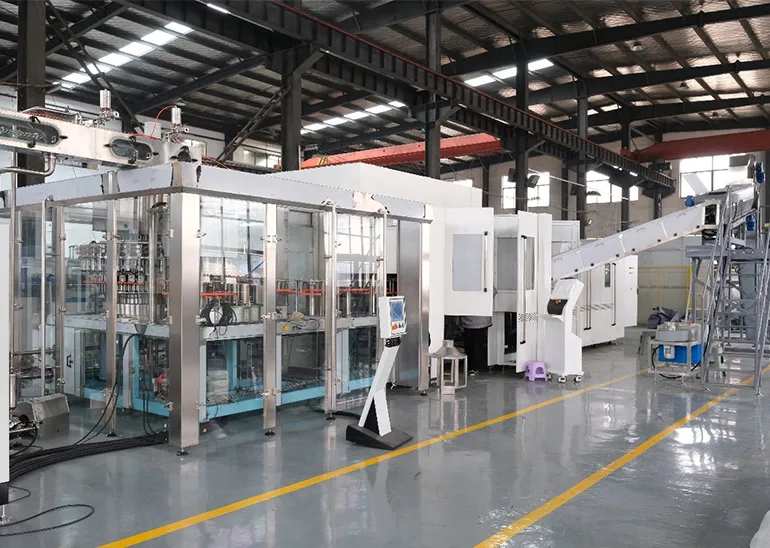
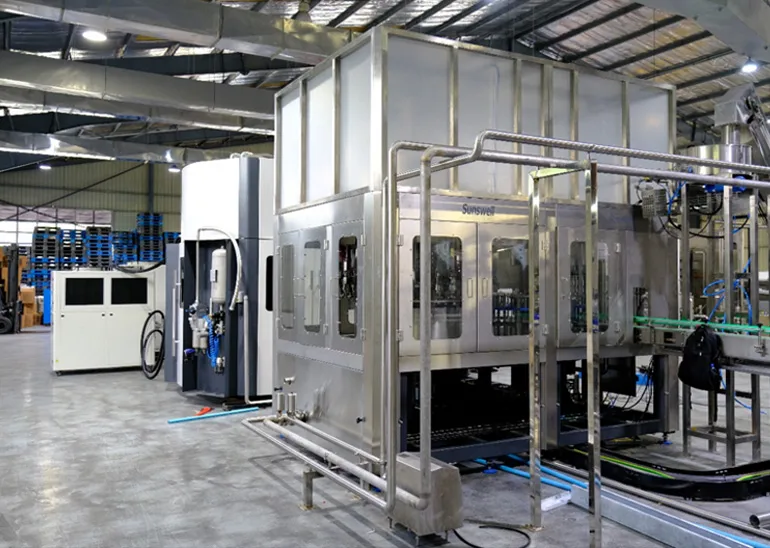
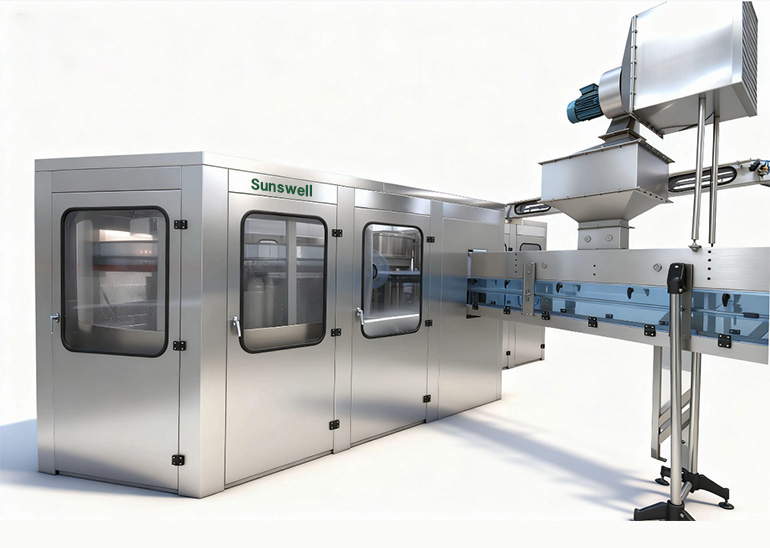
Project references
-
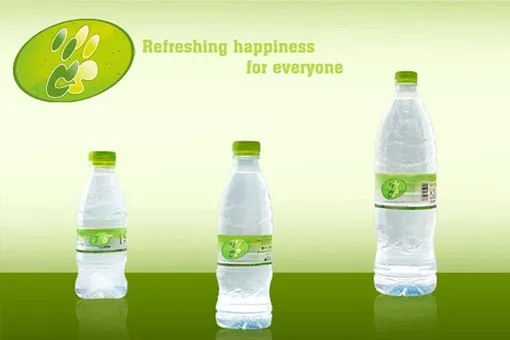
Taza, 4 Sets of 12,000BPH 1.5L Bottling Lines with Combiblock for Water, Maldives
Country: Maldives
Product: PET Bottled Mineralized Water
Capacity: 24,000BPH (500ml); 2 Lines
Solution:Water Production Line
Read More + -
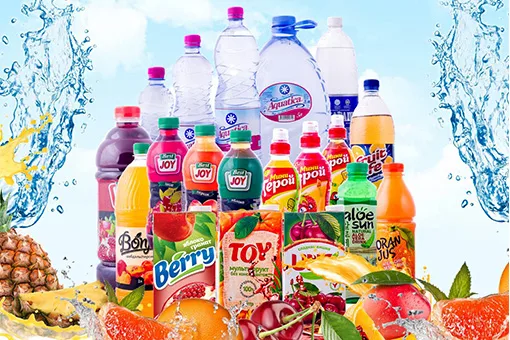
Rauan, 8 Sets of Bottlingand Canning Lines from 12,000-24,000BPH for Water, CSD and Juice, Kazakhstan
Country:Kazakhstan
Product: PET Bottled Sparkling Water, Canned Soft Drink, Canned Tea
Capacity: 25000CPH (250ml)
Solution:Three Lines,7000BPH(1.5L), 15000CPH(330ml),15000CPH(450ml)
Read More +
Have a specific project in mind?
Tell us product, target BPH, bottle sizes and market. We reply with a draft layout, equipment list and lead time estimate.
Fill the inquiry form ↑