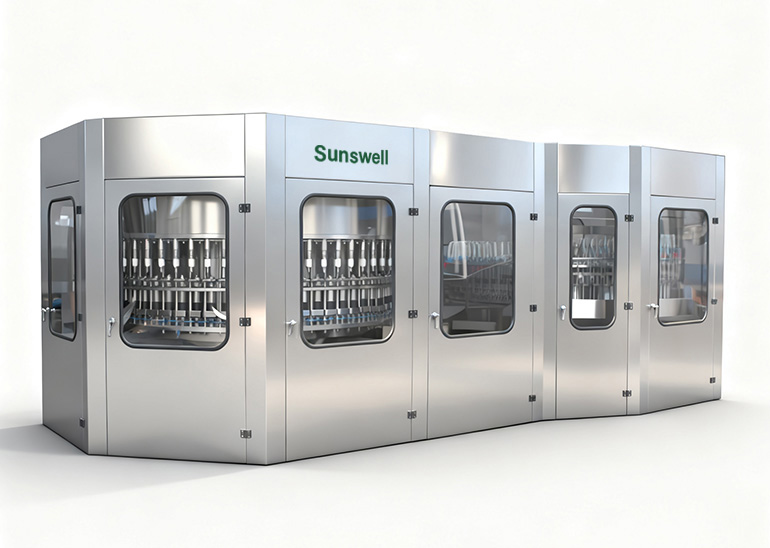
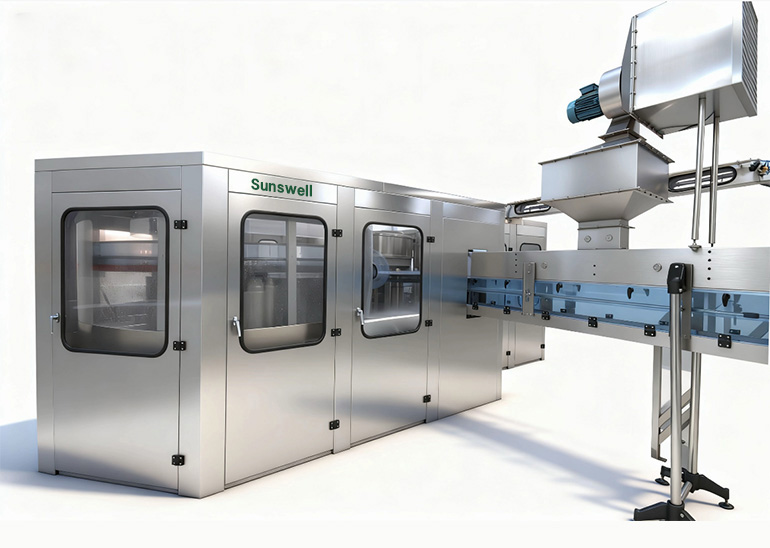
| Scope | Filling, capping and closing equipment |
| Filling principles | Gravity, volumetric, isobaric, piston, load cell |
| Capacity range | 2,000-48,000 BPH by configuration |
| Accuracy basis | Volume, weight or fill level |
| Material | SUS 304 product contact, CIP-ready |
| Key control | Fill accuracy, closure integrity, CIP time |
Filling principle comes from the product, not from the target BPH. Still liquid at a steady density runs gravity or volumetric; carbonated product needs isobaric; thick product with solids needs a piston; product sold by weight runs a load cell. A machine picked ahead of the product usually gets picked again.
Product(s), package(s), target BPH, water/utility specs, certification markets, footprint and budget range.
Four variables sit behind a fill number: the dosing principle, the product temperature, the bottle geometry, and the condition of the valve or piston seal. A machine that holds its tolerance on the factory test can drift in the plant when the product arrives warmer or the bottle wall gets thinner.
| Principle | Doses by | Fails when |
|---|---|---|
| Gravity | Fill level in the bottle | Bottle geometry varies |
| Volumetric | Chamber volume | Valve seal wears |
| Isobaric | Volume under counter-pressure | Pressure or temperature drifts |
| Piston | Displacement | Product carries solids |
| Load cell | Net weight | Product temperature moves |
A different bottle format means a different unit; see the Gravity Filling Machine for Still Water.
A CIP cycle is measured in tens of minutes to over an hour depending on the circuit and the soil. It is not production time, and a plan that counts it as production will miss its daily output every day. The number belongs in the capacity calculation, not in the shift handover.
The Volumetric Filling Machine for Still Water is the matching unit when this becomes a line project.
When the formats are far apart or the cleaning regimes conflict. Two smaller fillers each run at their own rate and can be cleaned independently. One large flexible filler carries every changeover on the critical path, and its downtime is the plant downtime.
The same question is worked through from another angle in How Upstream PET Bottle Production Affects Filling Line Efficiency.
It depends on the principle and the product. A volumetric or load cell filler holds a tighter band than gravity on a variable bottle. The tolerance belongs in the acceptance protocol, measured by weight on a defined sample.
A single frame carrying the rinser, the filler and the capper, driven and controlled together. It removes two transfers and the floor space between three separate machines.
From tens of minutes to over an hour, set by the circuit volume and the soil. It is a fixed cost per production day and should be planned as downtime, not squeezed into the shift.
Rated BPH is a steady-state figure at one format. Real output subtracts changeover, CIP, label changes and downstream stops, which is why planning uses a factor of 0.65-0.85.
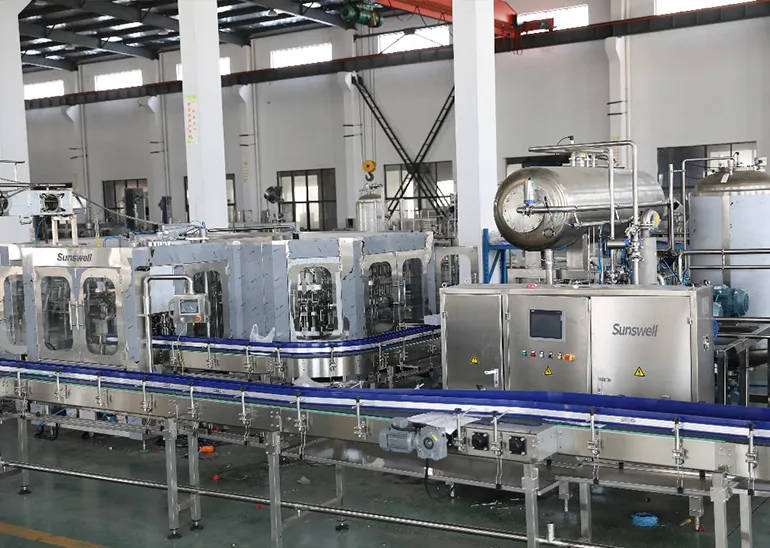
Country:Kazakhstan
Product: PET Bottled Sparkling Water, Canned Soft Drink, Canned Tea
Capacity: 25000CPH (250ml)
Solution:Three Lines,7000BPH(1.5L), 15000CPH(330ml),15000CPH(450ml)



 +86 13921964455
 [email protected]

A2 Dongjiu Industrial Park, 30 East Jintang Road, Tangshi, Zhangjiagang, Jiangsu 215600, China