


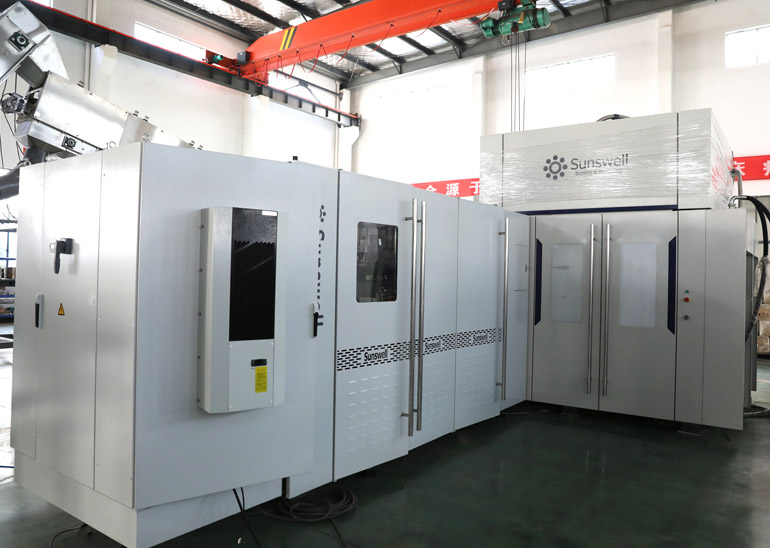
Cost Comparison · Combiblock Series
Combiblock vs Separate Blowing + Filling Line — Footprint, Manpower and TCO
One frame or three machines. The answer changes your factory layout, headcount, and per-bottle cost for the next decade.
20,000 m²
Manufacturing facility
444+
Lines delivered
71+
Countries exported
ISO/CE
Certified · SGS audited
80+
Staff · in-house R&D
Short answer: A combiblock typically saves 25–35% floor space, eliminates the air conveyor between blower and filler, reduces operator count by 2–4 people per shift, and enables bottle lightweighting that saves 1–3 grams of PET per bottle. For most lines above 6,000 BPH, the combiblock delivers a lower 5-year total cost of ownership — despite a marginally higher upfront equipment price. A separate line only wins at very low output (<2,000 BPH) or when you need unmatched flexibility across many bottle formats.
🎯 Key takeaways
- Floor space: combiblock saves ~30% vs separate line — no air conveyor, single frame
- Manpower: 1 operator runs the block; separate line needs 3–5 across blower, conveyor, filler
- Bottle weight: hot preform direct transfer enables 1–3 g per bottle saving — the dominant cost reducer
- TCO break-even: combiblock wins above ~4,000–6,000 BPH for still water; ~6,000 BPH for CSD
- When separate wins: multi-product low-volume plants, existing blower reuse, or bottles larger than 5 L
On this page
1. Floor footprint comparison
A separate blow-fill line requires three distinct zones connected by an air conveyor: the blow-moulding station, the air conveyor bridge (typically 3–8 metres), and the filling plus capping station. A combiblock collapses all three into one frame — typically 8–12 metres long × 2.5–3 metres wide for a 12,000 BPH water line.
The air conveyor itself occupies 15–25 m² and requires overhead clearance for bottle transport. Deleting it frees both floor area and ceiling height — valuable in brownfield plants where every square metre counts.
| Layout element | Separate line | Combiblock | Saving |
|---|---|---|---|
| Blow-moulder | ~18 m² | Integrated | — |
| Air conveyor | 15 – 25 m² | 0 m² | −100% |
| Filler + capper | ~22 m² | Integrated | — |
| Total footprint | 55 – 65 m² | 28 – 36 m² | ~30% |
2. Manpower and operator count
On a separate blow-fill line, a typical shift requires one operator at the blow-moulder monitoring preform feed and bottle discharge, one at the filler managing fill levels and cap feed, and often a third person watching the air conveyor for jammed or fallen bottles. With a combiblock, one operator oversees the entire block from a single HMI panel.
For a plant running two shifts, the difference is 2 operators × 2 shifts = 4 fewer operators per day. At a conservative fully loaded labour cost of $8,000–12,000/year per operator in most emerging markets, that translates to $32,000–48,000 saved per year — before accounting for recruitment, training and turnover.
3. Bottle weight and preform cost
This is the single largest cost driver. In a separate line, blown bottles travel 3–8 metres on an air conveyor before reaching the filler. During those 5–15 seconds, the PET cools from blow temperature (~110 °C) to near-ambient. This cooling forces a heavier preform to maintain top-load strength during transport.
A combiblock transfers the bottle directly from blow mould to filler grip within 1–2 seconds, while the PET is still warm and pliable. This allows bottle lightweighting of 1–3 grams per bottle. For a line producing 12,000 BPH × 16 h/day × 300 days = 57.6 million bottles/year, a 1.5 g saving equates to 86.4 tonnes of PET saved annually. At ~$1,400/tonne, that is $120,960/year in raw material cost reduction.
4. Energy and utility comparison
The combiblock shares one drive system and one control cabinet across all three functions. A separate line runs three independent drive trains. The air conveyor compressor on a separate line typically draws 11–15 kW continuously — power that does not exist on a combiblock.
| Utility | Separate line | Combiblock | Difference |
|---|---|---|---|
| Installed power | ~110 kW | ~78 kW | −29% |
| Compressed air (blow) | 25 – 30 bar | 20 – 25 bar | −15% |
| Conveyor air | 11 – 15 kW | 0 kW | −100% |
| Annual electricity (est.) | ~$65,000 | ~$47,000 | −$18,000 |
5. Five-year cost comparison framework
A 5-year total-cost model for a typical 12,000 BPH still water line (500 ml PET, 16 h/day, 300 days/year) shows where the difference accumulates:
| Cost driver | Separate line | Combiblock | Why |
|---|---|---|---|
| Equipment | Blower + filler + air conveyor + integration | One integrated block | Similar upfront; combiblock deletes conveyor and sync engineering |
| Floor space | >55 m² | <36 m² | No air conveyor bridge |
| PET preform | Heavier bottle — must survive air conveyor | 1 – 3 g lighter per bottle | Bottle body never touches a rail |
| Electricity | Three drive systems + conveyor compressor | One drive system, no conveyor | Shared motor and control cabinet |
| Labour | 3 – 5 operators per shift | 1 operator | Single HMI, single set of alarms |
The equipment cost is usually close. The savings do not come from a cheaper purchase price — they come from lighter bottles, lower electricity, and fewer people. Over five years the PET preform saving alone — roughly 80 tonnes at 1.5 g per bottle — typically outweighs any upfront difference several times over. For an exact TCO estimate, Sunswell prepares a line-specific model using your bottle drawings, local utility rates and labour costs.
6. When a separate line makes more sense
A combiblock is not always the answer. These are the scenarios where a separate blow + fill line is the better choice:
- Very low output (<2,000 BPH). The lightweighting benefit scales with volume. Below ~15 million bottles/year, the PET saving cannot offset the equipment premium within a reasonable payback.
- Multi-product, frequent changeovers. If you run 8+ SKUs daily with bottle formats from 200 ml to 2 L, a standalone blow-moulder with quick-change moulds offers more flexibility than a combiblock where blow and fill share mechanical timing.
- Reusing an existing blow-moulder. If you already own a well-maintained blower, adding a standalone filler + capper is cheaper than replacing everything with a combiblock.
- Bottles larger than 5 L. Large-format bottles require longer blow cycles that de-synchronise from filling speed. Separate machines allow independent cycle time optimisation.
- Budget-constrained startup. A separate line has a lower initial equipment cost. If capital is the binding constraint and you can accept higher opex, it is a viable Phase 1 strategy — with the option to upgrade later.
7. What changes day-to-day on the factory floor
Beyond the spreadsheet, the operational difference between a combiblock and a separate line shows up in three areas:
- Fewer stoppages. The air conveyor is the single most common failure point on a separate blow-fill line — bottles jam, fall over, or accumulate unevenly. Every jam costs 2–5 minutes of downtime. A combiblock has no air conveyor, so this entire failure category disappears. The result is a measurably higher OEE in practice.
- Simpler training. One control system, one HMI, one maintenance schedule. A new operator can be trained on the block in days rather than weeks — important in regions where experienced filling technicians are hard to recruit.
- Cleaner bottles. On an air conveyor, bottles rub against guide rails and each other at accumulation points, accumulating micro-scratches. A combiblock's neck-handling transfer produces cosmetically cleaner bottles — relevant for premium water, spirits and export brands where shelf appearance matters.
These are not theoretical benefits. Across the 400+ lines Sunswell has commissioned, combiblock installations consistently report higher uptime and lower per-bottle cost than separate-machine installations serving the same product and output. For a detailed reference, see our Combiblock project reference library.
About the author
Written by the Sunswell engineering team — led by Howie SUN, Founder & CEO, with 14 years in filling and blow-moulding equipment R&D and turnkey project delivery across 71+ countries.
Last reviewed: 2026-08-06 · Reviewed by Sunswell engineering team
Ask our engineering team →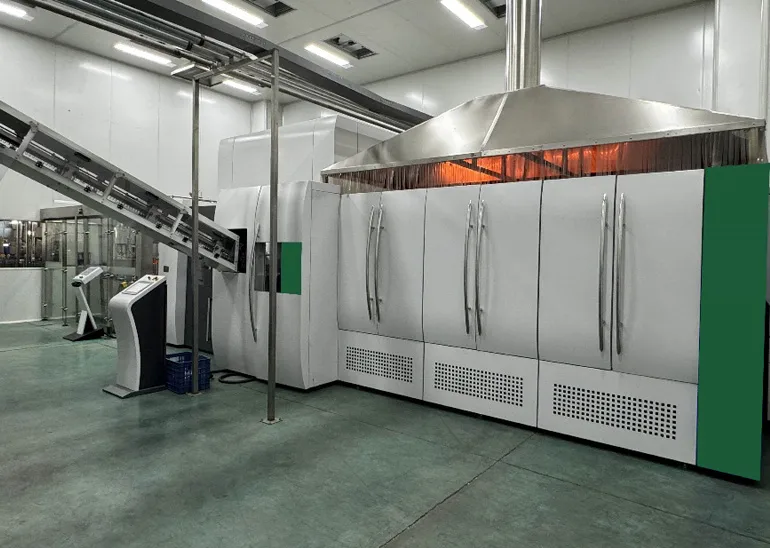
Project references
-

Vizit, 12,000BPH 1L Bottling Line with Combiblock for CSD, Kazakhstan
Country: Kazakhstan
Product: PET Bottled Carbonated Soft Drinks
Capacity: 12000BPH (1L)
Solution:Carbonated Drinks Production Line
Read More + -
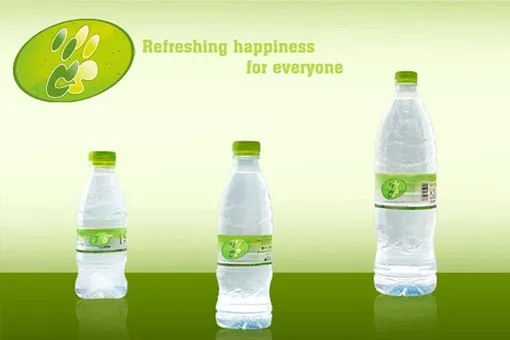
Taza, 4 Sets of 12,000BPH 1.5L Bottling Lines with Combiblock for Water, Maldives
Country: Maldives
Product: PET Bottled Mineralized Water
Capacity: 24,000BPH (500ml); 2 Lines
Solution:Water Production Line
Read More +
Have a specific project in mind?
Tell us product, target BPH, bottle sizes and market. We reply with a draft layout, equipment list and lead time estimate.
Fill the inquiry form ↑