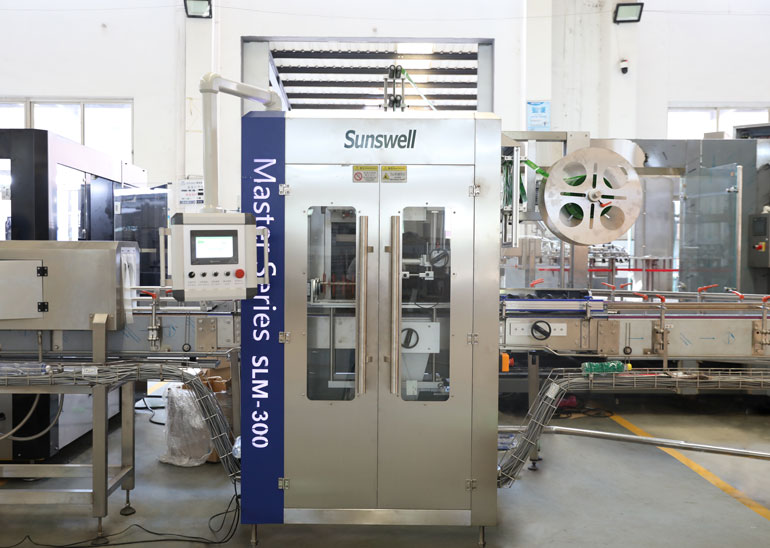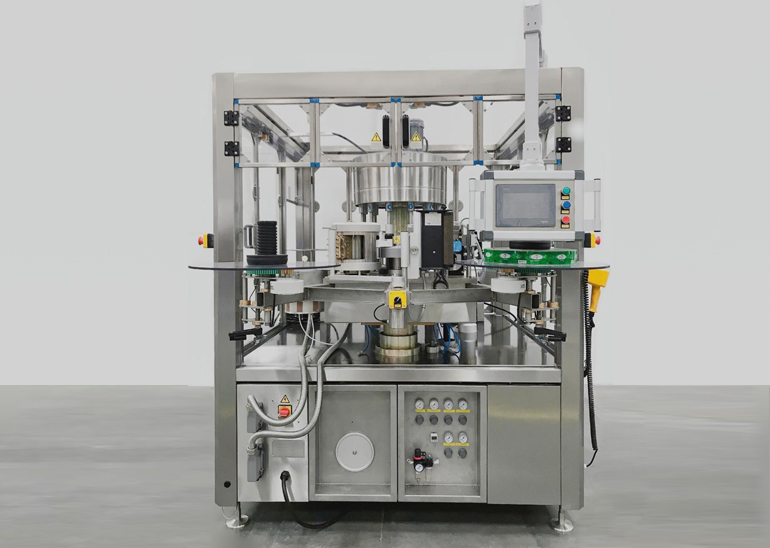
| Types | Sleeve, hot melt glue OPP, rotary sticker, self-adhesive |
| Rate | Matched to the filler, with an accumulator between |
| Key control | Label position, glue pattern, shrinkage, adhesion |
| Wetted parts | OPP film, PVC or PETG sleeve, paper sticker |
| Key decision | Full sleeve or partial wrap |
| Line position | After filling, before packing |
A consistent shrink needs the right film direction, a controlled tunnel temperature profile and a bottle that does not deform. Steam tunnels give a softer shrink than hot air and suit thin-wall bottles. A wrinkle at the shoulder is usually a film or temperature issue, not a speed issue.
After the filler and before the packer, normally with an accumulator on each side. The labeller is the most frequent short-stop on many lines, so the accumulator size in front of it decides whether a label roll change reaches the filler or not.
| Label type | Cost per unit | Best for |
|---|---|---|
| OPP wrap-around | Lowest at volume | High-speed round bottles |
| Full-body sleeve | Higher film cost | Full coverage and shaped bottles |
| Self-adhesive sticker | Middle | Short runs and flat or curved panels |
| Paper label with glue | Low material, slower | Glass bottles and craft products |
Throughput and change-part lists are on the Rotary Sticker Labeling page rather than in this note.
Surface energy, bottle temperature and glue choice. A cold bottle straight from the filler carries condensation, and a water-based adhesive will not bond to it. Hot melt handles a damp surface better, which is why it dominates high-speed beverage lines.
Throughput and change-part lists are on the Sleeve Labeling page rather than in this note.
Through the conveyor and an accumulator, not through a mechanical link. The labeller runs slightly faster than the filler and the accumulator absorbs the difference. A labeller matched exactly to the filler speed will stop the line at the first roll change.
By adjusting parameters such as label placement, speed, and pressure, manufacturers can achieve consistent labeling results regardless of bottle size, enhancing brand recognition and consumer perception.
The same question is worked through from another angle in How Does the Hot Melt Glue Labeling Machine Work.
A consistent circumference and no sharp undercut where the film cannot follow. Sleeves shrink around the shape, so a bottle with a deep waist needs a film with the right shrink direction. The bottle and the sleeve are designed together.
Usually uneven tunnel temperature, wrong film orientation, or a bottle that is still warm from filling. Check the tunnel profile and the film direction before changing the speed.
At high volume, an OPP wrap-around label usually is, because the film is thinner and the machine runs faster. A sleeve costs more per unit but covers the whole bottle and allows full-body design.
Perforation strength, film tension and tunnel temperature act together. A tear that appears after shrinkage usually means the perforation was cut too deep for the film gauge.
Hot melt glue applied at the leading edge, the trailing edge and the seam. The pattern and the pot temperature decide both the bond and how clean the bottle looks.
With two applicators or a combined unit, yes. They are separate stations with separate film paths, so the line needs the space and the changeover time for both.



 +86 13921964455
 [email protected]

A2 Dongjiu Industrial Park, 30 East Jintang Road, Tangshi, Zhangjiagang, Jiangsu 215600, China