The right upstream and supporting technology decides whether a beverage filling machine line runs efficiently, compliantly and profitably. In this guide Sunswell breaks down Homogenization and Emulsification in Beverage Processing Prior to Filling for B2B buyers planning or upgrading a production line.
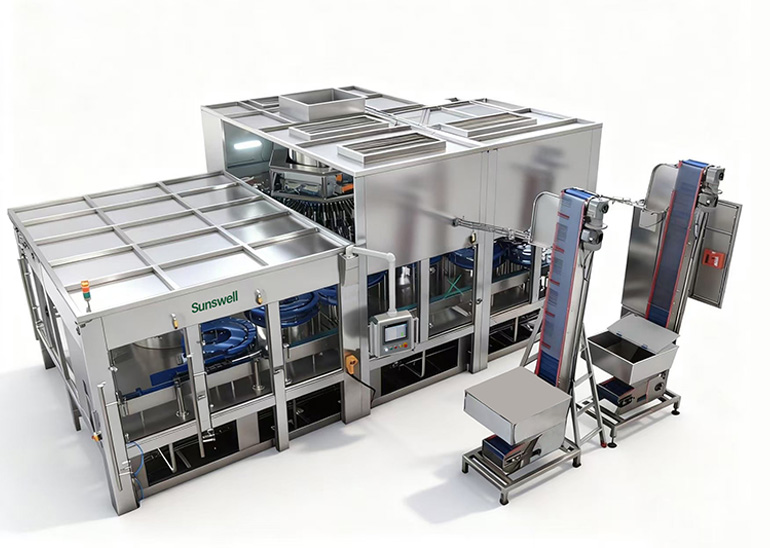
Homogenization and emulsification are upstream Processing Equipment steps that decide mouthfeel, shelf stability and visual uniformity long before product reaches the filling machine. For juice with pulp, plant milk, dairy and edible oil, the right shear and pressure profile prevents separation, sedimentation and off-flavours. This guide compares homogenizers, colloid mills and rotor-stator mixers, and shows how to size them ahead of the filler.
A homogenizer forces the product through a narrow gap at high pressure (typically 100–600 bar), shattering fat globules and suspended solids into a uniform micron-scale dispersion. In Juice Filling Machines lines this keeps pulp evenly suspended; in plant-milk lines it prevents the "sandiness" caused by improperly milled oats or soy.
Emulsification blends two immiscible phases (oil and water) into a stable droplet dispersion. It relies on mechanical shear plus emulsifiers; homogenization is the finishing, high-pressure step that locks the emulsion. Both are required for beverages such as protein drinks, flavoured milk and edible oil filling machine emulsions.
| Technology | Best for | Pressure / Shear | Typical use |
|---|---|---|---|
| High-pressure homogenizer | Juice, dairy, plant milk | 100–600 bar | Final particle size control |
| Colloid mill | Viscous, pulpy products | Medium shear | Pre-milling before homogenizer |
| Rotor-stator mixer | Batch emulsification | Low–medium | Tank-side blending |
| Ultrasonic homogenizer | Lab / niche | Localized high | R&D, small batches |
Throughput of the homogenizer must equal or exceed filler BPH converted to litres/hour. Undersizing forces batch mode and a buffer tank; oversizing wastes energy. For a 24,000 BPH water-equivalent juice line, plan for the corresponding volume at the product's specific gravity.
High-pressure shear generates heat. Pair the unit with a Pasteurizing Tunnel or UHT stage and keep the post-homogenizer line aseptic for sensitive SKUs. On a Combiblock the processor feeds directly into the filler without an open buffer.
Not for filtered, pulp-free juice. You need it when pulp, cloud or milk solids must stay uniformly suspended through the Juice Filling Machines run.
150–250 bar for most juices and plant milks; 300–600 bar for fine dairy emulsions and protein drinks.
Specify the right upstream Processing Equipment and Combiblock with Sunswell for a stable, uniform fill.



 +86 13921964455
 [email protected]

A2 Dongjiu Industrial Park, 30 East Jintang Road, Tangshi, Zhangjiagang, Jiangsu 215600, China