
| What is included | Filling, capping, labelling and packing equipment |
| Sizing basis | Demand in units per day, divided by productive hours and a production factor |
| Production factor | 0.65-0.85 depending on formats and changeovers |
| Key control | Fill accuracy, closure integrity, changeover time |
| Key decision | One flexible line or two dedicated lines |
| Acceptance | Output, accuracy, closure and changeover, measured |
Four inputs fix the shortlist: the product, the package, the daily demand and the number of formats per week. Everything else, including the brand of the PLC, is a detail that can be settled after those four are written down.
Understanding the torque requirements of your caps is vital in selecting the right capping machine.
Settle the product and the package before the machine. Product viscosity, acidity, carbonation and particle size decide the filling principle; the bottle neck finish decides the capping head and the change parts. A machine chosen before those two are fixed is chosen twice.
By considering factors such as torque requirements, speed, compatibility, and sealing integrity, you can select a capping machine that aligns with your production needs and quality standards.
| Decision | What it fixes | What it does not fix |
|---|---|---|
| Filling principle | Product and accuracy | Downstream capacity |
| Valve count | Rated BPH | Changeover and CIP time |
| Automation level | Labour per shift | Product quality |
| Line layout | Floor space and flow | Throughput of the slowest station |
Rated output, change parts and services are listed on the Gravity Filling Machine for Still Water page.
Compare the lowest rated station, the changeover time, the CIP time and the consumable cost per 1,000 units. A lower price with a slower packer or a longer CIP is not a lower cost. Ask both suppliers for the same four numbers in writing.
Rated output, change parts and services are listed on the Volumetric Filling Machine for Still Water page.
One full set of valve seals, one set of capping inserts, guide rail blocks and the change parts for the second format. These are the items with long lead times that stop a line for days. Buying them with the machine is cheaper than buying them in a hurry.
The same question is worked through from another angle in How to Select the Right Pump for Product Transfer.
On the same five numbers: the slowest station rating, the changeover time, the CIP time, the consumable cost per 1,000 units, and the spare parts lead time. A quotation that does not state all five cannot be compared with one that does.
Bottles per day divided by productive hours, then divided by a production factor of 0.65-0.85. The factor covers changeover, cleaning and downstream stops. Sizing at 1.0 is the most common planning error.
A well-maintained stainless line runs for well over a decade, with wear parts replaced on condition. The variables are water quality, cleaning regime and whether spare parts are kept in stock.
Capacity is usually added by a second line or by a downstream upgrade, not by speeding up the filler. The filler, the capper and the packer are matched, so raising one alone moves the bottleneck.
A monoblock combines rinse, fill and cap on one frame. A full line adds treatment, blowing, labelling, packing and palletizing around it. The monoblock is one station in a longer chain.
Ask for the factory acceptance test procedure, a reference line running the same format, and the spare parts list with lead times. A supplier who cannot show a running line has not commissioned many.
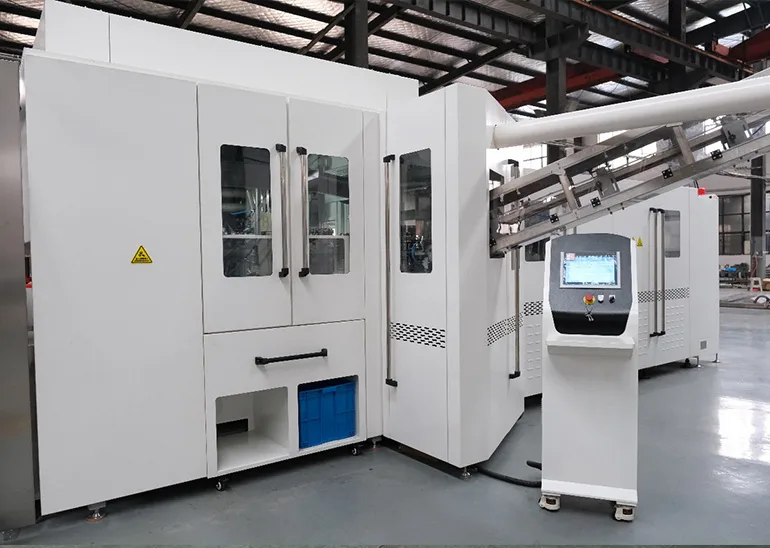
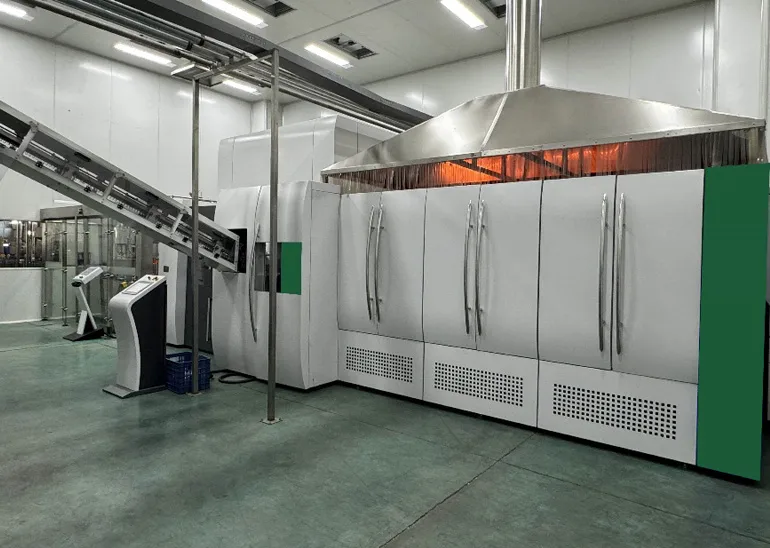
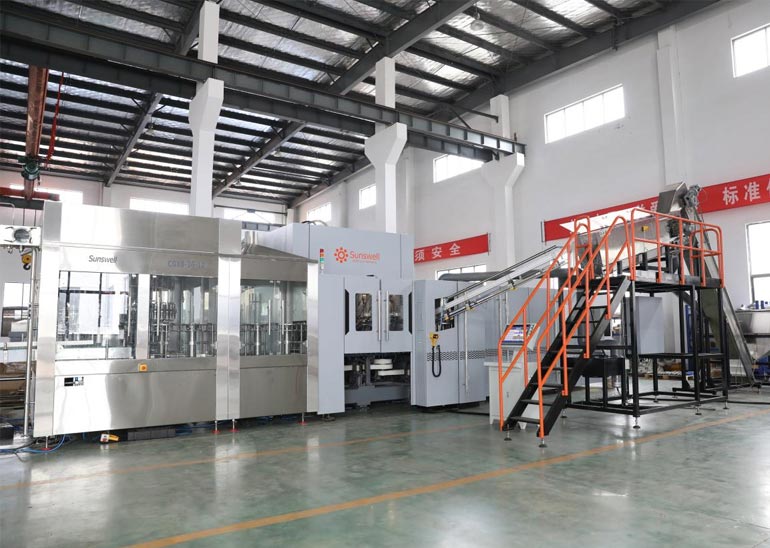
Country:Kazakhstan
Product: PET Bottled Sparkling Water, Canned Soft Drink, Canned Tea
Capacity: 25000CPH (250ml)
Solution:Three Lines,7000BPH(1.5L), 15000CPH(330ml),15000CPH(450ml)



 +86 13921964455
 [email protected]

A2 Dongjiu Industrial Park, 30 East Jintang Road, Tangshi, Zhangjiagang, Jiangsu 215600, China


