


Project Guide · Delivery
Shipping, Installation and Commissioning — What Happens After the Order
From crate to rated output: documents, site readiness, and the commissioning sequence that cannot be shortcut.
2–8
40 ft containers per line
20–45 d
Typical sea transit
15–30 d
Installation & commissioning
9+
Countries with service
444+
Lines delivered
Short answer: After the order, a filling line is crated into 2–8 forty-foot containers, ships in 20–45 days depending on destination, clears customs against a fixed document set, and is installed by local contractors under Sunswell supervision. Commissioning then escalates through dry run, empty bottle run, water run, product run and speed ramp to a signed Site Acceptance Test — typically 15–30 days with 2–4 engineers.
🎯 Key takeaways
- 2–8 containers per line — send the packing list to your unloading contractor before the vessel arrives
- Delays are administrative, not physical: agree HS codes and conformity certificates before shipment
- Site readiness is the schedule risk you control — run civil and utility work in parallel with manufacturing
- Installation is local work under our engineer's supervision; commissioning is done by our engineers
- Commissioning escalates: dry → empty bottle → water → product → speed ramp → SAT
- If site output lags the FAT figure, check air quality, voltage, preforms and caps before blaming the machine
On this page
1. How the line is packed and loaded
Equipment leaving the test bay is partially disassembled, protected and crated for sea transport. What matters to the buyer is not the packing method but the paperwork that comes with it, because that is what customs and your unloading crew will work from.
| Item | Packing method | Why |
|---|---|---|
| Machine frames and carousels | Wooden crate, film-wrapped, desiccant, bolted to base | Prevents shifting and salt-air corrosion in transit |
| Electrical cabinets | Separate crate, moisture barrier bag, desiccant | Humidity is the main risk to drives and PLCs |
| Filling valves and format parts | Boxed, labelled by bottle size | So the right change parts can be found without unpacking everything |
| Blow moulds | Oiled, individually boxed | Mould surfaces mark easily and marks transfer to every bottle |
| Conveyors | Bundled sections, numbered to the layout drawing | Assembly on site follows the drawing numbering |
| Spare parts | Consolidated crate with itemised list | Customs inspects this crate most often |
The packing list gives crate dimensions and weights. Send it to your unloading contractor before the vessel arrives — that one email prevents the most common arrival problem, which is a crate heavier than the available forklift.
2. Shipping documents and customs
Container delays are administrative far more often than they are physical. The standard document set:
- Commercial invoice and packing list
- Bill of lading or rail waybill
- Certificate of origin
- Conformity certificates for the destination — CE declaration, EAC/EAEU documentation for the Customs Union, SASO for Saudi Arabia
- Insurance certificate where the Incoterm places cover with the seller
- Fumigation certificate for wooden packing where the destination requires it
Agree HS codes with your broker before shipment. Blow moulding machinery, filling machinery and conveyors can fall under different headings with different duty rates. Reclassification after arrival means the container waits while the argument is resolved, and demurrage runs the whole time.
For Kazakhstan and other EAEU destinations, EAC certification requirements should be settled at contract stage, not at the border. Details in EAC certification for beverage machinery.
3. Site preparation — the schedule risk you control
Manufacturing lead time is fixed and visible. Site readiness is variable and invisible until the engineers land. This is why projects slip. Civil and utility work should run in parallel with manufacturing, starting from the approved layout drawing.
| Item | Specification | When to complete |
|---|---|---|
| Floor | Concrete cured, flat within ±3 mm over 2 m, drainage cut | 4 weeks before arrival |
| Power | Correct voltage and phase to the line panel, earth resistance measured | 2 weeks before arrival |
| Compressed air | LP and HP supply piped to tie-in points, dryer and filters in service | 2 weeks before arrival |
| Water | Treated water to filler, service water and drains at rinser | 2 weeks before arrival |
| Access route | Door widths and turning radius checked against crate sizes | Before booking the vessel |
| Lifting equipment | Forklift or crane rated above the heaviest crate | Before arrival |
| Consumables | Preforms, caps, labels, film, product — production quantity | Before engineers travel |
| People | Operators, one technician, one electrician assigned full-time | Before engineers travel |
Send photographs two weeks before the engineers travel. The poured floor, the incoming panel, the air tie-in points. We have rescheduled travel on the basis of those photos, and rescheduling costs far less than paid engineer-days spent waiting for a floor to cure.
4. Installation
Installation is local work under supervision. The sequence is fixed because each step depends on the tolerance achieved in the one before:
- Positioning. Machines are set on the layout marks. The layout drawing was approved months earlier — check it against the real building before the crane arrives, not after.
- Levelling. Each machine is levelled on its feet and anchored. Filling carousels are unforgiving of an out-of-level frame; fill accuracy problems traced back to levelling are common.
- Conveyor assembly. Sections are joined following the numbering on the layout drawing and aligned to machine infeeds and discharges.
- Utility connection. Power, compressed air, water and drains are connected by local contractors to the tie-in points. Our engineer verifies pressure, flow, voltage and phase rotation before anything is energised.
- Alignment and clearance check. Transfer points, star wheel gaps and guide rail heights are set. This is where an experienced engineer earns the airfare.
5. Commissioning
Commissioning escalates in stages and nothing advances until the previous stage is clean. The order protects both the machine and your material budget.
- Dry run. Drives jogged, rotation verified, interlocks and emergency stops tested. No bottles, no liquid.
- Empty bottle run. Bottles circulate without product until transfers run jam-free over a sustained period.
- Water run. Fill level accuracy and capping torque are tuned and recorded on water.
- Product run. Real product at reduced speed. Foaming, viscosity and temperature behaviour only appear here, which is why water testing never replaces it.
- Speed ramp. Output is stepped towards rated speed while reject rate is watched.
- Stability run and SAT. The line runs at rated output for the agreed continuous period; output, fill accuracy and reject rate are measured against the contract and signed.
Training runs alongside commissioning rather than after it, so operators learn on the moving line. Scope and structure are covered in global service and support.
6. When site output is below the factory figure
It happens, and the cause is almost never the machine that passed a witnessed FAT weeks earlier. Work through the variables in this order:
| Variable | Symptom | Check |
|---|---|---|
| Compressed air quality | Bottle wall defects, inconsistent blowing | Dew point and oil content at the machine tie-in, not at the compressor |
| Air pressure and flow | Output drops when other equipment runs | Pressure at the machine during full plant operation |
| Voltage stability | Random drive faults, unexplained stops | Log voltage over a full shift, including grid dips |
| Preform quality | Wall thickness variation, blow-outs | Compare batch against the preforms used at FAT |
| Cap consistency | Torque variation, leakers | Compare closures against the FAT batch; changed supplier is a frequent cause |
| Product temperature | Foaming, fill level scatter | Measure at the filler bowl, not at the tank |
| Water treatment | Scaling, rinser nozzle blockage | Hardness and filtration output |
This is why the FAT report matters. With signed factory data in hand, the question at site is never "can this machine do it?" but "which variable changed?" That reframing typically saves a week of unproductive argument and points straight at the utility that needs fixing.
Frequently asked questions
How many containers does a filling line need?
A compact water line often fits in 2–3 40-foot containers. A turnkey line with blowing, filling, labelling, packing and conveyors commonly runs to 5–8. The exact count comes from the packing list, which is issued before booking so you can plan unloading.
How long is sea freight from China?
Roughly 20–30 days to the Middle East and South Asia, 30–40 days to Europe and West Africa, 30–45 days to South America. Central Asian destinations such as Kazakhstan usually move by rail or by sea plus road, with transit and border formalities adding time.
Who unloads the containers?
The buyer. Confirm forklift or crane capacity against the heaviest crate on the packing list before the container arrives. The filler frame and the blow moulder are normally the two heaviest items.
What if my building is not ready when the line arrives?
Arrange dry, covered storage. Electrical cabinets and servo drives must not sit in an open yard through a rainy season. Demurrage at the port is expensive, so plan storage before the vessel arrives rather than after.
Can we install the line ourselves?
Mechanical positioning, levelling and utility connection are normally done by local contractors under our engineer's supervision. Commissioning — timing, calibration, PLC parameters and speed ramp-up — is done by our engineers, and doing it any other way puts the warranty at risk.
What utilities must be ready before commissioning?
Power at correct voltage and phase with earthing measured, compressed air at specified pressure and flow with dryer and filtration running, treated water to the filler, drains, and a cured level floor. Missing any one of these stops commissioning while engineers wait.
When does the warranty start?
12 months from commissioning or 15 months from bill of lading date, whichever comes first. The second condition exists so that a line stored for a year does not carry an open-ended warranty clock.
About the author
Written by the Sunswell engineering team — led by Howie SUN, Founder & CEO, with 14 years in filling and blow-moulding equipment R&D and turnkey project delivery across 71+ countries.
Last reviewed: 2026-08-26 · Reviewed by Sunswell engineering team
Ask our engineering team →Recommend Products
Project references
-
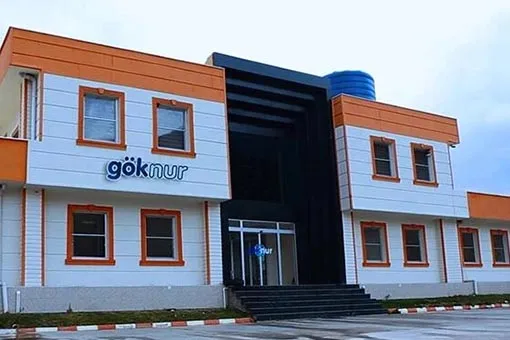
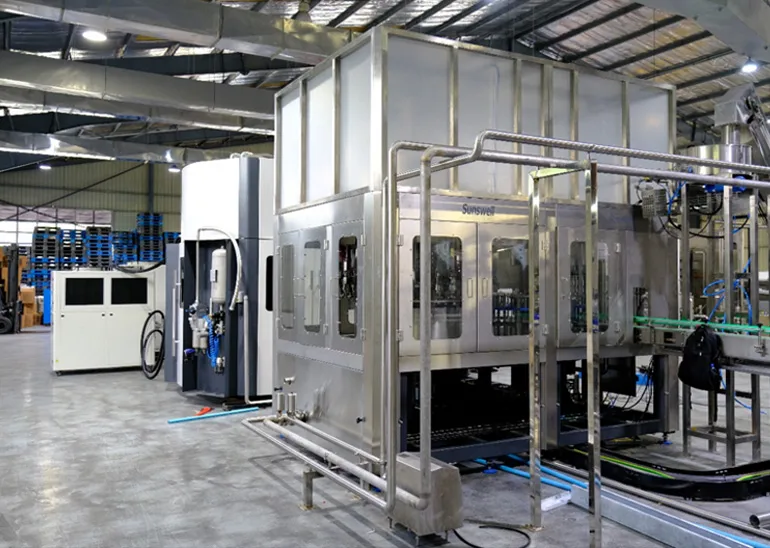
Goknur, 2 Sets of 18,000BPH Bottling Lines for Juice, Turkey
Country: Turkey
Product: Glass and PET Bottled Juice
Capacity: 20000BPH(330ml) Glass Bottle; 4000BPH(3L) PET Bottle
Solution:Juice Production Line
Read More + -
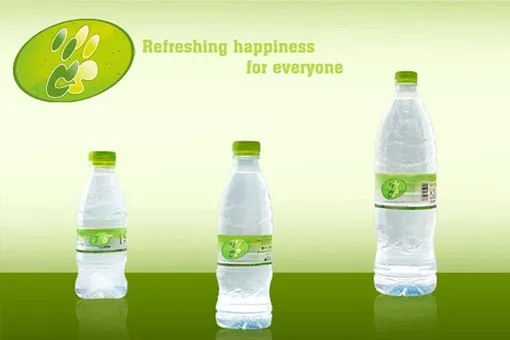
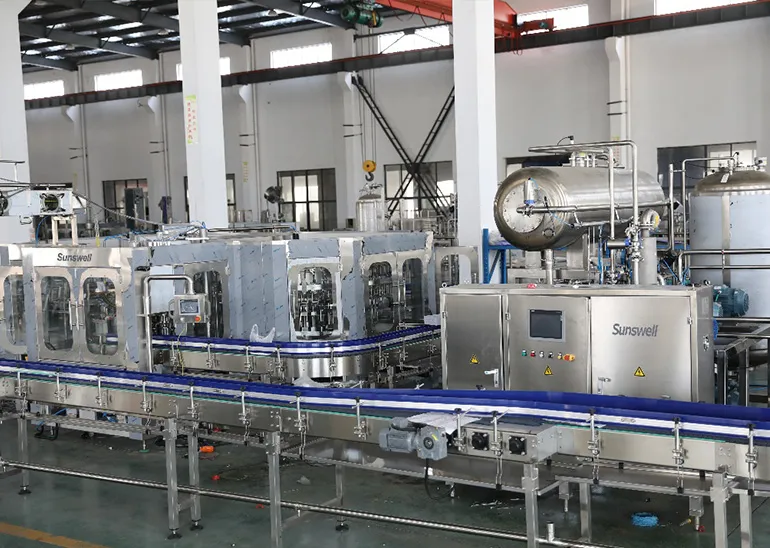
Taza, 4 Sets of 12,000BPH 1.5L Bottling Lines with Combiblock for Water, Maldives
Country: Maldives
Product: PET Bottled Mineralized Water
Capacity: 24,000BPH (500ml); 2 Lines
Solution:Water Production Line
Read More + -

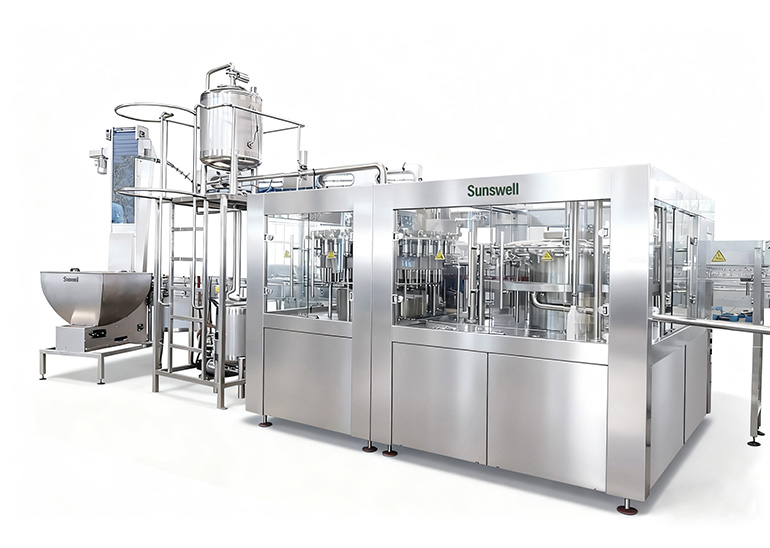
Rauan, 8 Sets of Bottlingand Canning Lines from 12,000-24,000BPH for Water, CSD and Juice, Kazakhstan
Country:Kazakhstan
Product: PET Bottled Sparkling Water, Canned Soft Drink, Canned Tea
Capacity: 25000CPH (250ml)
Solution:Three Lines,7000BPH(1.5L), 15000CPH(330ml),15000CPH(450ml)
Read More +
Have a specific project in mind?
Tell us product, target BPH, bottle sizes and market. We reply with a draft layout, equipment list and lead time estimate.
Fill the inquiry form ↑