
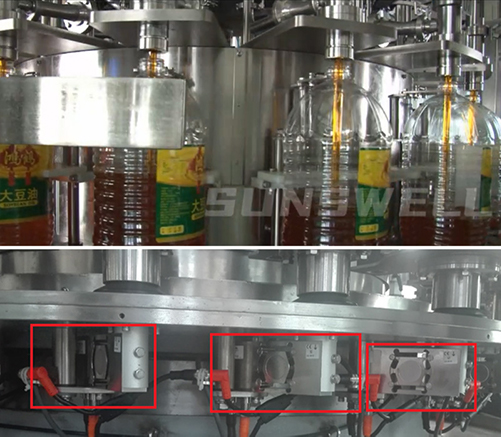
| Valve type | Load cell net-weight, or piston dosing |
| Capacity range | 12,000-36,000 BPH at 0.2-2 L |
| Viscosity | Up to 10,000 cP |
| Accuracy | Plus or minus 0.5 g per bottle |
| Package | PET or glass |
| Key control | Weight per bottle, temperature, drip-free cut-off |
Oil density changes with temperature, so a fixed volume delivers a different mass in the morning and in the afternoon. A load cell weighs what goes into the bottle and stops at the target mass. That is why an oil line is specified in grams and a water line in millilitres.
The weight error of the filled product is plus or minus 2.5 grams.
Oil clings. A valve that cuts off cleanly on water leaves a thread of oil on the bottle shoulder, and that thread becomes a rejected bottle and a dirty conveyor. The cut-off profile, the nozzle tip and the suck-back setting are the three things to watch at acceptance, not the fill speed.
| Dosing method | Accuracy basis | When it fits |
|---|---|---|
| Load cell | Net weight per bottle | Density moves with temperature |
| Piston | Displacement volume | Stable density, high speed, thick product |
| Volumetric valve | Chamber volume | Low-viscosity oil at steady temperature |
| Flow meter | Measured volume | Continuous flow, limited pulp or solids |
The Edible Oil Load Cell is the reference unit for this configuration.
Above a few thousand cP the product moves by pressure and time rather than by gravity, so the bowl, the feed pipe and the valve bore all grow. Temperature control also becomes part of the filling specification, because a cold oil at 10 C and the same oil at 25 C behave like two different products.
Throughput and change-part lists are on the Filling Machine for Viscous Product page rather than in this note.
Nothing, if the filler tares each bottle before dosing. That tare step is what separates net-weight filling from a flow meter. Without it, a heavy bottle delivers less product and the label claim fails.
The same question is worked through from another angle in How to Choose the Right Filling Machine for Edible.
Plus or minus 0.5 g per bottle on the reference specification. Real drift depends on product temperature, valve cut-off and the scale calibration interval, so the acceptance test should record all three.
The temperature at which the viscosity gives a clean cut-off and a repeatable weight, held steady through the shift. The exact band belongs to the product specification; the requirement is that it is controlled and recorded.
Product temperature, a worn valve seat, or scale calibration. Log the weight and the temperature together; a drift that follows temperature is a process problem, not a valve problem.
Yes, with different infeed parts and a different capping head. Glass brings breakage risk and a lower practical rate, so the two formats are usually run in separate campaigns.
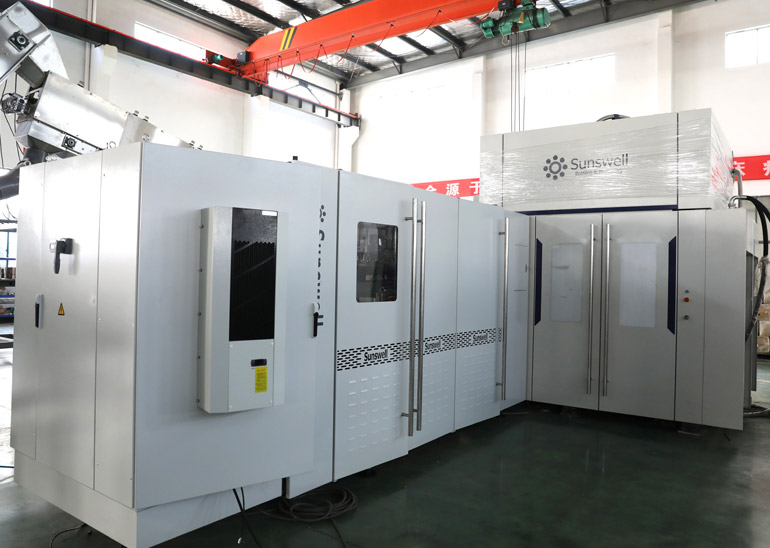
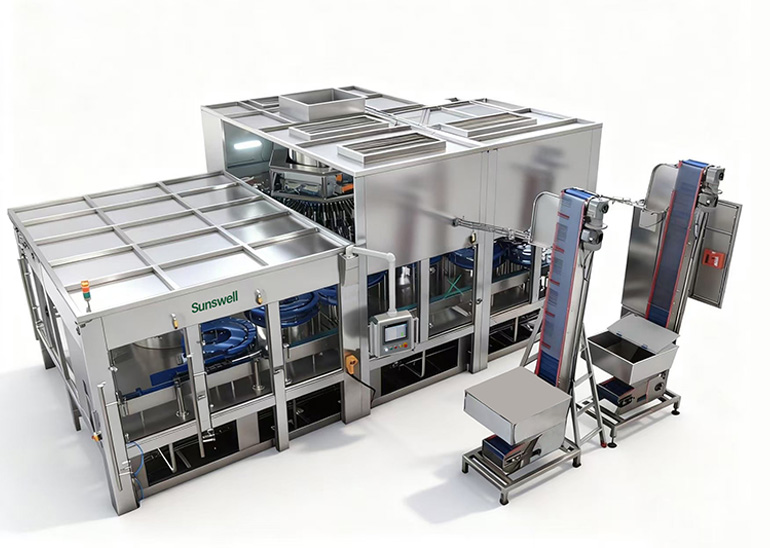
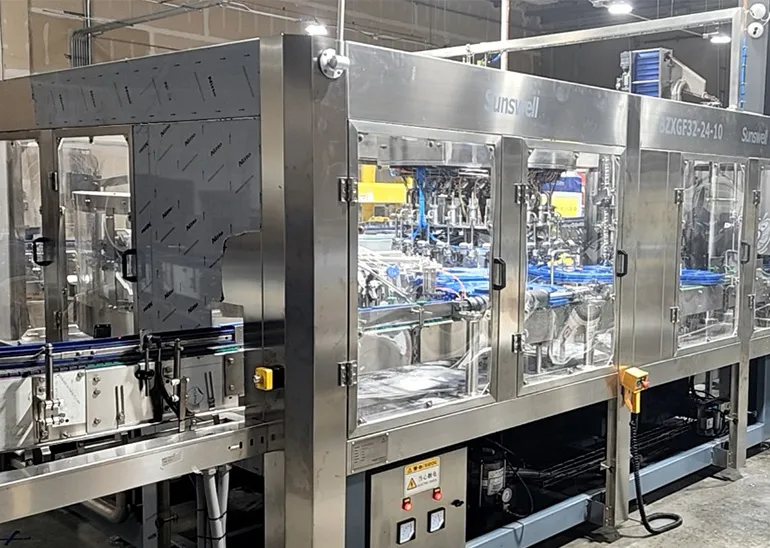
Country:Kazakhstan
Product: PET Bottled Sparkling Water, Canned Soft Drink, Canned Tea
Capacity: 25000CPH (250ml)
Solution:Three Lines,7000BPH(1.5L), 15000CPH(330ml),15000CPH(450ml)



 +86 13921964455
 [email protected]

A2 Dongjiu Industrial Park, 30 East Jintang Road, Tangshi, Zhangjiagang, Jiangsu 215600, China


