
| Filling principle | Hot-fill, up to 85 C |
| Capacity | 6,000-36,000 BPH at 0.2-2 L |
| Container | Heat-resistant PET geometry, or glass |
| Line | Hot-fill monobloc with tunnel pasteuriser |
| Products | Juice, tea, nectar, functional drinks |
| Key control | Fill temperature, hold time, cap seal |
Fill temperature and hold time together set the pasteurisation result. Below the target, shelf life is at risk; above it, the product cooks and the bottle deforms. The number belongs to the product and the bottle, not to the machine, and it should be written into the acceptance protocol with a tolerance.
Cap seals and filling valve O-rings, because they see the highest temperature every cycle. A seal that is fine on a water line at 20 C will harden in weeks at 85 C. The spare parts list should carry those two items in proportion to the number of valves, not as a single set.
| Route | Temperature | What it costs |
|---|---|---|
| Hot fill | Up to 85 C | Heat-resistant bottle and a cooling tunnel |
| Cold fill with preservative | Ambient | Formulation constraint, not a machine constraint |
| Cold fill with in-line pasteuriser | Product-side only | Separate pasteuriser and a closed filling zone |
| Hot fill in glass | Up to 85 C | Glass mass, slower line, higher transport cost |
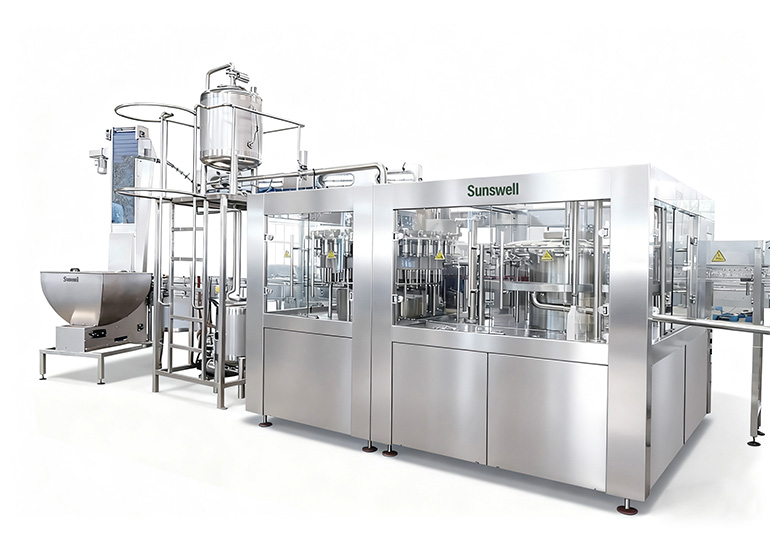
Where this becomes a line rather than a single machine, the Hotfill Type Filling Machine for Juice is the starting point.
Tea usually needs finer filtration, deaeration to protect aroma, and a fill temperature that does not strip the volatile notes. Tea also clouds after cooling, so the clarification step is part of the product design, not a filling detail.
The specification sheet for the Juice By Volumetric Filler carries the utility figures quoted here.
Glass brings mass, breakage and a slower line. It also brings a closure decision: crown, lug or screw. A glass hot-fill line usually runs at a lower rate than the same filler on PET, and the difference is handling and inspection, not the valve.
The same question is worked through from another angle in Understanding the Pasteurizing Tunnel Process in Juice Production.
No. Standard PET softens and deforms at fill temperature. The bottle needs a heat-resistant geometry, and the mould and preform are part of the project, not an afterthought.
It depends on the hold tube volume and the heater capacity. The line is not production-ready until the return temperature is stable, so start-up time belongs in the daily plan rather than being discovered at shift start.
Heat-sensitive pigments and vitamins degrade above the product temperature limit. The fill temperature and the hold time are the two variables; lowering either protects colour and shortens the microbial margin.
A controlled ramp rather than a cold plunge, so the bottle does not deform under vacuum. The tunnel zones are set per bottle geometry and validated with a temperature probe in the product.
Country: Turkey
Product: Glass and PET Bottled Juice
Capacity: 20000BPH(330ml) Glass Bottle; 4000BPH(3L) PET Bottle
Solution:Juice Production Line
Country:Kazakhstan
Product: PET Bottled Sparkling Water, Canned Soft Drink, Canned Tea
Capacity: 25000CPH (250ml)
Solution:Three Lines,7000BPH(1.5L), 15000CPH(330ml),15000CPH(450ml)



 +86 13921964455
 [email protected]

A2 Dongjiu Industrial Park, 30 East Jintang Road, Tangshi, Zhangjiagang, Jiangsu 215600, China


