In the global beverage market of 2026, the resurgence of sparkling water—driven by health-conscious consumers seeking "clean label" fizz—has transformed the carbonated water filling machine from a standard utility into a strategic asset. For factory managers and procurement directors, the challenge is no longer just about speed; it is about CO2 stability, hygienic integrity, and the agility to handle diverse packaging formats like PET, glass, and aluminum.
This technical analysis explores the critical innovations in isobaric filling technology and why your choice of equipment determines your plant's ROI in the "Made in China 2025" era.
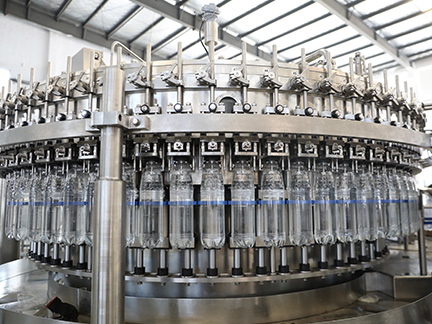
Unlike still water, carbonated water requires a pressurized environment to prevent CO2 breakout and foaming during the filling process. This is achieved through isobaric (equal pressure) filling technology.
Pressure Equalization: The filling valve first pressurizes the bottle with CO2 to match the pressure in the product tank. This allows the liquid to flow into the bottle by gravity without turbulence.
Precision Decompression: Modern machines utilize multi-stage "snifting" or degassing. By releasing pressure slowly before the bottle is unsealed, the machine prevents the "geyser effect," ensuring maximum product yield and consistent carbonation levels (typically measured in volumes of $CO_{2}$).
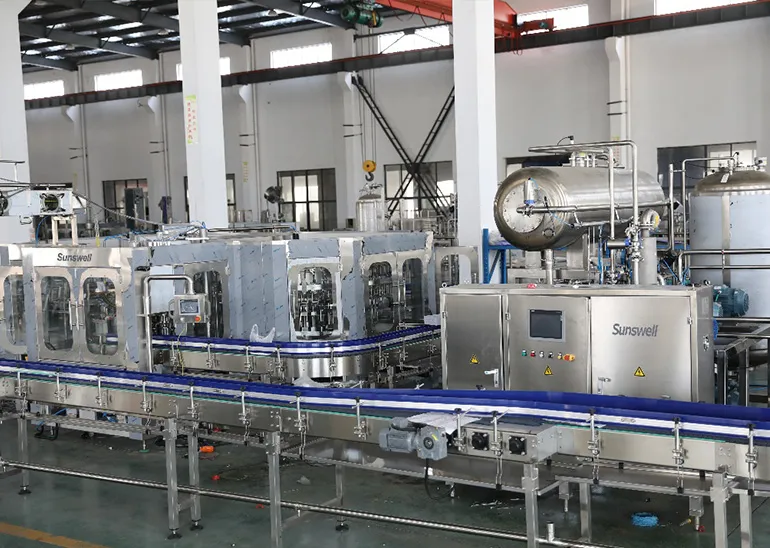
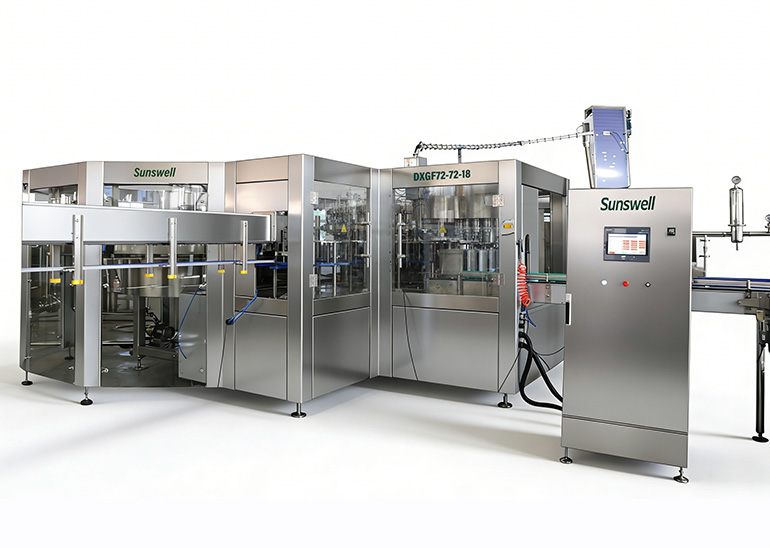
To meet 2026 hygiene standards, the industry has shifted toward the 3-in-1 Monobloc system. This integrated design eliminates the risks associated with open-air conveyors between stages.
Neck-Handling Technology: Bottles are conveyed by the neck throughout the process. This minimizes the need for height adjustments when switching between bottle sizes (e.g., 330ml to 1.5L), reducing changeover downtime by up to $60\%$.
Non-Contact Rinsing: Advanced rinsers use "overturning" clamps that grip the bottle neck without touching the mouth thread, preventing secondary microbial contamination.
Starwheel Synergy: Synchronized starwheels ensure smooth transition at speeds exceeding 24,000 BPH (Bottles Per Hour), critical for avoiding bottle jams in high-output environments.
For a decision-maker, the internal components of a carbonated water filling machine are the best indicators of its lifespan. In the competitive landscape, "Create in China" means utilizing global-tier components to ensure 24/7 operational stability.
| System | Standard Configuration | Strategic Benefit |
| Control System | Siemens / Mitsubishi PLC | High-speed logic processing and global parts availability. |
| Pneumatics | Festo / SMC | Precision valve actuation for consistent filling levels. |
| Material | Stainless Steel 316L (Contact) | Maximum corrosion resistance against carbonated acids. |
| Bearings | Igus (Germany) | Oil-free, maintenance-free operation in "wet" areas. |
Modern filling lines are no longer "black boxes." They are data-rich environments. Leading machines now feature IoT-enabled sensors that monitor vibration, motor temperature, and CO2 flow rates in real-time.
For a plant manager, this means the machine can predict a seal failure before it happens, allowing for scheduled maintenance instead of costly emergency shutdowns. Integration with a Touch Screen HMI (Human Machine Interface) allows operators to adjust filling parameters on the fly, ensuring the Overall Equipment Effectiveness (OEE) remains above $95\%$.
The 2026 market demands versatility. A future-proof carbonated water filling machine should be capable of handling:
Ultra-Lightweight PET: Advanced pressure control to prevent bottle deformation during the isobaric phase.
Glass and Cans: Modular carousels that allow for quick-change parts to accommodate premium glass lines or craft soda canning.
Temperature Variance: Capability for "Cold Fill" ($<5°\text{C}$) to maximize CO2 solubility or "Ambient Fill" to save on refrigeration energy.
The choice of a carbonated water filling machine is an investment in your brand's reputation. As we move toward a more automated and sustainable manufacturing landscape, your equipment must deliver more than just volume—it must deliver precision, hygiene, and data-driven intelligence.
At Sunswell, we are at the forefront of the "Create in China" movement. Established in 2011 and based in the award-winning city of Zhangjiagang, our 10,000m² international standardized workshop is the birthplace of world-class liquid packaging technology.
As a leading supplier with ISO9001, CE, and SGS certifications, Sunswell offers comprehensive turnkey solutions—from bottle blowing and isobaric filling to labeling and palletizing. Our independent R&D unit ensures that every machine, whether for PET, glass, or aluminum, is built with 316L stainless steel and top-tier components like Siemens and Festo.



 +86 13921964455
 [email protected]

A2 Dongjiu Industrial Park, 30 East Jintang Road, Tangshi, Zhangjiagang, Jiangsu 215600, China