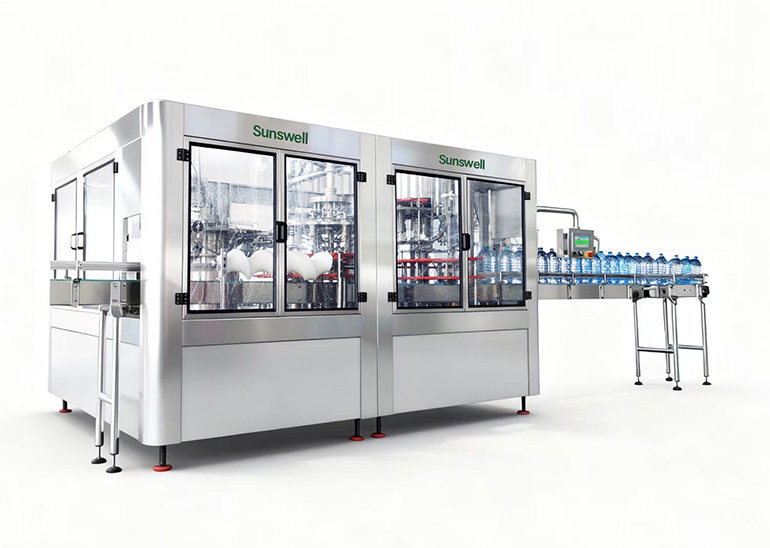
In the high-stakes world of beverage production, the efficiency of your water filling equipment is the single greatest determinant of your factory’s profitability. As we navigate 2026, the industry has shifted beyond simple automation toward "Intelligent Manufacturing"—where data, hygiene, and mechanical precision converge.
For plant managers and investors, selecting a water filling line is no longer just a procurement task; it is a strategic engineering decision that must account for total cost of ownership (TCO) and future-market adaptability.
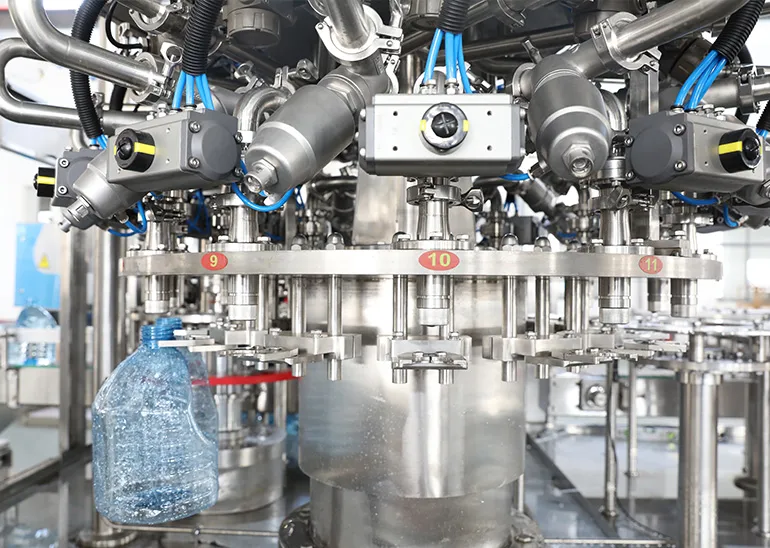
When evaluating high-capacity water filling equipment, the mechanical architecture is paramount. While linear fillers serve niche markets, Rotary Filling Systems are the industry benchmark for high-volume output.
Centrifugal Feeding: Modern rotary machines use precision starwheels to maintain a constant pitch between bottles. This eliminates the "bottleneck" effect common in older systems, allowing for stable production speeds exceeding 36,000 BPH.
Neck-Handling Versatility: By gripping the bottle at the neck rather than the base, equipment can handle ultra-lightweight PET bottles—reducing plastic consumption and material costs without risking bottle collapse during the filling or capping phase.
The core of water filling equipment is the valve technology. In 2026, the choice typically falls between two advanced methods:
Electronic Flow Meter Filling (Magflow): This non-contact technology uses electromagnetic induction to measure the exact volume of water. Because the filling valve never touches the bottle, the risk of cross-contamination is virtually eliminated. It offers a precision of $\pm 0.2\%$, ensuring zero product waste.
Mechanical Gravity Filling (High-Speed): For standard purified water, modern gravity valves now feature dual-speed cycles—fast fill for volume and slow fill for the final level—minimizing turbulence and oxygen pickup.
[Image: Technical diagram of a non-contact magnetic flow meter filling valve]
For modern water bottling, "clean" is a relative term. The highest-performing water filling equipment now integrates Aseptic-level hygiene standards even for non-aseptic products.
HEPA-Laminar Flow Hoods: By maintaining a positive pressure environment over the filling carousel, the machine creates a "clean zone" that prevents airborne microbes from entering the process.
Integrated CIP/SIP: Automated Clean-in-Place (CIP) systems use high-temperature caustic solutions and steam to sanitize every internal conduit. Modern equipment features "closed-loop" CIP, which recycles cleaning agents to reduce environmental impact and utility costs.
The most significant advancement in water filling equipment today is the integration of Industry 4.0. A "smart" machine is no longer a luxury; it is a necessity for maintaining a competitive Edge.
Real-time OEE Tracking: Operators can monitor Overall Equipment Effectiveness (OEE) via cloud-based dashboards. Any drop in torque on a capping head or a slight delay in valve actuation is flagged before it leads to downtime.
Servo-Driven Intelligence: By replacing mechanical cams with independent servo motors, changeovers between different bottle formats (e.g., from 500ml to 1.5L) can be achieved via a single touch-screen command, reducing changeover time from hours to minutes.
A filling machine does not operate in a vacuum. To maximize the ROI of your water filling equipment, you must consider the Turnkey Synergy:
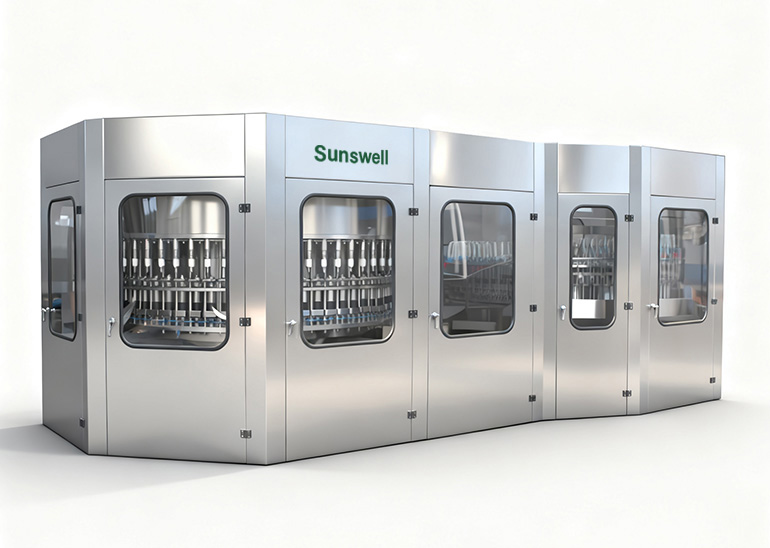
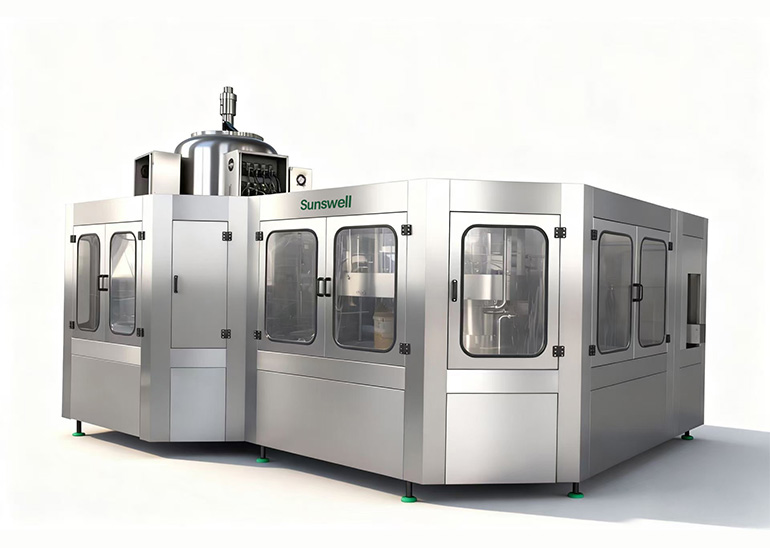
Blowing-Filling-Capping Combi: Integrating these three functions into a single "Combi-block" reduces footprint by $30\%$ and cuts energy consumption by eliminating the need for air conveyors.
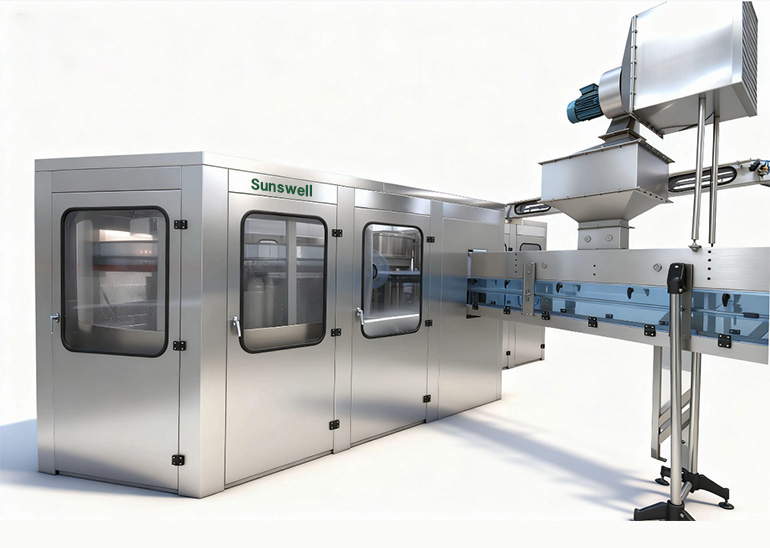
End-of-Line Automation: Modern lines must seamlessly transition into high-speed labeling, shrink-wrapping, and robotic palletizing to maintain the throughput generated by the filler.
The future of the liquid packaging industry belongs to those who prioritize quality, efficiency, and technological innovation. As the global landscape moves toward the "Made in China 2025" goals, the emphasis has shifted from "Products" to "Brands" and from "Speed" to "Intelligence." Investing in high-tier water filling equipment is the cornerstone of this transformation.
Since 2011, Sunswell has been at the forefront of the liquid packaging revolution. Located in the award-winning city of Zhangjiagang, our 10,000m² international standardized workshop houses over 80 expert staff dedicated to one goal: your production excellence.
As a global leader with ISO9001, CE, and SGS certifications, Sunswell provides more than just machinery; we provide complete turnkey solutions. From our independent R&D in blowing and filling technology to our sophisticated Combi-block systems, we empower factories worldwide to achieve higher quality and greater efficiency.
Whether you are bottling mineral water, juice, or edible oil in PET, glass, or cans, Sunswell is your partner in moving from "Made in China" to "Created in China."



 +86 13921964455
 [email protected]

A2 Dongjiu Industrial Park, 30 East Jintang Road, Tangshi, Zhangjiagang, Jiangsu 215600, China