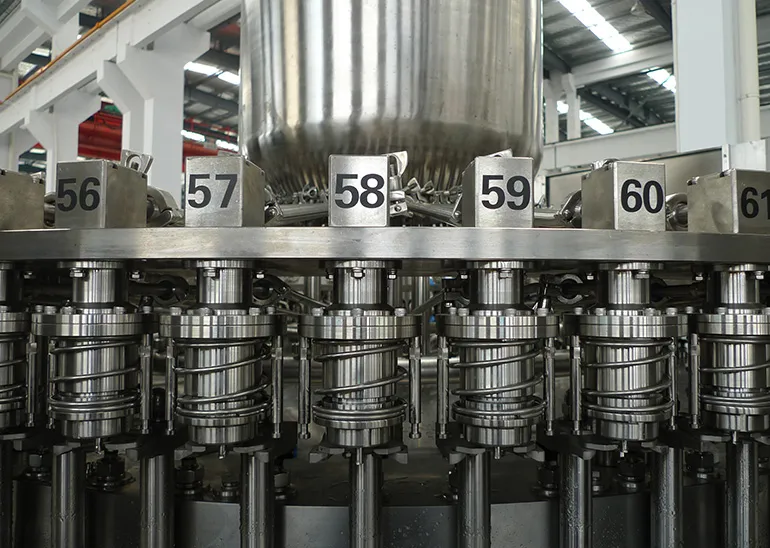
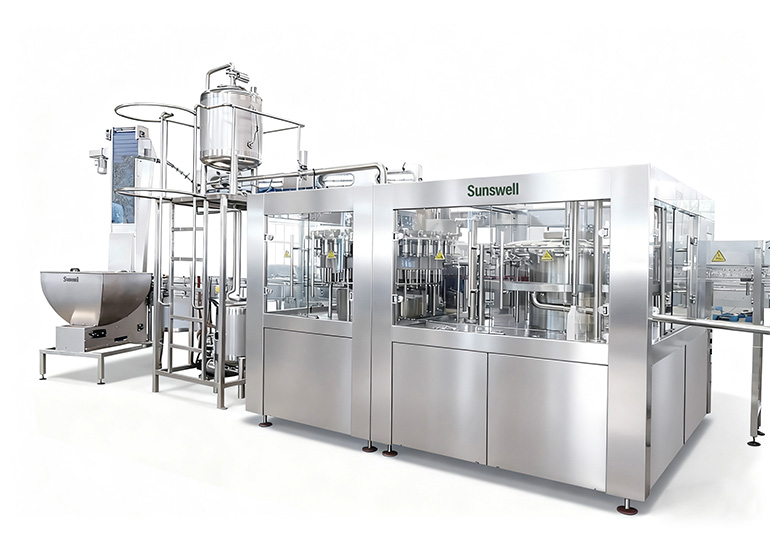
| Filling principle | Hot-fill, up to 85 C |
| Capacity | 6,000-36,000 BPH at 0.2-2 L |
| Package | Heat-resistant PET geometry, or glass |
| Line | Hot-fill monobloc with tunnel pasteuriser |
| Products | Juice, tea, nectar, functional drinks |
| Key control | Fill temperature, hold time, cap seal |
Hot filling does two jobs at once: it pasteurises the product on the way to the filler, and the residual heat sanitises the bottle and cap. That is why a hot-fill line can run an acidic juice without a separate bottle steriliser. The price is a heat-resistant bottle and a longer cooling tunnel.
The CIP system must reach all surfaces with validated caustic/acid cycles and verify via conductivity or temperature logging.
Pulp needs either a larger valve bore or a piston filler, and it needs continuous gentle agitation in the bowl. Dead corners in the product path settle fibre, then release it as a slug into the next bottle. Bowl geometry and return-flow design matter more than valve count here.
| Route | Temperature | What it costs |
|---|---|---|
| Hot fill | Up to 85 C | Heat-resistant bottle and a cooling tunnel |
| Cold fill with preservative | Ambient | Formulation constraint, not a machine constraint |
| Cold fill with in-line pasteuriser | Product-side only | Separate pasteuriser and a closed filling zone |
| Hot fill in glass | Up to 85 C | Glass mass, slower line, higher transport cost |
The Juice By Volumetric Filler is the matching unit when this becomes a line project.
The bottle leaves the filler at up to 85 C and has to come down in a controlled ramp. A plunge cools the outside first, the inside contracts later, and the panel pulls in. The tunnel zones are set per bottle geometry and checked with a probe in the product.
Site requirements, air and water consumption sit with the Hotfill Type Filling Machine for Juice.
With a storage trial on the actual product, bottle and closure, held at the intended temperature and sampled on a schedule. Changing the fill temperature, the bottle or the cap invalidates the previous result, which is why those three are treated as one specification.
The same question is worked through from another angle in How Volumetric Fillers Ensure Accuracy in Hotfill Juice Lines.
Up to 85 C, set per product and per bottle. The exact set point and tolerance belong in the product specification, because acidity, pulp content and bottle wall thickness all move it.
It replaces the bottle steriliser for acidic products, because the fill temperature and hold time do the microbial work. It does not replace correct product formulation or a validated hold tube.
Usually fill temperature above the bottle rating, or a vacuum that forms as the product cools. Check the fill temperature against the bottle specification and the cap seal before changing the cooling profile.
With a filter change and a different valve bore for the pulp, yes. Clear juice needs finer filtration, and pulp needs agitation in the bowl so the fibre does not settle.
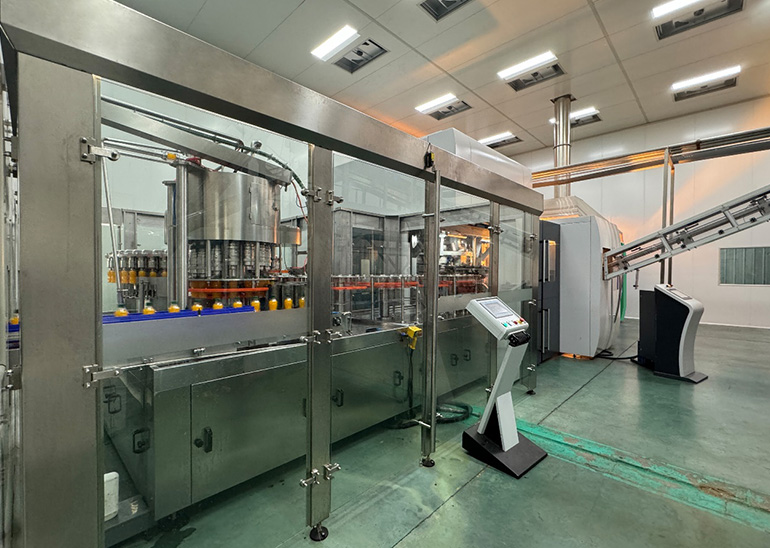
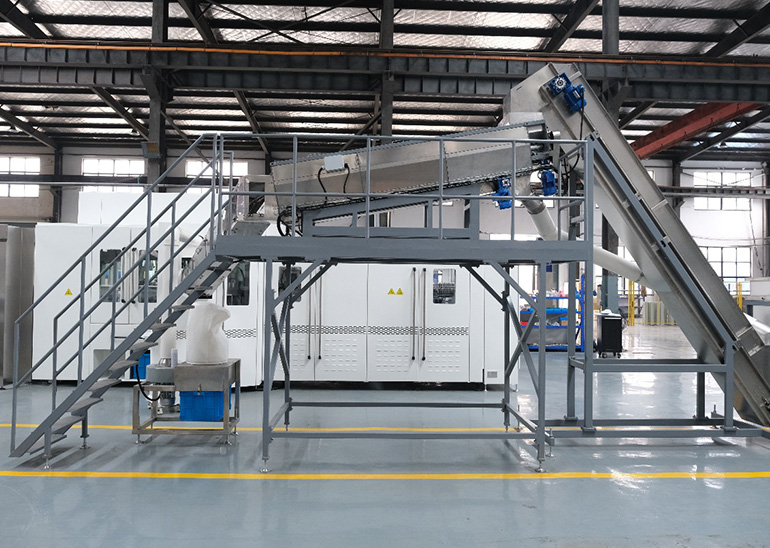

Country: Turkey
Product: Glass and PET Bottled Juice
Capacity: 20000BPH(330ml) Glass Bottle; 4000BPH(3L) PET Bottle
Solution:Juice Production Line
Country:Kazakhstan
Product: PET Bottled Sparkling Water, Canned Soft Drink, Canned Tea
Capacity: 25000CPH (250ml)
Solution:Three Lines,7000BPH(1.5L), 15000CPH(330ml),15000CPH(450ml)



 +86 13921964455
 [email protected]

A2 Dongjiu Industrial Park, 30 East Jintang Road, Tangshi, Zhangjiagang, Jiangsu 215600, China