


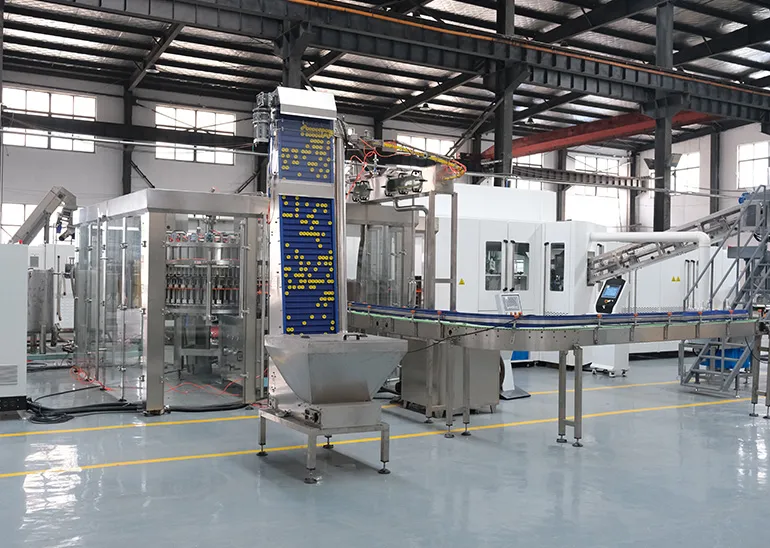
How it works · Juice / Tea
Juice & Tea (Hot-fill) Machine — How It Works and Key Components
A juice and tea filling machine hot-fills at 85–88 °C so the bottle and closure are heat-treated at fill. The product does the preservation; the machine holds the temperature and the seal.
85–88
°C fill temp
2,000–18,000
BPH range
444+
Lines delivered
71+
Countries exported
Hot-fill
Valve type
Short answer: Hot-fill heats the product to 85–88 °C, fills it hot into a temperature-rated bottle, seals it, then cools it so the headspace is snifted under vacuum. The heat treats the container and closure, giving shelf-stable juice and tea without cold filling (contact Sunswell). The bottle and closure must survive the temperature and the thermal shock of cooling — that is a bottle spec, not just a machine spec.
🎯 Key takeaways
- Hot-fill heats to 85–88 °C and treats the bottle and closure at fill.
- State product and pH — they set the heater hold and the bottle spec.
- The bottle must be heat-set PET; a cold-fill bottle collapses.
- Hot-fill suits acidic juice/tea; low-acid needs another process.
- Cooling capacity, not just the filler, can be the bottleneck.
On this page
1. The hot-fill process flow
Product is heated (usually by a tube or scraped-surface heater and held for a short time), filled hot into the bottle, capped, then inverted or conveyed through a cooler so the hot product contacts the closure and neck (treating them), and the headspace is snifted to a partial vacuum as it cools. The heat, not a separate sterilisation enclosure, does the preservation.
This is why hot-fill is the pragmatic alternative to cold filling (contact Sunswell) for shelf-stable juice and tea — no separate sterilisation enclosure, just temperature control and a bottle that can take it.
2. Temperature and why it matters
Fill at 85–88 °C so the container and closure are pasteurised at fill. Too low and you under-treat; too high and you damage flavour, colour and the bottle. The band is set by the product and its pH, so state both at quotation.
| Product | Fill temp | Why |
|---|---|---|
| Juice (pH < 4.5) | 85–88 °C | Pasteurises bottle and closure |
| Tea (shelf-stable) | 85–88 °C | Heat-treats container at fill |
| Low-acid | Not by hot-fill alone | Needs another validated process |
State the exact product and pH at quotation. They set the valve, the heater hold time and the bottle specification — hot-fill cannot preserve low-acid product on its own.
3. Bottle and closure requirements
The bottle and closure must tolerate 85–88 °C and the thermal shock of cooling. PET is common; the preform and bottle wall are specified for hot-fill (heat-set PET, sometimes with paneling to handle the vacuum). The closure must also take the heat at the seam.
This is a bottle-design decision made with your supplier, and it feeds back into the machine handling spec. A standard cold-fill PET bottle will collapse or distort under hot-fill vacuum.
4. Key components
The heater and hold section set the thermal process. The hot-fill valve and product path must tolerate temperature and thermal cycling. The capper seals under heat; the cooler and snift recover the headspace vacuum. For a combiblock the bottle is blown inline, so the blow set must also be hot-fill rated.
Specify the heater hold time and the bottle together. The thermal process and the bottle are one system; changing one without the other breaks the preservation.
5. Speed and accuracy
Hot-fill valves dwell longer than still-water valves because of temperature and the need to fill without trapping air, so the same BPH needs more valves than a water line. Volumetric or mechanical hot-fill valves meter the volume; accuracy is secondary to the thermal process being right.
Speed also depends on cooling capacity downstream — the cooler, not just the filler, can be the bottleneck.
6. Choosing your configuration
Inputs: product and pH, bottle drawing (hot-fill rated), target output, closure, and whether blown in-line. Hot-fill suits acidic juice and tea; low-acid or sensitive products need a different process. The valve choice is in the filler-valve comparison.
7. Specifying the machine
Send the product, pH, bottle drawing (heat-set) and closure, and target speed. The supplier returns heater hold time, valve count, turret size and the cooling/snift scope — the real preservation and capacity statement, on your bottle.
Frequently asked questions
Can hot-fill run pulp or juice with bits?
Yes, if the valve and product path are specified for particles; pulpy juice needs a filler and bottle that tolerate solids. State pulp content at quotation.
What temperature is used?
85–88 °C for shelf-stable juice and tea. The exact band is set by product and pH; state both at quotation.
Can any PET bottle be hot-filled?
No. The bottle and closure must be heat-set for 85–88 °C and the vacuum of cooling; a standard cold-fill PET bottle will distort or collapse.
Does hot-fill handle low-acid product?
Not on its own. Low-acid products need another validated process; hot-fill suits acidic juice and tea.
How fast can a hot-fill line run?
Roughly 2,000 to 18,000 BPH; valves dwell longer than water valves and cooling capacity can be the bottleneck.
What should I send the supplier?
Product, pH, heat-set bottle drawing, closure and speed. Rated speed must come back on your actual drawing.
About the author
Written by the Sunswell engineering team — led by Howie SUN, Founder & CEO, with 14 years in filling and blow-moulding equipment R&D and turnkey project delivery across 71+ countries.
Last reviewed: 2026-08-28 · Reviewed by Sunswell engineering team
Ask our engineering team →Recommend Products
Have a specific project in mind?
Tell us product, target BPH, bottle sizes and market. We reply with a draft layout, equipment list and lead time estimate.
Fill the inquiry form ↑