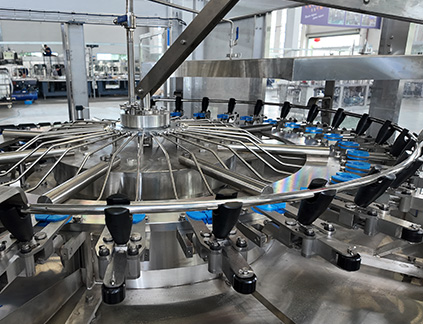
Recycled PET (PET) has moved from a sustainability nicety to a regulatory requirement. The EU's Packaging and Packaging Waste Regulation (PPWR) sets rising recycled-content minimums, and brands in Southeast Asia and for the African market are following voluntarily to access export channels. But PET is not mechanically identical to virgin PET, and bottlers often discover this only when the line starts jamming or the bottle leaks. This article explains what PET demands from your PET bottle filling line.
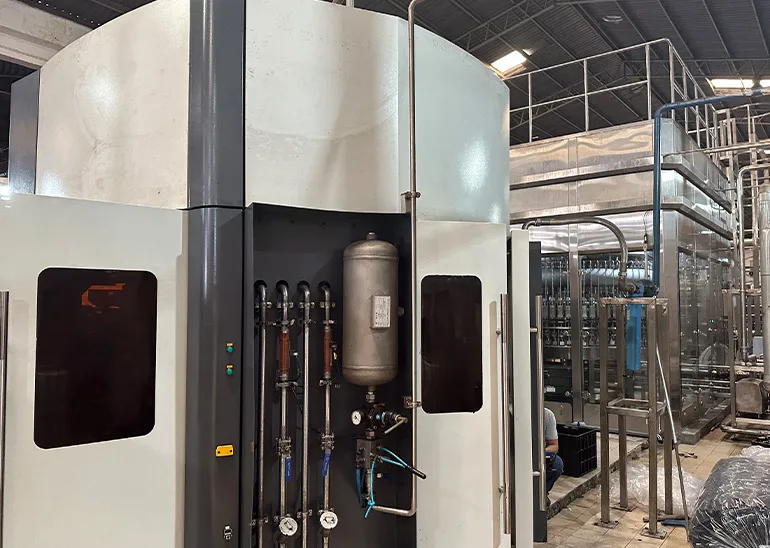
Lower top-load means bottles buckle under aggressive star-wheels and grippers. Specify neck-handling transfer (common on modern rotary fillers) and verify bottle design for PET content with your blow molder supplier.
Higher PET content may need adjusted preform heating profiles and slightly heavier base design to avoid paneling. Integrated blow-fill-cap reduces intermediate handling risk.
Softer bottles demand consistent capping torque—too high cracks the neck, too low leaks. Servo cappers with torque feedback reduce rejects.
PET raises the bar on pre-form/flake decontamination and on in-line inspection. Add vision inspection for color, gate, and closure defects.
PET pairs with lightweighting (thinner walls) to cut carbon footprint, but the two together stress the line further. Engineer for the combined worst case, not virgin-PET baseline.
When buying from China or elsewhere, ask the supplier to demonstrate filling on your target PET blend, not virgin PET. Request reject-rate data at FAT. Suppliers with export experience to regulated markets—such as Sunswell—understand these trade-offs.
A: Often yes with adjustments (neck-handling, capping torque, inspection), but validate reject rates on your actual blend before committing.
A: Only if decontamination (super-wash/SSP) is inadequate; proper processing removes off-notes.
A: Not generally, but export-oriented and multinational-led plants are adopting it; specifying PET-ready protects resale value.
Explore PET bottle filling solutions or ask about PET-ready lines.



 +86 13921964455
 [email protected]

A2 Dongjiu Industrial Park, 30 East Jintang Road, Tangshi, Zhangjiagang, Jiangsu 215600, China