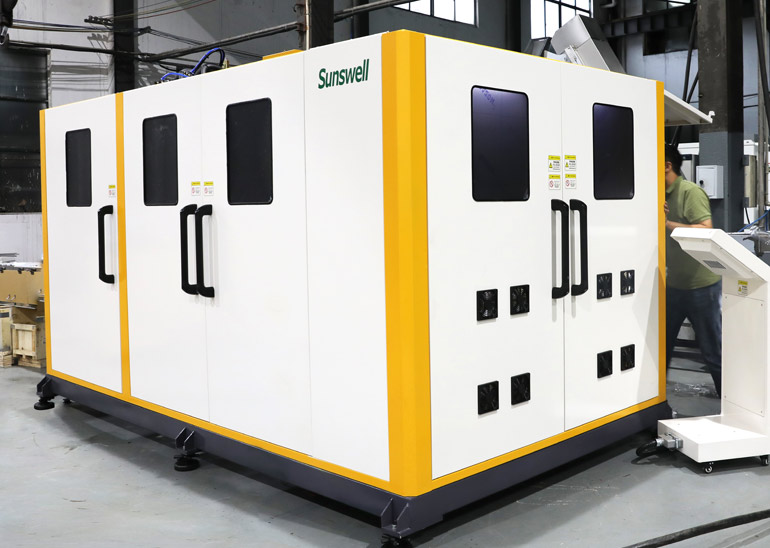
| Types | Linear and rotary blow moulding |
| Input | PET preform, heated in an oven before blowing |
| Output | Bottle matched to the filler neck and format |
| Key control | Preform temperature profile, mould cooling, stretch ratio |
| Integration | Stand-alone, or inside a combiblock |
| Key decision | Blow in-house or buy bottles |
Blowing in-house saves the bottle price and the transport of empty bottles, but adds preform purchasing, a mould per format, compressed air and a skilled operator. Below a certain annual volume the mould cost per format outweighs the saving, which is why small plants buy bottles and large plants blow.
A mould change is a mechanical operation: mould halves, bottom insert, stretch rod height, oven recipe and gripper settings. On a linear machine it is a scheduled stop measured in tens of minutes; on a rotary machine it is longer because there are more cavities to set.
| Machine | Output pattern | Format changes |
|---|---|---|
| Linear | Lower output, more formats | Frequent, shorter changeover |
| Rotary | High output, fewer formats | Longer changeover, more cavities |
| Two-stage on site | Preform bought in | Mould per format still required |
| Combiblock integrated | Linked to filler | Changeover stops the whole block |
Sizing for this duty runs through the Linear Blow Molding, where the valve count is set out.
Blowing needs high-pressure air, and producing it is the largest single energy cost in a PET line. Recovery of blowing air, correct nozzle sizing and leak maintenance on the high-pressure circuit are the three measures that move the number, and none of them is visible in a machine quotation.
For the same duty in another bottle format, the Rotary Blow Molding is specified separately.
Neck finish decides the filler and capper change parts. Body shape decides the star wheels and guide rails. Wall thickness decides whether the bottle survives the filler and the conveyor. A lightweighting project that changes the base is a filling line project as much as a bottle project.
The same question is worked through from another angle in How Blow Molding Supports Custom Bottle Branding.
Because the neck is the dimension that mates with the cap. It is shielded from the lamps and often cooled directly, so it stays below the point where the material would relax. A warm neck deforms under the capper and leaks.
One preform per bottle. The preform weight is the bottle weight, so preform lightweighting is the main material saving, and it changes the blowing recipe and often the mould.
Yes, with a mould set per format and an oven recipe per preform. Changeover time, not capability, is the limit, and it is why plants with many formats often keep a separate small machine.
Indirectly. Wall thickness distribution and base quality decide the bottle's mechanical strength and its barrier performance. A bottle that passes the drop test can still lose carbonation if the wall is thin at the base.
Usually a cold base or an uneven stretch. The base is the last area to reach blowing temperature, and a short oven or a fast cycle leaves it under-stretched.
It is a scheduled stop measured in tens of minutes on a linear machine and longer on a rotary machine, because every cavity is set. The oven recipe and the stretch rod height change with the mould.
Country:Kazakhstan
Product: PET Bottled Sparkling Water, Canned Soft Drink, Canned Tea
Capacity: 25000CPH (250ml)
Solution:Three Lines,7000BPH(1.5L), 15000CPH(330ml),15000CPH(450ml)



 +86 13921964455
 [email protected]

A2 Dongjiu Industrial Park, 30 East Jintang Road, Tangshi, Zhangjiagang, Jiangsu 215600, China