
| What is included | Filling, capping, labelling and packing equipment |
| Sizing basis | Demand in units per day, divided by productive hours and a production factor |
| Production factor | 0.65-0.85 depending on formats and changeovers |
| Key control | Fill accuracy, closure integrity, changeover time |
| Key decision | One flexible line or two dedicated lines |
| Acceptance | Output, accuracy, closure and changeover, measured |
Changeover, CIP, label roll changes and downstream stops. A line rated at 12,000 BPH and run with four formats and two changeovers per shift delivers closer to 8,000. The production factor is not a discount on the machine; it is what the plant actually gets.
When the formats are far apart, or when one product cannot tolerate the cleaning regime of the other. A single flexible line carries changeover cost every day; two dedicated lines carry capital cost once. The crossover is usually visible in the annual changeover hours.
| Decision | What it fixes | What it does not fix |
|---|---|---|
| Filling principle | Product and accuracy | Downstream capacity |
| Valve count | Rated BPH | Changeover and CIP time |
| Automation level | Labour per shift | Product quality |
| Line layout | Floor space and flow | Throughput of the slowest station |
For the same duty in another bottle format, the Gravity Filling Machine for Still Water is specified separately.
Rated output at the specified format, fill accuracy on a defined sample, closure torque or seam measurement, and a full changeover timed with the customer watching. Anything not measured at acceptance becomes a discussion after the money is paid.
The Volumetric Filling Machine for Still Water is the matching unit when this becomes a line project.
By the cost of the labour it replaces and the consistency it adds, not by the technology. A robot palletizer pays on three shifts with a stable pattern; it does not pay on one shift with five patterns. The same logic applies to inspection and packing.
The same question is worked through from another angle in Double-Head Sleeving Machine: Throughput and Film Control.
On the same five numbers: the slowest station rating, the changeover time, the CIP time, the consumable cost per 1,000 units, and the spare parts lead time. A quotation that does not state all five cannot be compared with one that does.
Bottles per day divided by productive hours, then divided by a production factor of 0.65-0.85. The factor covers changeover, cleaning and downstream stops. Sizing at 1.0 is the most common planning error.
A well-maintained stainless line runs for well over a decade, with wear parts replaced on condition. The variables are water quality, cleaning regime and whether spare parts are kept in stock.
Valve count, automation level, material of construction, whether blowing is included, and the packing format. Price follows the specification, so two quotes are only comparable when the specifications match.
Ask for the factory acceptance test procedure, a reference line running the same format, and the spare parts list with lead times. A supplier who cannot show a running line has not commissioned many.
Between 0.65 and 0.85. A single-format line on one shift sits near 0.85; a line with four formats and two changeovers per shift sits near 0.65.
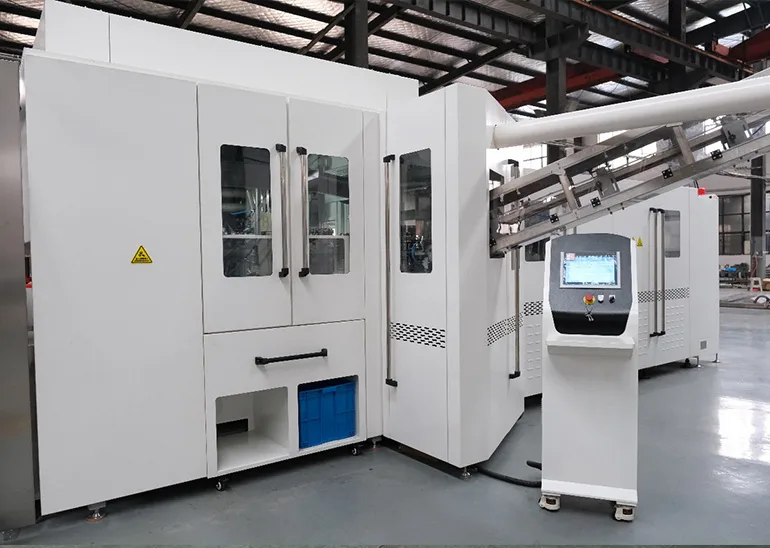
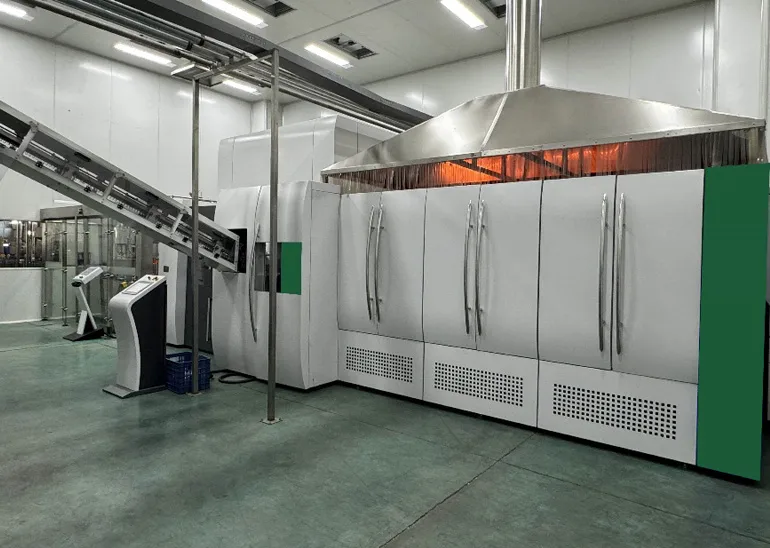
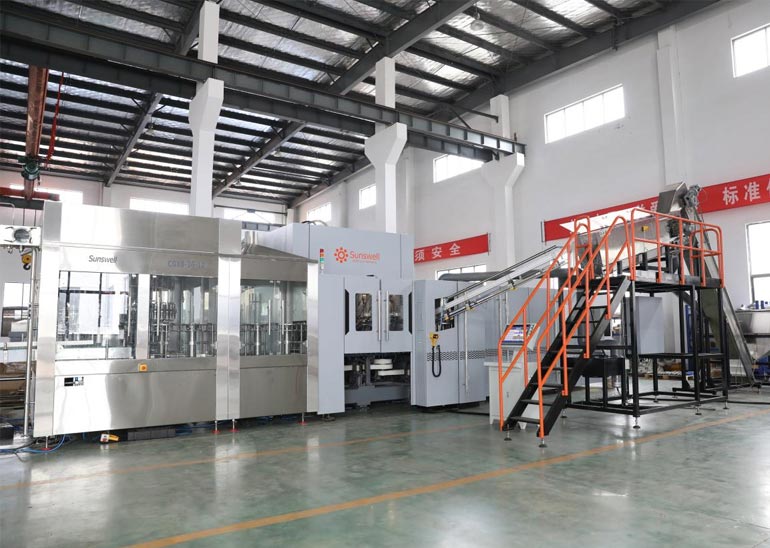
Country:Kazakhstan
Product: PET Bottled Sparkling Water, Canned Soft Drink, Canned Tea
Capacity: 25000CPH (250ml)
Solution:Three Lines,7000BPH(1.5L), 15000CPH(330ml),15000CPH(450ml)



 +86 13921964455
 [email protected]

A2 Dongjiu Industrial Park, 30 East Jintang Road, Tangshi, Zhangjiagang, Jiangsu 215600, China


