| Combines | Blow moulding, filling and capping in one block |
| Capacity range | 2,000-48,000 BPH |
| Bottle sizes | 0.2-16 L PET |
| Products | Still water, CSD, juice, tea, edible oil |
| Valves | Load cell, volumetric, mechanical or semi-electric |
| Operation | One operator for the complete block |
Four inputs fix the shortlist: the product, the package, the daily demand and the number of formats per week. Everything else, including the brand of the PLC, is a detail that can be settled after those four are written down.
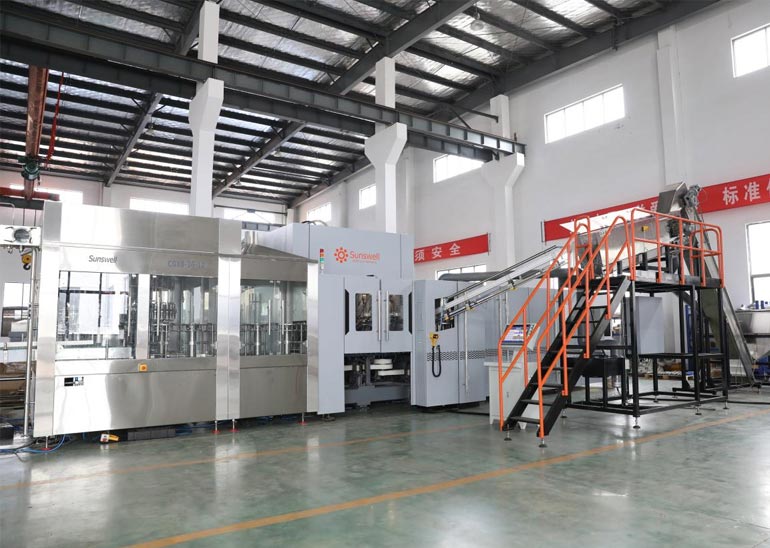
A combiblock joins blow moulding, filling and capping into one frame with one drive and one control system. The preform goes in at one end and the capped bottle comes out at the other, with no intermediate buffer and no bottle storage between blowing and filling.
| Configuration | What is inside | Typical use |
|---|---|---|
| 3-in-1 monoblock | Rinse, fill, cap | Still water in bought bottles |
| Combiblock | Blow, fill, cap | PET lines with in-house blowing |
| Combiblock + labeller | Blow, fill, cap, label | Single-footprint PET line |
| Combiblock + packer | Blow to case | High-volume single-format plant |
The specification sheet for the Blow-fill-cap Combibloc for CSD & Sparkling Water carries the utility figures quoted here.
Consistent dimensions, a stable colour and a controlled moisture level. A preform that varies in neck dimension stops the filler; one that varies in temperature response changes the bottle. The block cannot compensate for an inconsistent input.
Valve count, utility schedule and footprint sit on the Blow-fill-cap Combibloc for Still Water page.
Oven lamp checks, mould cooling water quality and gripper alignment. The oven is the item that drifts quietly: a failing lamp changes the temperature profile and the bottle wall without stopping the machine.
The same question is worked through from another angle in How to Maintain Rotary Blowing Filling Capping Machine.
A monoblock combines rinsing, filling and capping. A combiblock adds blow moulding, so the preform goes in and the capped bottle comes out. The two terms are often confused, and the difference is whether a blow moulder is inside the block.
With change parts for the mould, the star wheels and the filling recipe, yes. The changeover is longer than on a filler alone because the mould set changes, and the production factor for a two-format week is lower than for a single format.
The blower and the filler are mechanically linked, so bottles move directly from the mould to the filler. Removing the buffer saves space and dust exposure, but it also removes the cushion that absorbs short stops.
With a mould set and a recipe per format, yes. The changeover includes the mould, so it is longer than a filler-only change and is normally scheduled between campaigns rather than inside a shift.
Country: Kazakhstan
Product: PET Bottled Carbonated Soft Drinks
Capacity: 12000BPH (1L)
Solution:Carbonated Drinks Production Line
Country: Maldives
Product: PET Bottled Mineralized Water
Capacity: 24,000BPH (500ml); 2 Lines
Solution:Water Production Line



 +86 13921964455
 [email protected]

A2 Dongjiu Industrial Park, 30 East Jintang Road, Tangshi, Zhangjiagang, Jiangsu 215600, China