


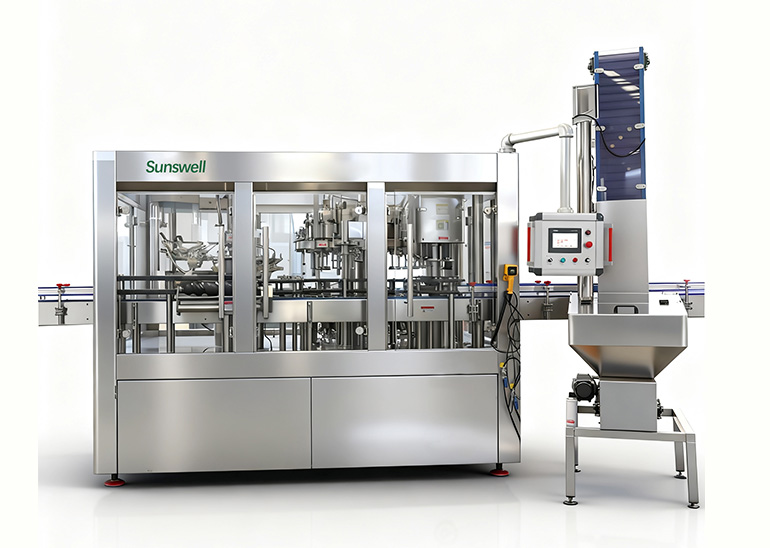
Production line · RTD tea
Ready-to-drink Tea Production Line — Complete Process and Equipment List
Tea is a deceptively simple drink with unforgiving chemistry: it hazes, it oxidises, and its flavour is built from volatiles that vanish when the process is careless. This page walks the RTD tea line — extraction, batching, heat treatment, hot-fill, cooling and packing — and points out where tea lines differ from juice lines.
444+
Lines delivered
71+
Countries exported
18,000
BPH juice/tea hot-fill scale
80+
Staff
20,000
m² workshop
Short answer: The RTD tea line runs: leaf or concentrate → extraction → batching with sweetener and flavours → deaeration → heat treatment → hot-fill into a heat-rated bottle → capping → cool-down → labelling and packing. The tea-specific risks are haze (polyphenols), oxidation and flavour loss — so extraction control, deaeration and a short, well-controlled hot path matter more than in a juice line. Glass and heat-rated PET are the mainstream packages.
🎯 Key takeaways
- Tea hazes when polyphenols complex with metals or oxygen — deaeration and clean water are non-negotiable.
- Extraction control sets the flavour: time and temperature are the recipe, not the leaf alone.
- Hot-fill into a heat-rated bottle is the mainstream route; the bottle spec is part of the line.
- A short, controlled hot path protects the volatile tea flavour.
- Glass or heat-rated PET — decide the package before the filler is specified.
On this page
1. The complete process
The line: tea leaf or concentrate → extraction → batching with sweetener, flavours and acid → deaeration → heat treatment → hot-fill → capping → cool-down → labelling → packing. The process mirrors a juice line, but the tea-specific stations — extraction and the anti-haze treatment — decide whether the drink looks and tastes right.
For producers who start from concentrate or a tea base, extraction is skipped and the line begins at batching. Either way, the water quality, deaeration and hot path are the parts that separate a clear, stable tea from a hazy, dull one.
2. Extraction and batching
Extraction is where the tea flavour is made: leaf, water, time and temperature are the recipe. Over-extraction brings bitterness and haze; under-extraction gives a weak brew. Commercial lines control extraction with fixed time-temperature profiles rather than by taste, so the same cup comes out every batch.
Batching then blends the extract with sweetener, flavour and acid to the final recipe, and the tank farm and CIP path are sized on the recipe changeover schedule — tea residue is stubborn, and a clean line between flavours matters.
3. The haze problem
Tea forms haze when polyphenols complex with oxygen, metals or proteins. The practical controls are deaeration (remove the oxygen), clean stainless and water chemistry (no iron or excess hardness), and a defined clarification step where the recipe needs it. A hazy tea is not a safety issue — it is a brand issue, and it is almost always preventable at the design stage.
State the target appearance — clear tea vs cloudy 'milk-tea style' — in the spec. The clarification and homogenising decisions depend on it.
Cloudy milk-tea products follow a different path (with homogenising); clear teas follow a tight filtration and deaeration path. The spec decides the machine.
4. Heat treatment and hot-fill
Heat treatment reduces the microbial load, and hot-fill preserves by temperature: the product fills hot into a heat-rated bottle, the bottle is capped, and the heat held in the sealed package completes the preservation. For tea, the hot path should be short and controlled, because prolonged heat degrades the delicate flavour volatiles.
The filler for hot-fill tea is a hot-product valve set with a heat-rated product path — the same family as hot-fill juice, which is why tea and juice often share a line in practice.
5. Glass vs heat-rated PET
Glass is the prestige package for RTD tea: it takes the hot fill without compromise and carries the brand weight. Heat-rated PET is lighter and cheaper, with the vacuum-panel design that hot-fill demands. Both work; the choice drives the filler, the capper and the cooling section.
Decide the package before the filler is specified. A filler built around PET necks differs from one built around glass finishes, and changing later means re-engineering the infeed and capper.
6. Cooling and packing
After capping, the bottle cools in a controlled tunnel or ambient flow. For tea, cooling speed matters twice: thermally, to avoid bottle distortion from vacuum stress, and organoleptically, to stop flavour degradation. The labeller and packer then finish the bottle — shrink or carton for PET, labels for glass.
The cooling tunnel is the rate-setter after the filler, and the line is balanced on the cooled bottle. Undersize it and the filler starves.
7. Equipment list and scale
| Station | 6,000–12,000 BPH | 12,000–18,000 BPH |
|---|---|---|
| Extraction | Batch extractor (leaf) or base dosing | Automated extraction + CIP |
| Batching | Tank farm, manual control | Automated batching + inline dosing |
| Deaeration | Compact deaerator | Full deaeration + clarification |
| Heat treatment | Plate heat exchanger | PHE + hot-fill loop |
| Filler | Hot-fill mechanical valve | Hot-fill volumetric valve |
| Cooling | Cooling tunnel | Tunnel + ambient flow |
RTD tea shares most of its downstream with juice filling machines and glass bottle filling machines — the tea-specific investment is the front end, and it is worth getting right.
Frequently asked questions
Why does tea go hazy in the bottle?
Polyphenols complex with oxygen, metals or proteins and form haze. Deaeration, clean water chemistry and the right clarification step prevent most of it.
Can tea and juice run on the same line?
Yes, in practice — both hot-fill into heat-rated bottles and share the downstream. The front end (extraction vs batching) differs and the CIP path must handle both.
Glass or PET for RTD tea?
Glass is heat-tolerant and carries the brand; heat-rated PET is lighter and cheaper with vacuum panels. Decide before the filler is specified.
Is hot-fill enough for tea preservation?
For mainstream high-acid tea drinks, yes — the heat held in the sealed bottle completes the preservation without preservatives.
Does tea need a homogeniser?
Only for cloudy milk-tea style products. Clear teas need filtration and tight deaeration instead.
Can Sunswell deliver an RTD tea line?
Yes — Sunswell supplies hot-fill machines for juice and tea in PET and glass, with the extraction and batching front end specified per product. Send the recipe and bottle drawing for a spec.
About the author
Written by the Sunswell engineering team — led by Howie SUN, Founder & CEO, with 14 years in filling and blow-moulding equipment R&D and turnkey project delivery across 71+ countries.
Last reviewed: 2026-08-28 · Reviewed by Sunswell engineering team
Ask our engineering team →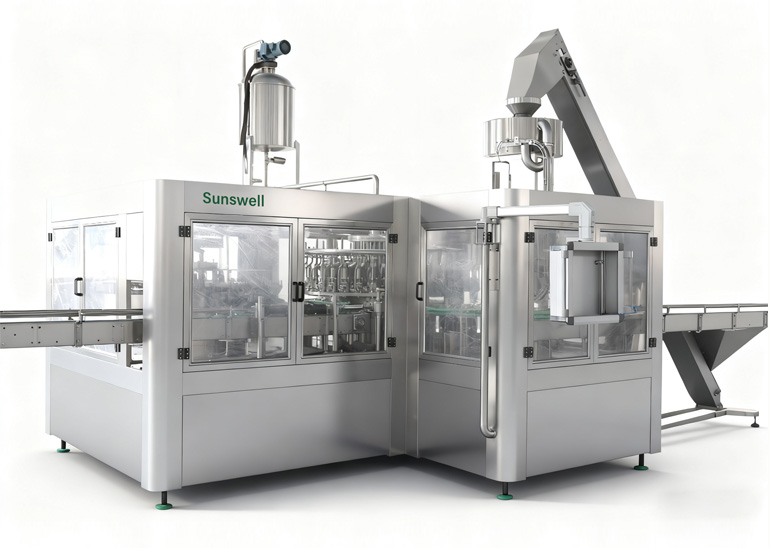
Have a specific project in mind?
Tell us product, target BPH, bottle sizes and market. We reply with a draft layout, equipment list and lead time estimate.
Fill the inquiry form ↑