


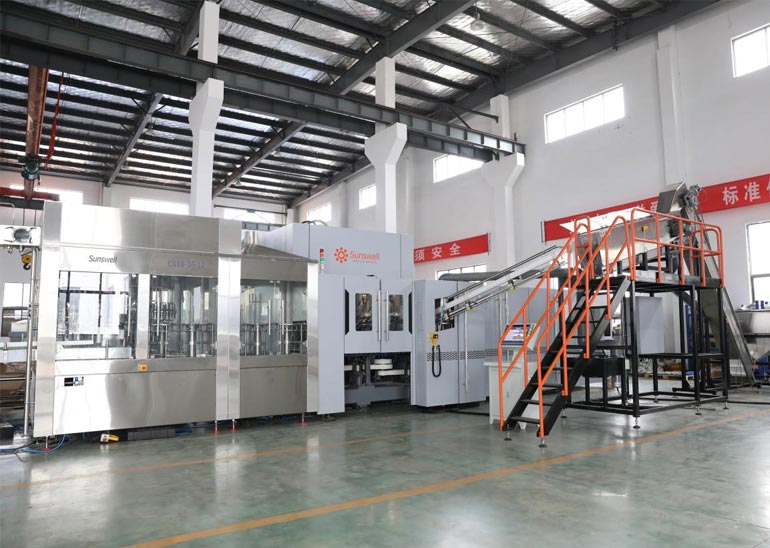
FAQ · PET Blow Moulding
PET Blow Moulding — Frequently Asked Questions
Selection, technical, installation, certification and commercial questions, answered with parameters for blow moulding.
2,000–48,000
BPH blow
0.2–15
L bottle range
444+
Lines delivered
71+
Countries exported
9+
Countries with service
Short answer: A PET blow moulding machine heats a preform and blows it into a bottle inside a mould, so selection turns on preform and bottle geometry, cavity count and output. Linear blowers suit lower, flexible volume; rotary suits high steady output, with the crossover around 12,000–18,000 BPH on standard formats. Small and large formats are different families. Above roughly 12,000 BPH a blow-fill-cap block normally wins on weight, floor and operators; below that, a separate blower is the better purchase. This page answers the questions buyers ask most, grouped by subject.
🎯 Key takeaways
- Blowing starts from a preform, not a bottle
- Linear for flexible volume; rotary above ~12–18k BPH
- Small 0.2–2 L and large 3–15 L are different families
- Block wins above ~12,000 BPH; separate blower below or if you sell empties
- Scope-normalise quotations — oven control, neck cooling and moulds are common exclusions
- Ask three questions in writing: sustained output on your bottle, exclusions, changeover time
On this page
1. Selection questions
The questions buyers ask before a specification exists. The full selection logic is in the PET blow moulding selection guide.
What output should I size a blower for?
On the volume you can sell within roughly two years, not the market you hope to hold in ten. A regional start-up is usually served by 4,000–12,000 BPH. Idle cavity capacity still carries installed power, footprint and a larger spare part inventory. Plan the building for a second line rather than over-sizing the first.
Can one machine run water, CSD and juice bottles?
Across the same blower only if the bottle shapes are compatible. The blower makes the bottle; the filler downstream decides the product. A blower specified for a standard 0.2–2 L round bottle runs any of those products once filled, but a non-round or large bottle is a different mould and often a different machine family.
Do I need a combiblock for blowing?
Only above its economic speed. A blow-fill-cap block blows PET from a preform and only applies to PET, integrating blowing and filling. Below roughly 12,000 BPH, or where you sell empty bottles, a separate blower plus filler is the better purchase. See the selection guide for the crossover.
What information does a supplier need to quote?
- Target output at a named bottle size
- Every bottle format you intend to run, including later ones
- Bottle and preform drawings, or samples
- Neck finish and base design
- Whether the blower feeds a filler, a combiblock or sells empty bottles
- Site conditions: power, high-pressure air, building dimensions and door openings
2. Technical questions
Which blower type is right for my volume?
Linear for flexible, lower volume; rotary for high steady output. The crossover is roughly 12,000–18,000 BPH on standard 0.2–2 L formats. A multi-SKU plant may prefer linear for changeover even at higher volume, because rotary changeovers are more involved.
Why does bottle size change the rate?
Two reasons. The mould needs longer to cool a larger bottle before ejection, and the blowing cycle takes longer for more air volume. Neither is a machine limitation another supplier removes; they are properties of the process. A line rated at a small format will not hold that rate on a large one.
What does the preform oven do?
It heats the preform to the temperature where PET stretches and orients correctly. Oven lamp count and control set heating uniformity, which sets wall thickness and bottle strength. Preform design and oven settings are specified together, not independently.
What causes bottle defects?
| Symptom | Most common cause | Check first |
|---|---|---|
| Thick uneven walls | Oven heat uneven | Lamp and preform heating profile |
| Weak bottle | Poor stretch / orientation | Stretch rod and preform design |
| Neck out of spec | Neck cooling inadequate | Neck cooling and handling |
| Base fault | Base design or cooling | Base geometry and mould |
| Slow drift | Oven lamp aging | Lamp life and calibration |
3. Installation and commissioning questions
What does the building need?
- Level floor with load capacity and any foundation work done
- Power at correct voltage and frequency, stable to the machine
- High-pressure air generation and drying sized for blowing
- Treated air at the machine tie-in, not just at the compressor
- Drainage, ventilation and lighting in the production area
- Access route for machine sections, including door widths and lift capacity
How long does commissioning take?
In phases: mechanical installation, utility connection, dry run, bottle run and speed ramp, then training. Blow moulding has no foaming or hot-fill temperature step, so it commissions relatively cleanly — delays are usually site readiness, not the machine.
What is checked at the factory acceptance test?
Mechanical operation, controls, safety interlocks, output at rated speed and bottle quality on your own preforms and moulds. Send real preforms and the actual mould in production quantity; testing on generic items then finding yours differ defeats the purpose. Agree the acceptance criteria in writing first.
4. Certification and compliance questions
What certification does Sunswell hold?
ISO 9001 and CE certification, with SGS audit. Equipment is built in a 20,000 m² facility and 444+ lines have been delivered to 71+ countries. These are company and equipment credentials; market-entry approval for your destination is a separate process with your importer.
Who handles destination-market certification?
Handled with your importer, because the scheme depends on the destination and on who is the responsible importer. Sunswell supplies the technical documentation, drawings and declarations. Start it early — certification runs in parallel with manufacturing.
What food-contact documentation is available?
Material specifications for product-contact parts, including stainless steel grades and elastomer types, supplied with the machine documentation. For the bottle itself, the PET grade and any barrier layer are specified with your preform supplier; state the destination market at quotation if a specific standard applies.
5. Commercial questions
How much does a blow moulding line cost?
Price scales with output, cavity count, type (linear or rotary) and whether it is a standalone or a combiblock, then with oven control, neck cooling and downstream scope. Figures without a defined scope mislead. Send bottle drawings, format mix and target output and request a written quotation against a stated scope. Tiers are compared in PET blow moulding configurations compared.
What is usually missing from a cheap quotation?
Oven control, neck cooling, moulds for your formats, format parts for additional sizes, installation, commissioning, training and a commissioning spare part set. Build one scope list, send it to every supplier and require line-by-line answers including exclusions.
What are the main running costs?
High-pressure air for blowing is the largest single utility item, then oven power, labour, consumables such as preforms and caps, and spare and wear parts including moulds and oven lamps. Preform cost is the dominant material cost and the main lever on bottle economics.
What after-sales support is available?
Sunswell runs local service in 9+ countries and supports installations across 71+ export markets with remote diagnostics, spare parts and engineer visits. Agree response expectations and the spare part list in the contract rather than after the first breakdown.
Three questions that prevent most disputes. Ask every supplier, in writing: what is the sustained output on my bottle; what is excluded from this quotation; and what is the changeover time between my two most common formats. Those three separate comparable quotations from ones that only look comparable.
6. Related resources
Longer treatments of the subjects above:
- PET blow moulding selection guide — output, format and architecture
- PET blow moulding configurations compared — economy, mainstream and high-speed tiers with TCO
- Combiblock vs separate line — the architecture decision
- Blow moulding machines — the full range
- Combiblock capacity selection — capacity bands across products
The block family is in the combiblock range, and complete lines are scoped in the water production line solution.
Frequently asked questions
What does a blow moulding machine actually do?
It heats a PET preform in an oven until the PET is stretchable, then blows it into a bottle shape inside a mould using high-pressure air. The preform is the starting point, not a finished bottle, so the machine makes the bottle rather than filling one.
Linear or rotary — which do I need?
Linear for lower, flexible volume; rotary for high, steady output. The crossover is roughly 12,000–18,000 BPH on standard 0.2–2 L formats. A plant with many SKUs often prefers linear for changeover even where rotary would reach the rate.
How many cavities do I need?
About 1,500–2,200 bottles per cavity-hour at 0.5 L depending on the machine and bottle, so a 24,000 BPH line needs roughly 12–16 cavities at that size. Use this to sanity-check a quotation, not to specify from, and confirm on your bottle drawing.
Can one blower run 0.5 L and 5 L bottles?
No. Small format 0.2–2 L and large format 3–15 L are separate machine families. Mould size, clamping force, neck handling and cooling all differ, and a 15 L bottle cannot be carried by its neck when full. Plants selling both buy two blowers.
Should the blower be separate or in a combiblock?
Above roughly 12,000 BPH on standard formats a blow-fill-cap block normally wins on bottle weight, floor area and operators. Below about 8,000 BPH, on large formats, or where you sell empty bottles, a separate blower plus filler is the better purchase. See combiblock vs separate line for the full comparison.
How light can a bottle be?
Lighter inside a block than on a line with an air conveyor, because a neck-handled bottle never rides on its base and does not need the stiffness margin conveyor travel demands. The achievable weight is set with the preform supplier and mould designer against bottle height, neck finish and top load. Any figure quoted before the drawing is reviewed is a guess.
What spare parts should be held for a blower?
Moulds and mould components, seals, oven lamps and a commissioning set of wear items. Moulds are the largest single spare, so hold the moulds for your running formats and identify long-lead items at handover.
Is training included with a blow moulder?
Operator and maintenance training is delivered during commissioning and should be written into the contract with defined duration and scope. It covers running, mould change, oven setting, calibration and first-line fault diagnosis, in the languages your team uses.
About the author
Written by the Sunswell engineering team — led by Howie SUN, Founder & CEO, with 14 years in filling and blow-moulding equipment R&D and turnkey project delivery across 71+ countries.
Last reviewed: 2026-08-10 · Reviewed by Sunswell engineering team
Ask our engineering team →Recommend Products
Project references
-

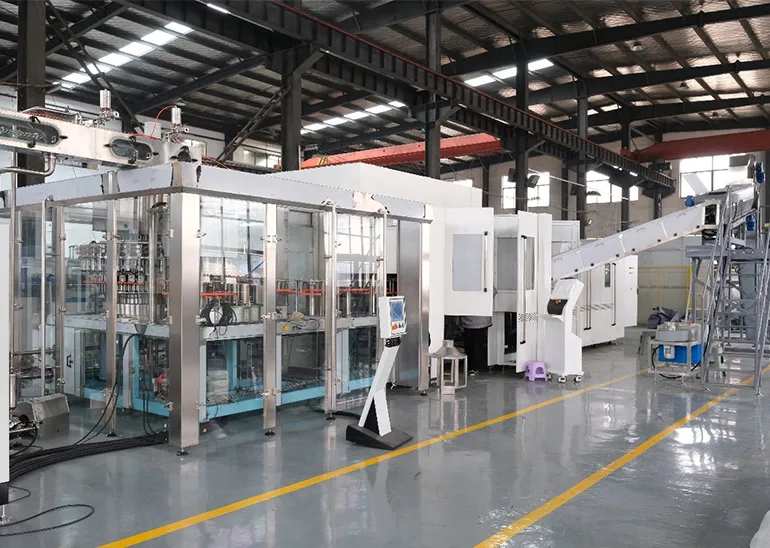
Vizit, 12,000BPH 1L Bottling Line with Combiblock for CSD, Kazakhstan
Country: Kazakhstan
Product: PET Bottled Carbonated Soft Drinks
Capacity: 12000BPH (1L)
Solution:Carbonated Drinks Production Line
Read More + -
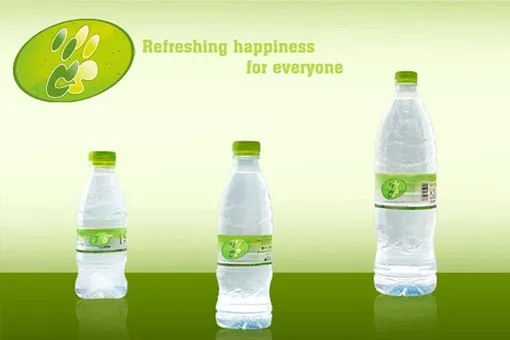
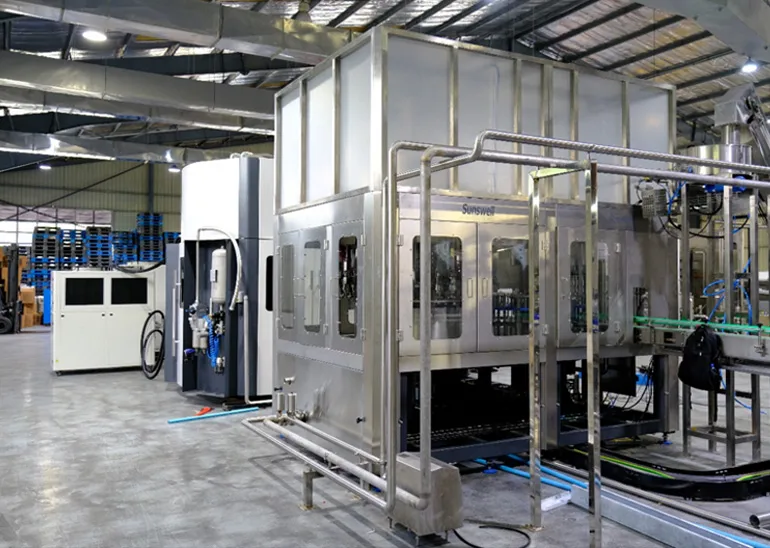
Taza, 4 Sets of 12,000BPH 1.5L Bottling Lines with Combiblock for Water, Maldives
Country: Maldives
Product: PET Bottled Mineralized Water
Capacity: 24,000BPH (500ml); 2 Lines
Solution:Water Production Line
Read More + -
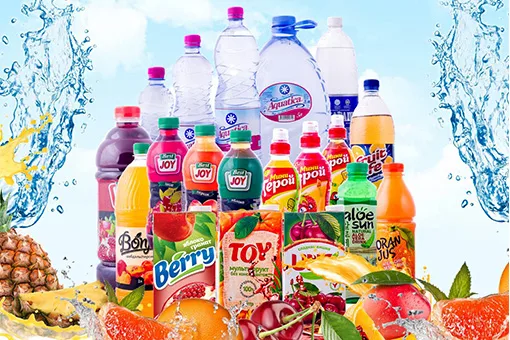
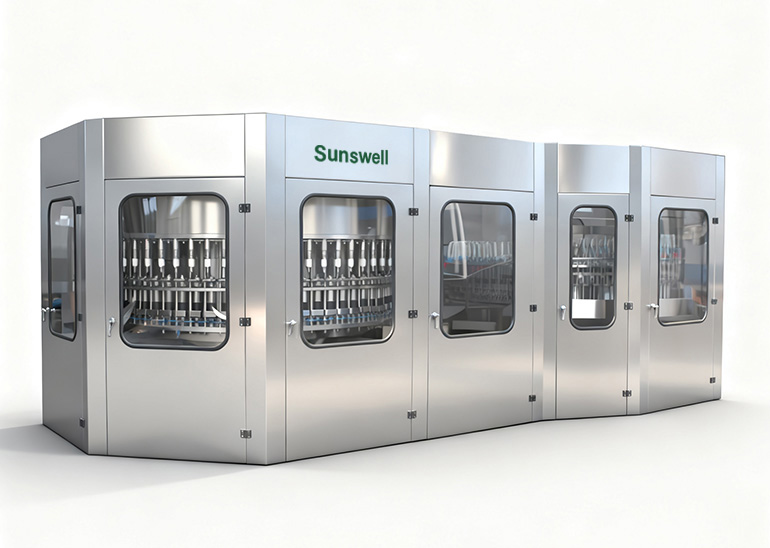
Rauan, 8 Sets of Bottlingand Canning Lines from 12,000-24,000BPH for Water, CSD and Juice, Kazakhstan
Country:Kazakhstan
Product: PET Bottled Sparkling Water, Canned Soft Drink, Canned Tea
Capacity: 25000CPH (250ml)
Solution:Three Lines,7000BPH(1.5L), 15000CPH(330ml),15000CPH(450ml)
Read More +
Have a specific project in mind?
Tell us product, target BPH, bottle sizes and market. We reply with a draft layout, equipment list and lead time estimate.
Fill the inquiry form ↑