


Company · Manufacturing
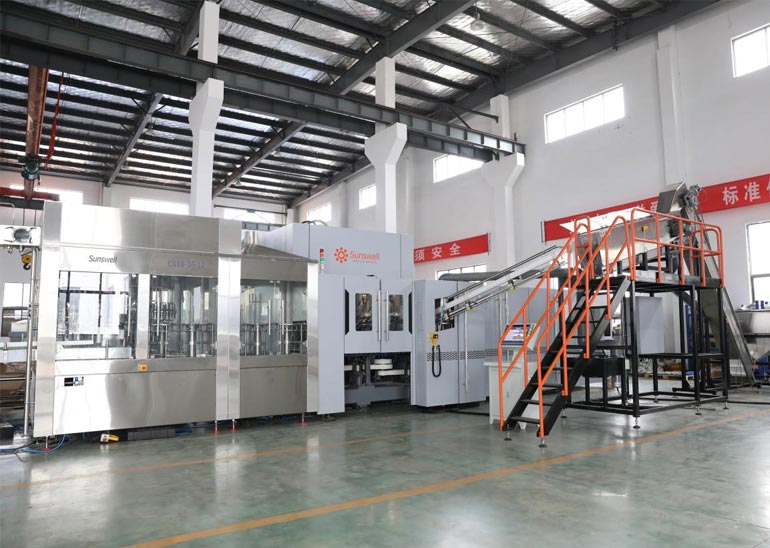
Manufacturing Capability — 20,000 m² Facility, In-house Machining and Assembly
What is made in house, what is bought in, and how an order moves from drawing to crate.
20,000 m²
Manufacturing facility
444+
Lines delivered
71+
Countries exported
80+
Staff · in-house R&D
ISO/CE
Certified · SGS audited
Short answer: Sunswell manufactures beverage filling equipment in a 20,000 m² plant in Zhangjiagang, Jiangsu. Frames, carousels, filling valves, capping turrets and format parts are machined and assembled in house; PLCs, servo drives, pneumatics and bearings are bought from named brands fixed in the contract. Lead time is 45–75 days for a single machine and 90–120 days for a turnkey line.
🎯 Key takeaways
- 20,000 m² plant in Zhangjiagang — machining, assembly, electrical build and test bay under one roof
- Filling valves, carousels and format parts are made in house, so worn parts can be remade from the original drawing
- PLC, servo, pneumatics and bearings are named-brand bought-in — specified in the technical annex before you sign
- Lead time 45–75 days single machine / 90–120 days turnkey line, set by long-lead items not assembly
- Four QC checkpoints: incoming material, in-process machining, sub-assembly test, FAT
- 444+ lines to 71+ countries, with multi-line orders staged for sequential commissioning
On this page
1. The plant in numbers
Sunswell manufactures in Zhangjiagang, Jiangsu — a city on the Yangtze about two hours from Shanghai that has become the centre of China's beverage machinery industry. The facility covers 20,000 m² and is organised as a single flow from raw stock to the test bay.
| Area | Function | What it means for your order |
|---|---|---|
| Machining shop | CNC turning, milling, drilling of frames, carousels, star wheels | Format parts and change parts are made in house, so replacements match the original |
| Stainless fabrication | SUS 304/316 tanks, guards, product-contact parts | Weld quality and surface finish are controlled, not subcontracted |
| Sub-assembly | Filling valves, capping heads, blow moulding stations | Valves are assembled and leak-tested as units before they reach the main line |
| Main assembly | Machine build, alignment, mechanical timing | Your machine occupies a defined bay with a defined team |
| Electrical build | Cabinet wiring, PLC programming, HMI configuration | Programmes are written and tested here, not on your factory floor |
| Test bay | Water run, speed test, Factory Acceptance Test | The line runs before it is crated — this is where problems get found |
2. What is made in house and what is bought in
No machinery builder makes everything. The honest question is which parts are made in house, because those are the parts that define machine behaviour and spare-part availability five years from now.
2.1 Made in house
- Base frames and machine bodies — welded, stress-relieved and machined flat
- Filling carousels, star wheels, guide rails and neck-handling grippers
- Filling valves in all four types: load cell, volumetric, mechanical, semi-electric
- Capping turrets and torque heads
- Blow moulding clamp stations and stretch-rod assemblies
- Format and change parts for every bottle size you run
2.2 Bought from named suppliers
- PLC, HMI, servo drives and VFDs
- Pneumatic valves, cylinders and air preparation units
- Bearings, linear guides and gearboxes
- Sensors, safety relays and electrical protection devices
- Blow moulds — made by specialist mould shops to bottle drawings
Why the split matters. In-house parts mean a worn star wheel can be remade from the original drawing. Bought-in parts mean you can source a replacement sensor locally at 3 a.m. without waiting for a container. A builder who machines nothing has no drawings; one who buys nothing standard leaves you dependent for every small failure. The useful position is in the middle, and it should be visible in the technical annex before you sign.
3. From order to crate
- Technical clarification (1–2 weeks). Bottle drawings, preform data, product properties, target output, utilities, market and certification requirements are fixed in writing.
- Design and drawings (2–3 weeks). Layout drawing, utility schedule and machine general arrangement go out for buyer approval. Nothing is cut before approval.
- Procurement (runs in parallel). Long-lead items — servo drives, moulds, specialty stainless — are ordered first, because they set the schedule.
- Machining and fabrication (3–5 weeks). Frames, carousels and format parts are cut, welded and machined.
- Assembly and wiring (3–4 weeks). Mechanical build, cabinet wiring, PLC programme load.
- Water run and FAT (1–2 weeks). The line runs on water at rated speed. The buyer or a third-party inspector attends or reviews video and data.
- Disassembly, marine packing, loading. Modules are wrapped, crated with desiccant and loaded with a photographic record.
4. Quality control built into the sequence
Inspection is not a final gate. It sits at four points where a defect is still cheap to fix:
| Checkpoint | What is verified | Record |
|---|---|---|
| Incoming material | Stainless grade certificates, component brand and model | Material certificate file |
| In-process machining | Critical dimensions and surface finish on carousels and valves | Dimensional inspection sheet |
| Sub-assembly test | Valve leak test, capping torque calibration | Test record per unit |
| Factory Acceptance Test | Speed, fill accuracy, reject logic, safety circuits | Signed FAT report with data |
The FAT report travels with the machine and becomes the baseline for site acceptance. If output at the customer's plant differs from the FAT figure, the gap is a utility or material variable, and having the factory data makes that argument short. Full detail is in the quality control and FAT process page.
5. What the plant can produce
Output capacity matters to a buyer for one reason: whether your line gets built on time when the factory is busy. Sunswell has delivered 444+ lines to 71+ countries, with concurrent build capacity for multiple turnkey projects. Multi-line orders — the eight lines supplied to a single Kazakhstan group, for example — are staged so commissioning is sequential rather than simultaneous, which is what the customer's own team can actually absorb.
Ask for the build slot in writing. A delivery time quoted without a production slot is an estimate. A delivery time tied to a named slot, with the long-lead purchase orders already placed, is a commitment. The difference shows up in month three, not month one.
Frequently asked questions
How big is the Sunswell factory?
20,000 m² of manufacturing space in Zhangjiagang, Jiangsu Province, covering machining, sub-assembly, main assembly, electrical build and a test bay where lines are run before shipment.
Do you build the machines yourselves or assemble bought-in units?
Frames, carousels, star wheels, filling valves and format parts are machined and assembled in house. Servo drives, PLCs, pneumatics and bearings are bought from named brands — specified in the contract so you know exactly what arrives.
Which brands do you use for electrical components?
Buyers normally specify a preference and we quote against it. The component brand list is fixed in the technical annex before the order, because it drives both price and local spare-part availability in your market.
Can I visit the factory before ordering?
Yes, and we encourage it. Visits are arranged in Zhangjiagang, roughly two hours from Shanghai. If travel is not possible, a live video walk-through of your machine on the assembly floor is the practical substitute.
Can you customise a line to my bottle and product?
That is the normal case. Bottle drawings, preform data, product viscosity, temperature and target output define the configuration. Fully standard off-the-shelf lines are rare in this industry — every plant has different bottles.
How long does manufacturing take?
A single machine is typically 45–75 days. A turnkey line with blowing, filling, labelling, packing and conveyors is typically 90–120 days, driven by the longest-lead item rather than by assembly time.
How many engineers work on design?
Sunswell employs 80+ staff with an in-house R&D and mechanical design group. Design, machining, assembly and commissioning sit in the same building, which is why a change requested during assembly can be executed in days rather than weeks.
About the author
Written by the Sunswell engineering team — led by Howie SUN, Founder & CEO, with 14 years in filling and blow-moulding equipment R&D and turnkey project delivery across 71+ countries.
Last reviewed: 2026-08-26 · Reviewed by Sunswell engineering team
Ask our engineering team →Recommend Products
Project references
-
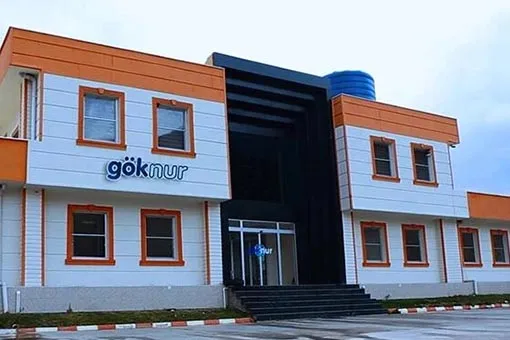
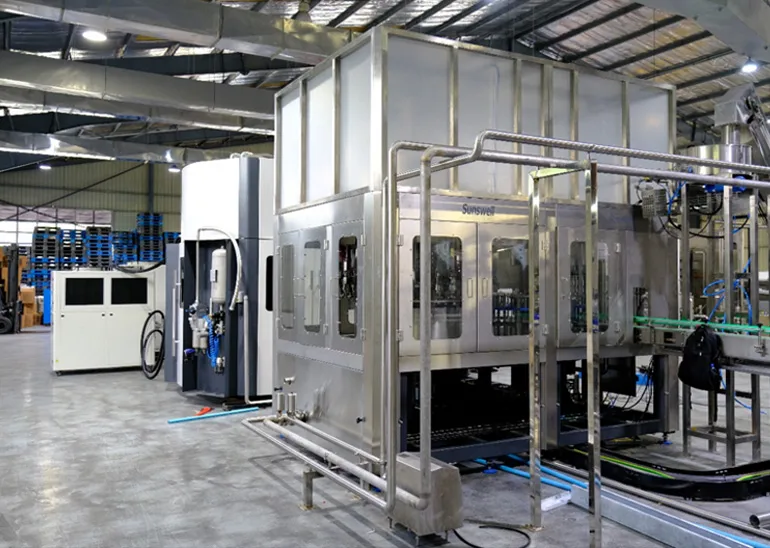
Goknur, 2 Sets of 18,000BPH Bottling Lines for Juice, Turkey
Country: Turkey
Product: Glass and PET Bottled Juice
Capacity: 20000BPH(330ml) Glass Bottle; 4000BPH(3L) PET Bottle
Solution:Juice Production Line
Read More + -
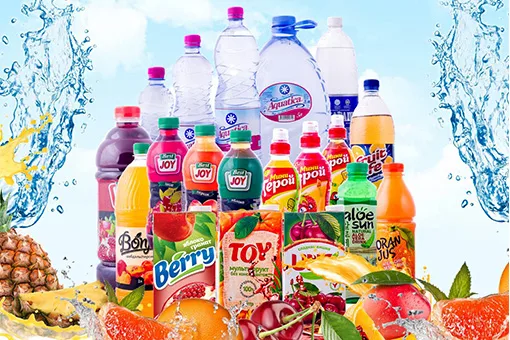
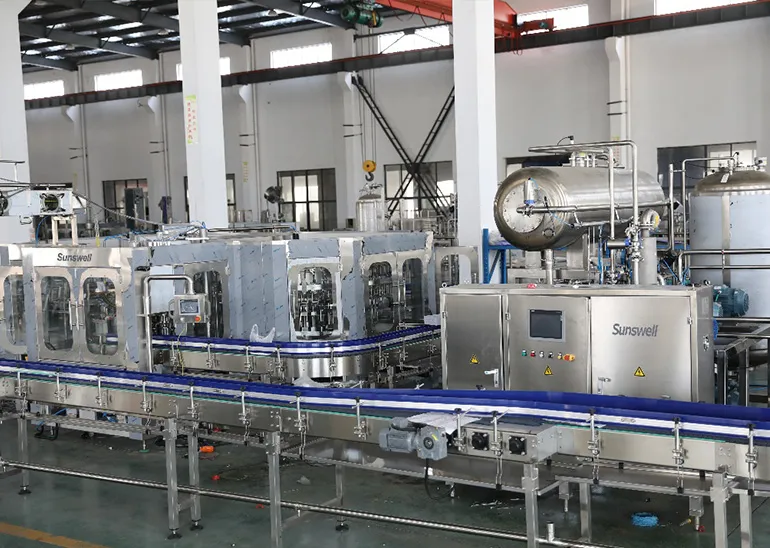
Rauan, 8 Sets of Bottlingand Canning Lines from 12,000-24,000BPH for Water, CSD and Juice, Kazakhstan
Country:Kazakhstan
Product: PET Bottled Sparkling Water, Canned Soft Drink, Canned Tea
Capacity: 25000CPH (250ml)
Solution:Three Lines,7000BPH(1.5L), 15000CPH(330ml),15000CPH(450ml)
Read More +
Have a specific project in mind?
Tell us product, target BPH, bottle sizes and market. We reply with a draft layout, equipment list and lead time estimate.
Fill the inquiry form ↑