


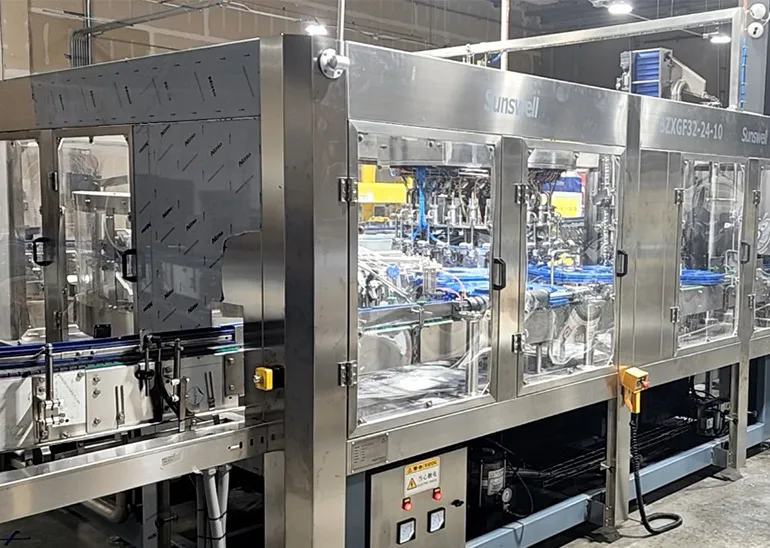
Production line · Daily chemical
Daily Chemical & Home Care Production Line
Detergents, shampoos and cleaners are the products that fill like water but behave like neither: they foam, they vary in viscosity and they corrode ordinary seals. This page walks the home-care line — and the material and handling choices that make it survive.
444+
Lines delivered
71+
Countries exported
20,000
m² workshop
80+
Staff
2011
Sunswell founded
Short answer: The home-care line runs: batching → filling (gravity, piston or load cell, per viscosity) → capping → labelling → packing. The specialisms are chemical-resistant materials (seals and wetted parts rated for aggressive products), foam control at the valve, and viscosity-matched dosing. The line is a filling line like any other — the materials and the product path are the difference.
🎯 Key takeaways
- Chemical resistance decides the wetted parts — seals and valves must be rated for the product.
- Foaming products need foam-control filling — the valve and the speed are specified for it.
- Viscosity spans water-thin to paste — the filler is matched to the product family.
- Trigger and dispensing closures need a capper built for them.
- Batching accuracy and changeover matter — most plants run many SKUs on one line.
On this page
1. The complete process
The line: batching and storage → filling → capping → labelling → packing → palletising. No heat treatment, no gas — the process is short. The engineering is in the materials (chemical resistance), the valve (foam control), and the changeover (many SKUs on one line). Home-care plants are typically multi-product, so flexibility is a design criterion, not a feature.
The same line often runs detergent, softener, shampoo and cleaner in sequence — which makes cleaning between products a routine station in the schedule.
2. Chemical-resistant materials
Detergents and cleaners attack ordinary elastomers and some plastics — the wetted parts (seals, valves, hoses) must be rated for the specific chemistry. This is a materials specification made with the product list, and it is where a cheap line fails first: seals swell, valves leak, and the 'saving' becomes a rebuild.
Send the full product list and safety data sheets with the enquiry. The wetted-parts spec follows the chemistry, and no generic line is 'chemical-proof'.
Confirm the seal and hose materials in the technical agreement, with the products they are rated for.
3. Foam control
Surfactant products foam at the fill, and foam means air in the bottle, drips and a messy valve. Foam control is engineered: a valve that fills below the surface, reduced fill speed, and product-path design that minimises aeration. The filler for a foaming product is different from a water filler — this is a spec, not an adjustment.
Anti-foam valves and dip-tube filling are the standard answers; the right one depends on the product and the speed.
4. Filling by viscosity
Home-care products span water-thin to thick paste: gravity filling suits thin liquids, piston filling meters viscous products, and load-cell weighing handles the expensive or declared ones. The filler is matched to the product family the line will run — and a plant that runs thin and thick products either chooses a compromise filler or runs two.
Viscosity also sets the product path: larger valves and dosing for thick products, gentle handling for foaming ones.
5. Closures and capping
Home-care closures include simple caps, trigger sprayers, pumps and dispensing closures — each with its own capper or application station. Trigger and pump closures are applied with orientation, which adds a station and a cost. The closure is part of the product's function, so the capper is specified around it, not around the bottle alone.
Confirm the closure types and their application requirements with the supplier before the capper is quoted.
6. Multi-SKU changeover
Most home-care plants run dozens of SKUs: different products, bottles, closures and labels through the week. The line's changeover speed — quick-release change parts, recipe storage, fast cleaning between products — decides how many SKUs the plant can realistically run. A line that takes a day to change over kills a 20-SKU schedule.
Ask for the changeover procedure and times in the proposal, and test a changeover at FAT on two representative SKUs.
7. Equipment list
| Station | Typical equipment | Notes |
|---|---|---|
| Batching | Tank farm, dosing | Per product |
| Filling | Gravity / piston / load cell | Foam and viscosity matched |
| Capping | Screw capper, trigger/pump application | Closure-driven |
| Labelling | Self-adhesive / sleeve | Many SKUs |
| Packing | Carton / shrink + palletiser | Per format |
The home-care line shares its stations with the filling machine family — the differentiators are materials, foam control and changeover.
Frequently asked questions
Can any filling line run detergents?
No — the wetted parts must be rated for the chemistry. Seals, valves and hoses are specified on the product list, not on the brochure.
How do you fill foaming products?
With foam-control valves and speed — below-surface or dip-tube filling that minimises aeration. It is a spec, not an adjustment.
Which filler for thick products?
Piston for viscous, load cell for expensive or declared ones. The filler is matched to the product family.
Do trigger closures need special capping?
Yes — triggers and pumps are applied with orientation, adding a station and a cost. The capper follows the closure.
How many SKUs can one line run?
As many as the changeover schedule allows — quick-release parts, recipe storage and fast cleaning decide it. Test a changeover at FAT.
Does Sunswell supply home-care lines?
Yes — Sunswell supplies filling lines for daily chemical and home care products with chemical-rated wetted parts, foam control and multi-SKU changeover.
About the author
Written by the Sunswell engineering team — led by Howie SUN, Founder & CEO, with 14 years in filling and blow-moulding equipment R&D and turnkey project delivery across 71+ countries.
Last reviewed: 2026-08-28 · Reviewed by Sunswell engineering team
Ask our engineering team →
Have a specific project in mind?
Tell us product, target BPH, bottle sizes and market. We reply with a draft layout, equipment list and lead time estimate.
Fill the inquiry form ↑