


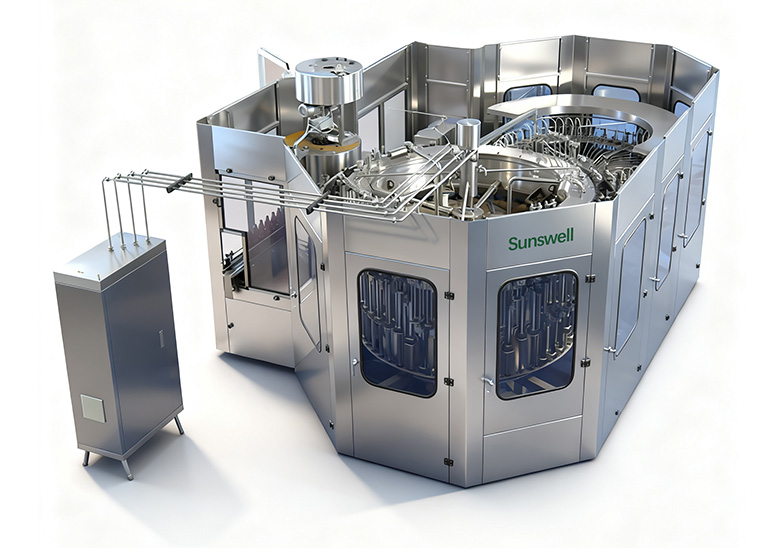
Production line · Beer
Beer & Craft Beverage Production Line
Beer is carbonated, oxygen-sensitive and alive — which is why its line is isobaric filling, oxygen management, pasteurising or micro-filtration, and a package that excludes light and air. This page walks the packaging line from bright tank to pallet, with the equipment list for bottles, cans and kegs.
444+
Lines delivered
71+
Countries exported
24,000
CPH canning case
20,000
m² workshop
2011
Sunswell founded
Short answer: The beer packaging line runs: bright tank → counter-pressure filling (bottles or cans) → capping or seaming → pasteurising or micro-filtration → labelling → packing. Beer is filled under counter-pressure like CSD, but with stricter oxygen control — dissolved oxygen shortens shelf life and dulls flavour. Glass, cans and kegs are the three routes, each with its own filler discharge.
🎯 Key takeaways
- Beer is isobaric-filled like CSD — counter-pressure is a requirement, not an option.
- Oxygen control is the beer-specific discipline: low dissolved oxygen, short lines, purged packages.
- Glass and cans dominate; kegs add a dedicated filling route.
- Pasteurising or micro-filtration follows filling, per the beer and the market.
- The bright tank and the filler are one system — the beer should not travel far or sit open.
On this page
1. The complete process
The line: bright tank → bottle or can rinsing → counter-pressure filling → capping (crown, roll-on) or seaming → pasteurising or micro-filtration → labelling → packing → palletising. Kegs run a separate short line: washing, filling under counter-pressure and sealing. The packaging line is the brewery's second half — and where most quality complaints actually start.
The process is built around three enemies of beer: oxygen, light and temperature. Every station answers one of them.
2. Counter-pressure filling
Beer is filled the way CSD is: the bottle or can is pressurised with CO2 before the valve opens, so the beer enters at equilibrium and the dissolved CO2 stays in solution with minimal foam. The filler is isobaric, with the counter-pressure set per beer — different carbonation levels need different pressures.
Fill under back-pressure also protects the beer from oxygen pickup at the fill, which is why the filler's gas handling is a spec item, not a detail.
3. Oxygen management
Dissolved oxygen is the fastest route to stale beer. The line controls it at every point: deaerated rinse and purge gases, a short product path from bright tank to filler, purged packages, and low-oxygen capping. A well-run line keeps pickup minimal; a careless one oxidises the beer it was brewed to protect.
Ask the supplier to state the line's oxygen-pickup design: purge points, gas handling and sealed paths. Oxygen pickup is a number the design should address.
Oxygen management is engineering, not magic — and it is cheaper to design in than to fix with additives.
4. Pasteurising vs micro-filtration
Beer is preserved either by pasteurising (tunnel or flash) or by micro-filtration, with the choice set by the beer, the pack and the market. Tunnel pasteurising is standard for bottles and cans at scale; micro-filtration suits beers that must not be heat-treated and is run with the corresponding hygiene regime. The route is a process decision made with the brewery, not a default.
Both routes protect the beer, and both add equipment — budget them as line stations, not accessories.
5. Glass, cans, kegs
Glass is the classic beer package — crown or roll-on closure, light-protecting colour. Cans are the growth format — light-proof, cheap to pack, and seamed at the filler discharge. Kegs are a separate route: washing, counter-pressure filling and sealing, with a faster cycle and a different hygiene regime. Most breweries run two or three of these lines, not one.
Decide the package mix before the filler is specified — the discharge (capper vs seamer vs keg rack) is built into the machine.
6. Equipment list
| Station | Typical equipment | Notes |
|---|---|---|
| Rinsing | Bottle/can rinser | Purge before fill |
| Filling | Isobaric counter-pressure filler | CO2 back-pressure, low oxygen |
| Closing | Crown/roll-on capper or can seamer | Follows the package |
| Preservation | Tunnel pasteuriser or micro-filtration | Per beer and market |
| Packing | Labeller, packer, palletiser | Glass: wrap or carton; can: tray+wrap |
The beer line is the CSD line's demanding cousin — the CSD filling machine technology applies, with oxygen control added.
7. Scale and layout
Beer lines range from craft-scale (a few hundred bottles or cans per hour) to industrial (tens of thousands per hour). Craft breweries often start with a compact mono-filler and add a canning line later; large breweries run dedicated glass, can and keg lines. The hall layout follows the line — bright tank near the filler, pasteuriser with clear flow, and warehouse behind the packer.
Size to the brewery's forecast, not the brand's ambition — a second shift beats a half-empty line every time.
Frequently asked questions
Is beer filled like CSD?
Yes — isobaric counter-pressure filling, with CO2 back-pressure. Beer adds stricter oxygen control than most CSD.
Bottles, cans or kegs?
Most breweries run two or three: glass and cans for retail, kegs for draught. The filler discharge follows the package.
How is beer preserved?
Pasteurising (tunnel or flash) or micro-filtration, set by the beer, the pack and the market.
Why does oxygen matter in beer?
Dissolved oxygen stales beer — it dulls flavour and shortens shelf life. The line is designed to keep pickup minimal.
Can a craft brewery start small?
Yes — compact mono-fillers run a few hundred bottles or cans per hour, with a canning line added as volume grows.
Does Sunswell supply beer lines?
Yes — Sunswell supplies isobaric fillers and canning lines for beer and carbonated drinks, including a 24,000 CPH canning line, plus glass bottling and keg routes.
About the author
Written by the Sunswell engineering team — led by Howie SUN, Founder & CEO, with 14 years in filling and blow-moulding equipment R&D and turnkey project delivery across 71+ countries.
Last reviewed: 2026-08-28 · Reviewed by Sunswell engineering team
Ask our engineering team →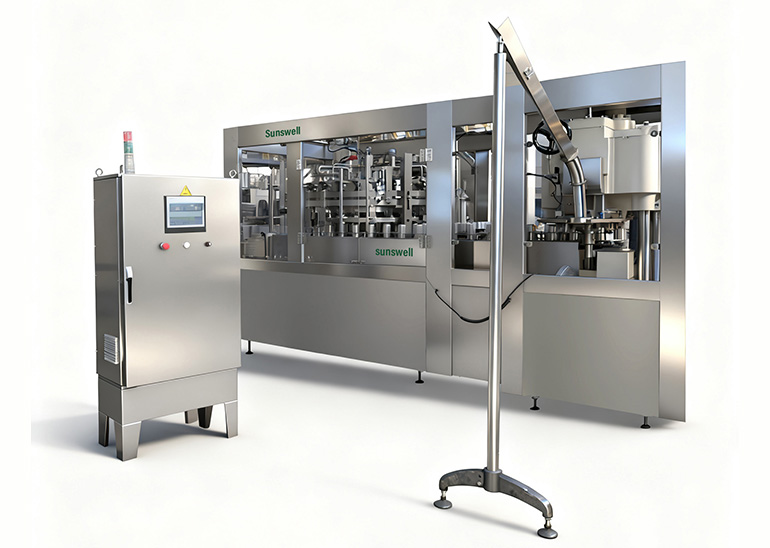
Have a specific project in mind?
Tell us product, target BPH, bottle sizes and market. We reply with a draft layout, equipment list and lead time estimate.
Fill the inquiry form ↑