In the high-volume world of liquid packaging, the transition from a profitable operation to a market leader is defined by the sophistication of your bottled water equipment. As global demand for purified and alkaline water continues to climb, plant managers in 2026 are facing a new reality: the need to balance ultra-high-speed production with increasing pressure for sustainable, energy-efficient, and "intelligent" manufacturing.
Whether you are upgrading an existing facility or designing a greenfield project, choosing the right equipment configuration is the most critical capital decision you will make this year.
Modern bottled water equipment begins long before the filling valve. To compete in the premium and export markets, your purification stage must exceed standard municipal filtration.
Multi-Stage Reverse Osmosis (RO): Today's high-tier RO systems are designed with "Smart Membranes" that self-adjust based on inlet water TDS (Total Dissolved Solids). This ensures a consistent mineral profile while reducing wastewater discharge by up to $25\%$.
Ozone & UV Sterilization Synergies: The dual-barrier approach is now the industry benchmark. Ozone provides residual disinfection within the bottle, while high-intensity UV loops at the point of fill ensure a 99.99% microbial kill rate without altering the water’s taste profile.
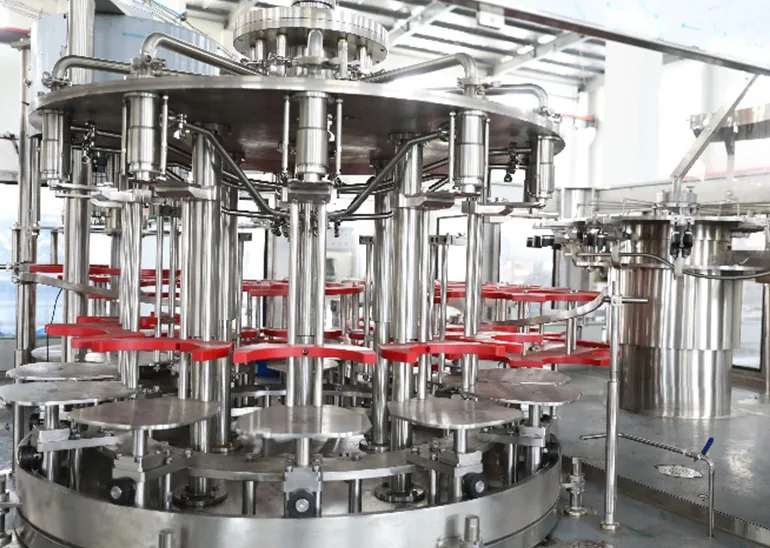
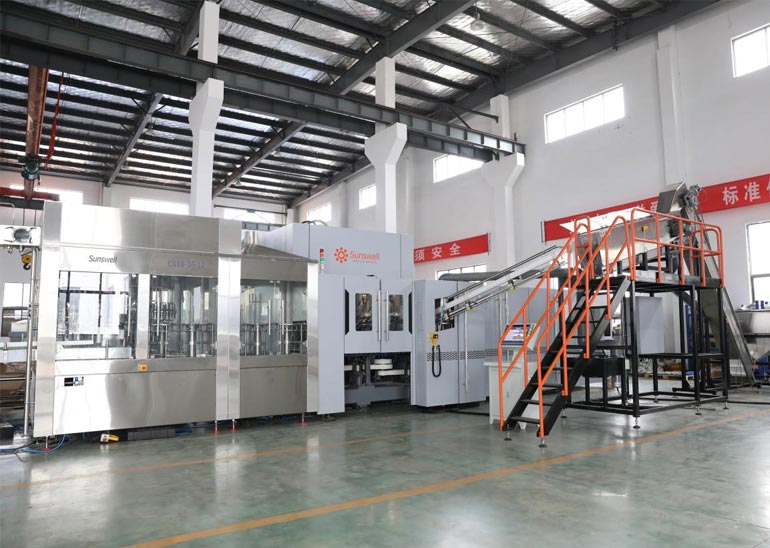
The era of disconnected machines linked by sprawling air conveyors is over. The Combi-Block—which integrates blow molding, filling, and capping into a single, synchronized unit—is the hallmark of modern bottled water equipment.
Total Hygiene: By eliminating the travel distance between the blower and the filler, the risk of empty bottles being exposed to ambient factory dust is eradicated.
Lower TCO (Total Cost of Ownership): With a single interface and fewer moving parts than a traditional linear line, maintenance costs are reduced by $15\text{--}20\%$, and energy consumption drops significantly due to the elimination of high-powered air blowers for conveyors.
Reduced Footprint: Combi systems reclaim up to $30\%$ of your factory floor space, allowing for more secondary packaging or storage capacity.
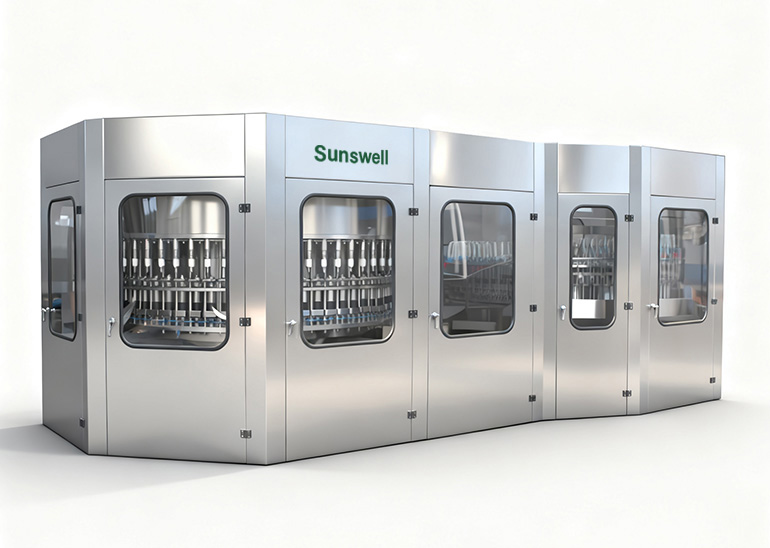
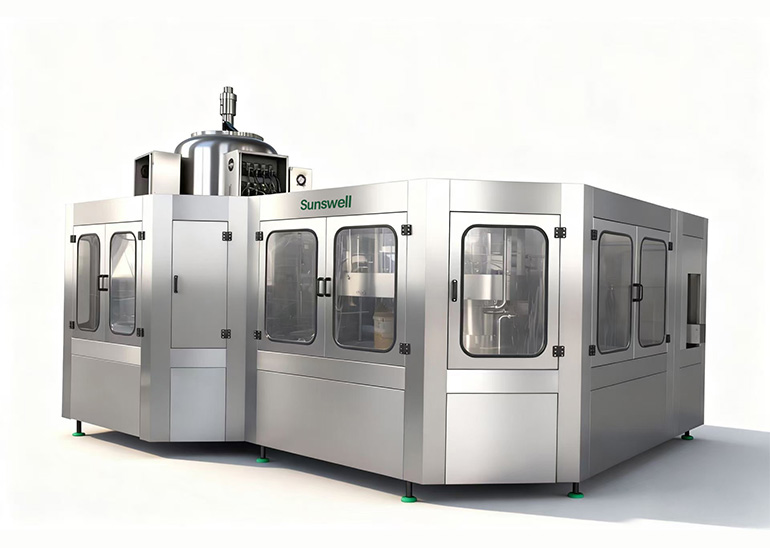
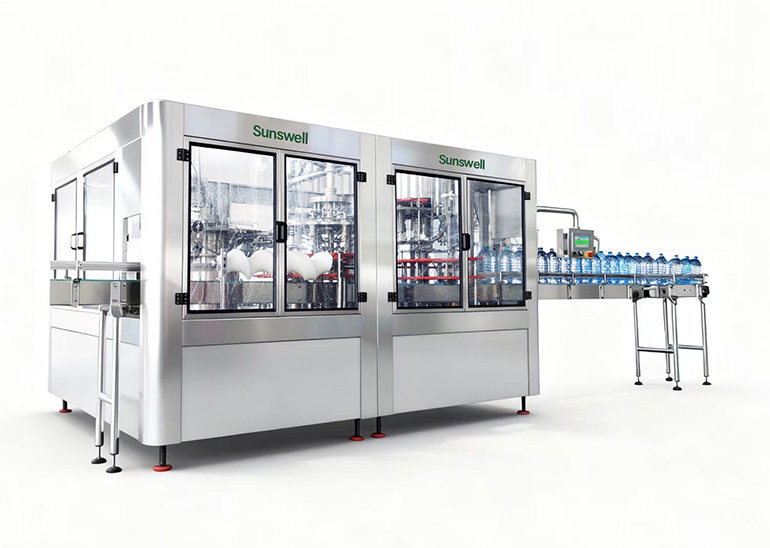
[Image: A Sunswell high-speed Combi-block system in operation]
At speeds of 24,000 to 48,000 BPH, mechanical errors can lead to massive product loss. Advanced bottled water equipment now utilizes Neck-Handling technology paired with precision gravity or flow-meter valves.
Lightweighting Support: As brands move toward "Eco-PET" (ultra-thin plastics), equipment must be gentle. Neck-handling ensures the bottle body is never under mechanical stress during the filling process, preventing deformation.
Precise Level Control: Using vacuum-assisted snifting valves ensures every bottle is filled to the exact same millimeter, maintaining the visual "shelf appeal" that consumers demand in retail environments.
By 2026, bottled water equipment has become part of the "Internet of Packaging." For a plant manager, the ability to monitor operations remotely is a game-changer.
Digital Twin Integration: Modern PLCs (Programmable Logic Controllers) now create a virtual replica of your production line. You can simulate "what-if" scenarios—such as changing a bottle shape—before ever stopping the physical line.
Predictive Maintenance: Sensors monitor the vibration of bearings and the heat of motors. Instead of waiting for a breakdown, the system alerts your team to replace a part during a scheduled shift change, maintaining an OEE (Overall Equipment Effectiveness) above $92\%$.
The "Equipment" lifecycle ends with how the product is ready for the pallet. Sustainability trends for 2026 have shifted toward:
PCR (Post-Consumer Recycled) Film: Shrink wrappers that can handle $100\%$ recycled film without tearing or losing seal integrity.
Biodegradable Handles: High-speed applicators for multipack carriers that replace traditional plastic rings with sustainable alternatives.
The bottled water industry is no longer just about volume; it’s about the intelligence of the system. Choosing equipment that is modular, digital-ready, and energy-efficient is the only way to safeguard your investment against the rising costs of labor and raw materials.
At Sunswell, we embody the spirit of "Made in China 2025" by leading the shift from speed-centric manufacturing to quality-driven engineering. Based in our 10,000m² international standardized workshop in Zhangjiagang, we have spent over a decade perfecting the bottled water equipment that powers the world's leading beverage brands.
Holding ISO9001, CE, and SGS certifications, Sunswell offers a comprehensive R&D-backed portfolio, including:
High-Speed Combi-Block Solutions
Complete Purification and RO Systems
Automated Labeling, Packaging, and Palletizing
We don't just sell machines; we provide turnkey plants designed for maximum ROI and global export compliance. From PET and glass to aluminum, Sunswell technology ensures your brand is built on a foundation of precision and reliability.



 +86 13921964455
 [email protected]

A2 Dongjiu Industrial Park, 30 East Jintang Road, Tangshi, Zhangjiagang, Jiangsu 215600, China