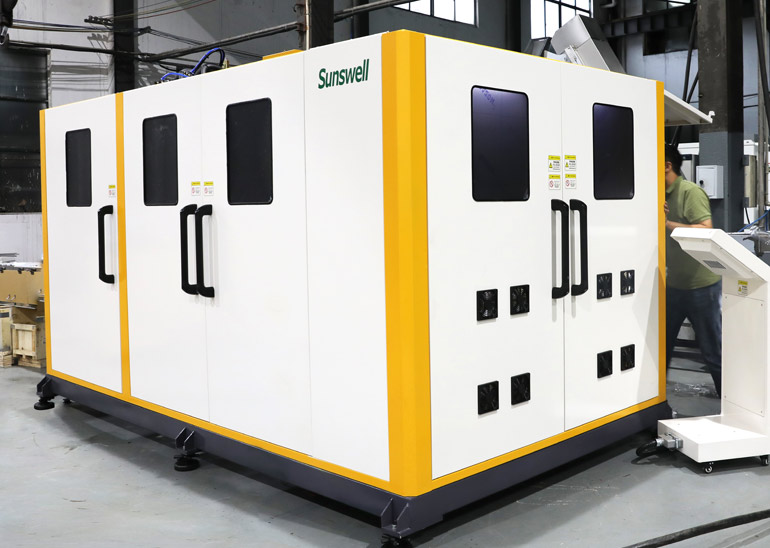
| Filling principle | Load cell (net weight), gravimetric |
| Capacity, 0.2–2 L | 12,000–36,000 BPH |
| Stations combined | Blow molding + filling + capping in one frame |
| Product range | Sunflower, soybean, rapeseed, corn, peanut, blended oils |
| Product contact | SUS 304, food-grade seals |
| Control | Siemens PLC and touch screen, recipe per SKU |
A volumetric filler doses by chamber size. It assumes the product arrives at a known density and drains completely. Edible oil breaks both assumptions: density shifts with temperature, and high viscosity means the last few millilitres leave the valve more slowly than the first.
| Condition | Effect on a volumetric filler | Effect on a load cell filler |
|---|---|---|
| Oil temperature falls overnight in an unheated hall | Fill weight rises, because the same volume is denser | No effect — the target is weight, not volume |
| Valve wear after a few months of production | Dose drifts slowly and silently | Drift is caught by the checkweigher trend, not by the consumer |
| Change from 1 L to 5 L | Needs a different chamber or a mechanical adjustment | Recipe change on the HMI |
| Foaming at the valve outlet | Foam fills the chamber, product short-fills | Foam sits on top of the weighed product and is detected |
If the product is thicker still — paste, sauce, honey — the comparison shifts again, and the piston filler trade-off is the closer reference. The trade-off here is speed. A load cell needs a settle time before the reading is stable, so each filling head cycles slower than a volumetric valve. On a 1 L bottle the difference is measurable; on a 5 L bottle the settle time is absorbed by the longer fill and the gap narrows.
Three machines share one frame and one control system: the rotary blow molding unit, the filling and capping monoblock, and the transfer between them. Combining them removes the air conveyor, which is where light PET bottles get scratched and where oil residue builds up.
| Section | Function | Engineering point for oil |
|---|---|---|
| Blow molding | Preform heating, stretching, high-pressure blowing | Heavier bottle wall than water — the preform heating profile has to be re-tuned, not reused |
| Transfer | Direct neck-handling from blow to fill | No air conveyor means no oil mist settling on the bottle surface |
| Filling | Load cell, net weight dosing | Drip-free valve design matters more than speed; a drop of oil on the neck becomes a complaint |
| Capping | Cap unscrambling, pick-and-place, torque control | Oil film on the neck reduces friction — torque has to be set for a lubricated surface |
Oil oxidises on contact with oxygen, and the headspace in a filled bottle is the main exposure point. Three measures do most of the work:
| Bottle format | Typical capacity band | Where the constraint sits |
|---|---|---|
| 0.2–1 L | 12,000–36,000 BPH | Load cell settle time per head |
| 1.5–2 L | 12,000–36,000 BPH | Blow molding cycle, not filling |
| 3–5 L | Below the 0.2–2 L band, set per project | Bottle handling and case packing |
The machine behind these bands is the load cell combiblock for edible oil. Note where the ceiling moves. On small formats the filler is the limit; on 2 L and above the blow molding cycle and the packer take over. Quoting the filler rating alone for a 5 L line overstates the line.
Run the test on your own oil, at your own plant temperature, with your own bottle. Four checks decide whether the machine is right:
Because the target is a weight on the label, and oil density changes with temperature. A load cell measures what is actually in the bottle; a volumetric chamber measures a volume that only equals the label weight at one specific temperature.
It can, but the constraint shifts from filling to bottle handling and packing. A 5 L bottle needs different grippers, wider conveyors and a packer rated for the case weight. Verify the packer rating before accepting the filler rating.
Mainly by nitrogen dosing into the headspace before capping, by keeping the distance between filler and capper short, and by holding a consistent fill level so the headspace volume does not vary between bottles.
It depends on the product, the format and the valve condition. The honest answer is that accuracy is a measured result on your product, not a catalogue figure — ask for the fill weight spread from a test run on oil, not on water.
Yes. Oil residue needs a food-grade alkaline wash at a temperature that dissolves the film, followed by a rinse that removes the detergent completely. The CIP recipe is separate from the water-line programme and has to be validated on site.
Country: Kazakhstan
Product: PET Bottled Carbonated Soft Drinks
Capacity: 12000BPH (1L)
Solution:Carbonated Drinks Production Line
Country: Maldives
Product: PET Bottled Mineralized Water
Capacity: 24,000BPH (500ml); 2 Lines
Solution:Water Production Line



 +86 13921964455
 [email protected]

A2 Dongjiu Industrial Park, 30 East Jintang Road, Tangshi, Zhangjiagang, Jiangsu 215600, China