| Stages | Pre-treatment, RO, disinfection |
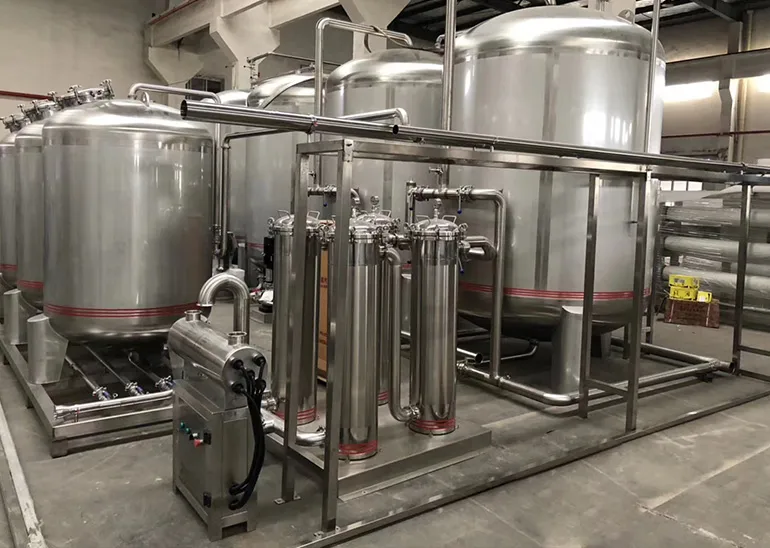
| Pre-treatment | Multi-media filter, carbon filter, softener |
| RO | Reverse osmosis with a storage and buffer tank |
| Disinfection | UV, ozone, or both |
| Key control | Raw water analysis, recovery rate, conductivity |
| Key decision | Which stages the raw water actually needs |
Four inputs fix the shortlist: the product, the package, the daily demand and the number of formats per week. Everything else, including the brand of the PLC, is a detail that can be settled after those four are written down.
NSF International certification (notably NSF/ANSI 61 for drinking-water contact) is a key trust signal for North American buyers of Water Treatment Systems and beverage lines.
Flow, temperature, concentration and time, all four together. A CIP that meets the temperature but not the flow does not clean the far end of the circuit, and the failure appears as a micro result weeks later. The station is sized on the largest circuit it serves.
| Stage | Removes | Driven by |
|---|---|---|
| Multi-media filter | Suspended solids | Turbidity of raw water |
| Carbon filter | Chlorine and organics | Municipal dosing and taste |
| Softener | Hardness | Calcium and magnesium in the analysis |
| RO | Dissolved salts | Conductivity target of the product |
| UV or ozone | Micro-organisms | Storage time and final barrier |
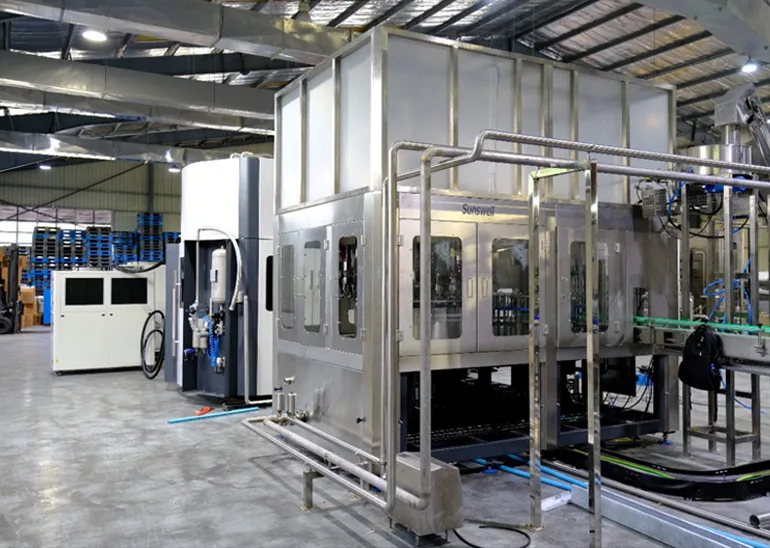
Reference unit for this duty: the Water Treatment.
Meter the intake and the reject stream separately, then divide by production. The ratio between them is the number that moves when recovery improves. Most water-saving projects start with a leak survey and a reject re-use review, not with a new membrane.
NSF/ANSI 61 limits contaminants leaching from wetted materials into drinking water; NSF/ANSI 169 covers food-equipment materials.
The unit behind this configuration is the Pre-treatment.
By permeate flow against filler demand plus the buffer tank volume. The tank covers the RO flush and any short stop; without it, the filler waits on the membrane. Sizing the RO at exactly the filler rate is a common design error.
The same question is worked through from another angle in How to Optimize Water Treatment Integration in Bottling Lines.
Pre-treatment removes suspended solids, chlorine and hardness that would foul or damage the membrane. RO removes dissolved salts. RO without correct pre-treatment fails early and expensively.
It can be used only after analysis. Borehole water often carries hardness, iron or manganese, all of which need a stage before the RO or before filling.
RO removes minerals as well as contaminants, and very low-mineral water tastes flat. Some plants blend or re-mineralise. The target is a specification set with the product, not the lowest possible conductivity.
It is a controlled circuit that circulates cleaning solution at a set flow, temperature, concentration and time. Any line filling a product other than water needs one, and its capacity follows the largest circuit.
Country: Maldives
Product: PET Bottled Mineralized Water
Capacity: 24,000BPH (500ml); 2 Lines
Solution:Water Production Line
Country:Kazakhstan
Product: PET Bottled Sparkling Water, Canned Soft Drink, Canned Tea
Capacity: 25000CPH (250ml)
Solution:Three Lines,7000BPH(1.5L), 15000CPH(330ml),15000CPH(450ml)



 +86 13921964455
 [email protected]

A2 Dongjiu Industrial Park, 30 East Jintang Road, Tangshi, Zhangjiagang, Jiangsu 215600, China