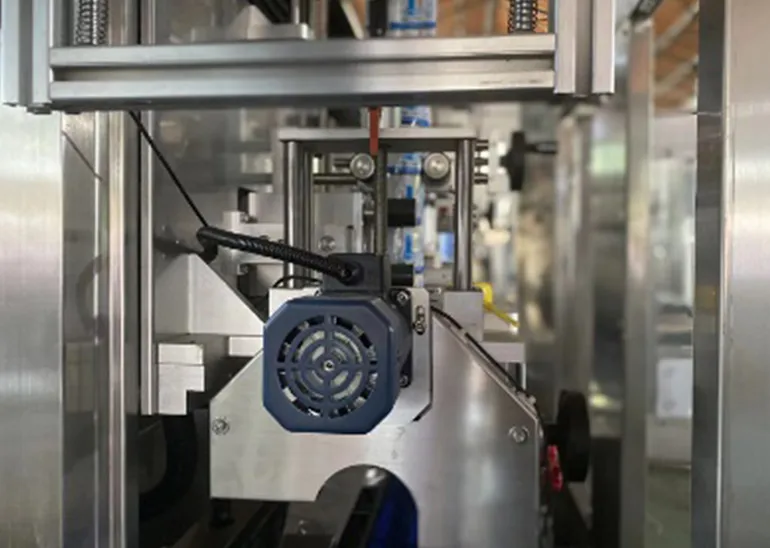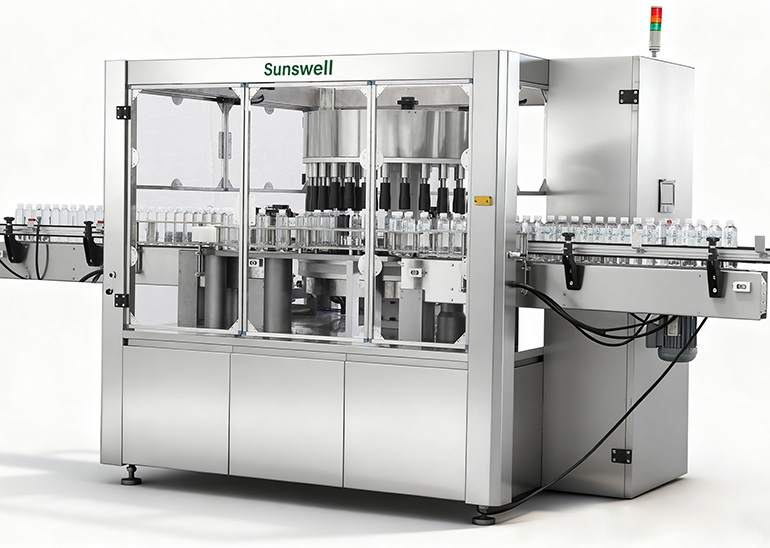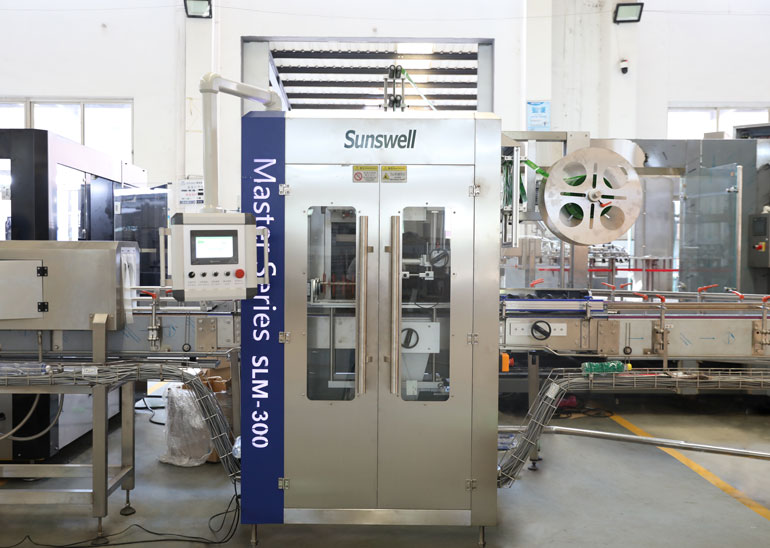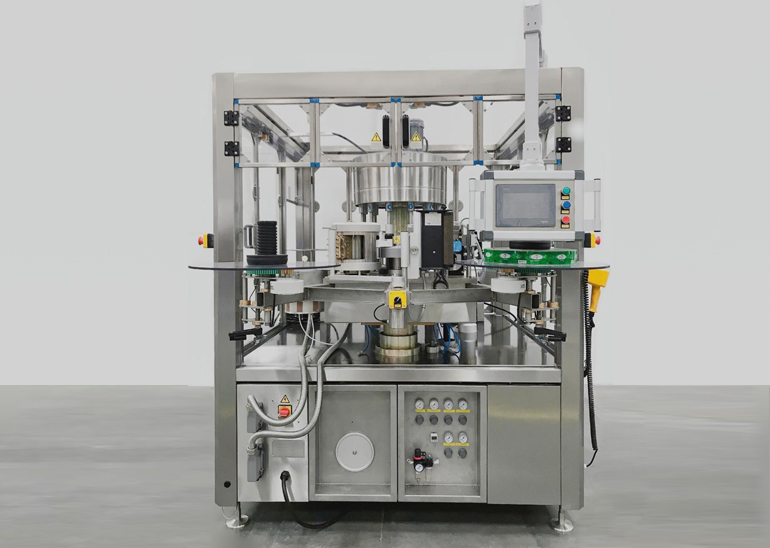
| Types | Sleeve, hot melt glue OPP, rotary sticker, self-adhesive |
| Speed | Matched to the filler, with an accumulator between |
| Key control | Label position, glue pattern, shrinkage, adhesion |
| Wetted parts | OPP film, PVC or PETG sleeve, paper sticker |
| Key decision | Full sleeve or partial wrap |
| Line position | After filling, before packing |
The label is positioned relative to the bottle, so any variation in bottle rotation, conveyor speed or label feed shows up as drift. On a round bottle the orientation is set by a roller or a star wheel; on a square bottle it is set by a mechanical aligner. Drift is usually a bottle handling problem, not a label problem.
After the filler and before the packer, normally with an accumulator on each side. The labeller is the most frequent short-stop on many lines, so the accumulator size in front of it decides whether a label roll change reaches the filler or not.
| Label type | Cost per unit | Best for |
|---|---|---|
| OPP wrap-around | Lowest at volume | High-speed round bottles |
| Full-body sleeve | Higher film cost | Full coverage and shaped bottles |
| Self-adhesive sticker | Middle | Short runs and flat or curved panels |
| Paper label with glue | Low material, slower | Glass bottles and craft products |
Reference unit for this duty: the Rotary Sticker Labeling.
Surface energy, bottle temperature and glue choice. A cold bottle straight from the filler carries condensation, and a water-based adhesive will not bond to it. Hot melt handles a damp surface better, which is why it dominates high-speed beverage lines.
The specification sheet for the Sleeve Labeling carries the figures quoted here.
Through the conveyor and an accumulator, not through a mechanical link. The labeller runs slightly faster than the filler and the accumulator absorbs the difference. A labeller matched exactly to the filler speed will stop the line at the first roll change.
The same question is worked through from another angle in How to Optimize Labeling Machines for Different Bottle Sizes.
Because a missing or skewed label is a customer reject that the line cannot see. A camera at the labeller outlet with a reject gate catches it at the source, before the packer hides it inside a case.
It is matched to the filler, typically with margin above the filler rating so that a short stop does not reach the filler. The practical limit is the shrink tunnel dwell time, not the sleeve applicator.
Usually uneven tunnel temperature, wrong film orientation, or a bottle that is still warm from filling. Check the tunnel profile and the film direction before changing the speed.
Perforation strength, film tension and tunnel temperature act together. A tear that appears after shrinkage usually means the perforation was cut too deep for the film gauge.
Hot melt glue applied at the leading edge, the trailing edge and the seam. The pattern and the pot temperature decide both the bond and how clean the bottle looks.
Usually too little glue, a cold bottle, or a seam pressed before the glue sets. Check the glue pattern and the bottle temperature before changing the speed.



 +86 13921964455
 [email protected]

A2 Dongjiu Industrial Park, 30 East Jintang Road, Tangshi, Zhangjiagang, Jiangsu 215600, China