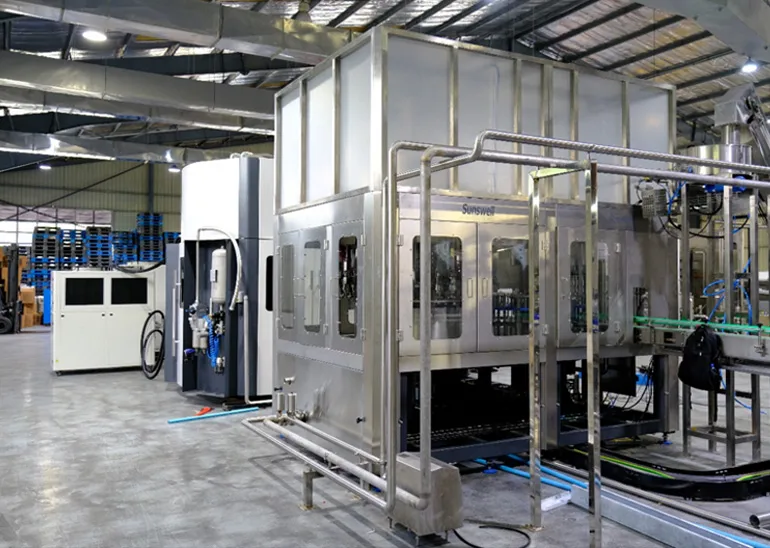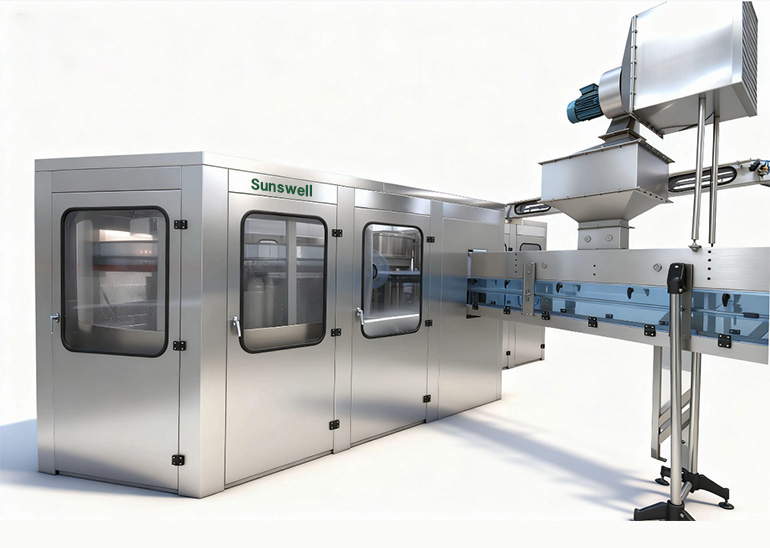
According to industry data compiled by Zenith Global and Statista, the global bottled water market surpassed USD 300 billion in 2024 and is forecast to grow at a CAGR of 5–6% through 2030, driven by rising health awareness, urbanization, and unreliable municipal water infrastructure across emerging economies. For beverage producers planning a new line, the single most important early decision is not the filler brand—it is the water source type, because purified water, mineral water, and flavored/sparkling water each impose fundamentally different requirements on the filling line. This article breaks down how source type drives line design, with practical reference points for buyers in the African market, Southeast Asia, and beyond.
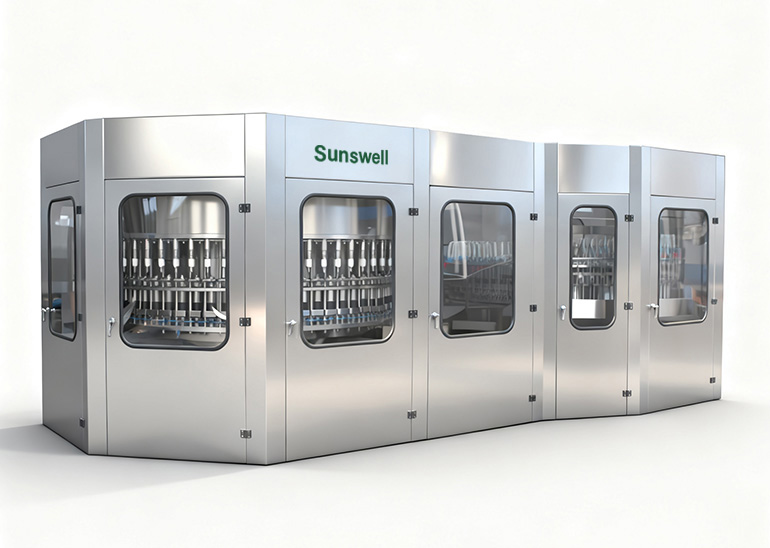
A bottled water production line is only as good as the water chemistry it must handle. The source determines the pretreatment train, the sterilization method, the filler specification, and even the package format. Mis-match the two and you risk off-taste, microbiological failure, or excessive capital spend on capabilities you do not need.
Purified water starts from municipal or well water and is brought to drinking standard through multi-stage filtration and reverse osmosis. The defining equipment is the water treatment system, not the filler. Lines for purified water typically run 6,000–36,000 BPH and use gravity or low-pressure filling valves.
Mineral water is protected by source certification and may only receive minimal physical treatment (typically filtration + UV or ozone, never RO, which would strip minerals). In the European market and increasingly in Southeast Asia, "natural" claims are legally regulated, so the line must preserve the mineral profile. This pushes buyers toward gentler filling and stricter microbiological control.
Carbonated water (CSD-style) requires an isobaric filler, a CO₂ dosing system, and pressure-rated bottles. Although still "water," the equipment is closer to a CSD filling machine than a still-water line.
For entrepreneurs building a plant in Africa (Kenya, Nigeria, Ghana), groundwater often carries high TDS and iron/manganese, demanding robust pretreatment before RO. Buyers from China sourcing complete lines frequently choose a turnkey approach to manage the water-treatment-to-filler interface. In Southeast Asia (Vietnam, Indonesia, Thailand), tropical temperatures raise the bar on cooling and sanitation, favoring hot-climate-grade stainless and reliable CIP.
Match BPH to realistic market demand, not aspirational peak. A 12,000 BPH water filling machine suits a regional brand; 24,000+ BPH suits export-oriented operations. Oversizing inflates CAPEX and energy cost.
Gravity fillers dominate still water below 12,000 BPH for simplicity and low product loss. Above that, rotary pressure or volumetric fillers improve speed and consistency.
Ozone (0.2–0.4 ppm residual) or UV (30–40 mJ/cm² dose) are the two standard sterilization routes. Ozone gives residual protection in the bottle; UV is chemical-free but offers no carry-over effect.
Because the water-treatment and filling stages are interdependent, sourcing them separately often creates integration gaps. An integrated supplier such as Sunswell—which has delivered lines to Kazakhstan, the Maldives, and across Africa—can engineer the complete chain from raw water to palletized case, reducing commissioning risk.
A: No. Natural mineral water must retain its mineral content, so RO is generally prohibited. Use filtration + UV/ozone only.
A: Many profitable regional plants start at 4,000–8,000 BPH for 500 ml PET, scaling up as distribution grows.
A: UV is simpler and cheaper to maintain; ozone adds in-bottle residual protection. Choose based on local regulation and distribution temperature.
Explore complete water production line solutions or contact our engineering team for a source-specific line proposal.



 +86 13921964455
 [email protected]

A2 Dongjiu Industrial Park, 30 East Jintang Road, Tangshi, Zhangjiagang, Jiangsu 215600, China