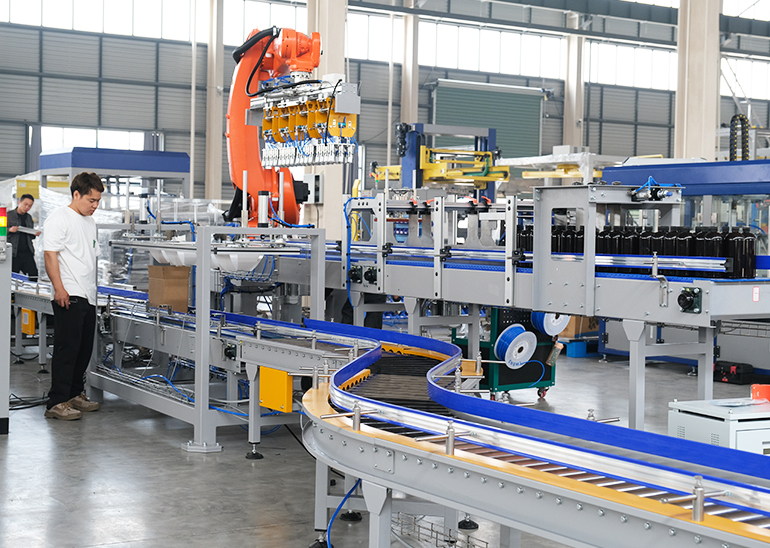
The global energy and functional drink segment has outgrown traditional carbonated soft drinks in several markets, and producers in Southeast Asia, the Middle East, and Latin America are racing to add capacity. But energy drinks are not "just soda with caffeine." Their formulation—higher carbonation, heat-sensitive actives, and aggressive flavors—places specific demands on the CSD filling machine and downstream packaging. This article explains how to select the right line.
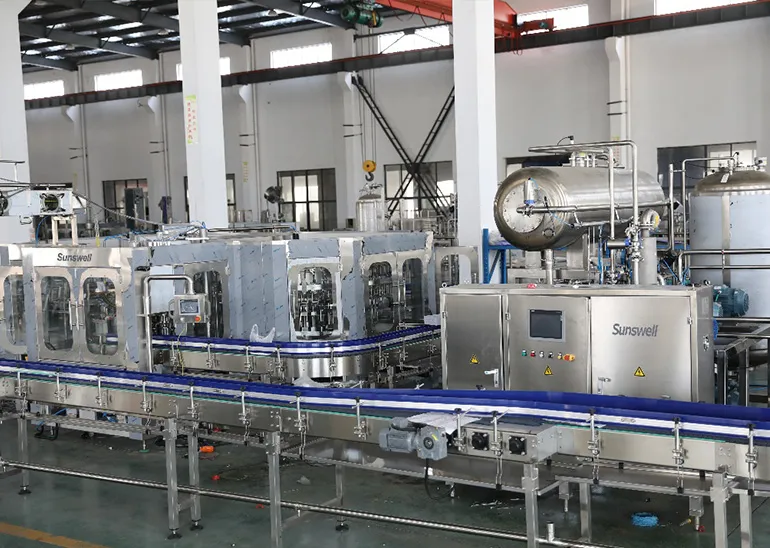
Energy drinks require isobaric (counter-pressure) filling to retain CO₂ and minimize oxygen pickup. Key parameters:
Cans give the best oxygen barrier and premium shelf presence. A dedicated aluminum can filling machine with seam monitoring is ideal for 8,000–24,000 CPH lines.
For 500 ml–1.5 L value segments, a CSD rotary filler with pressure-rated PET and secure caps works well. Watch CO₂ retention in lightweight PET.
A chilled, efficient carbonator (mixing syrup/water/CO₂ at low temperature) stabilizes volumes. Undersized carbonation causes foaming and inconsistent Brix.
Energy drink residues are sticky and acidic. A robust CIP-capable circuit with passivation protects the bowl and valves.
For cans, seam integrity is the shelf-life gate. Specify online seam inspection, not just post-batch checks.
Ask for a reference run on a similar formulation and request dissolved-oxygen and CO₂-loss data from FAT. Suppliers with CSD experience across from China exports—such as Sunswell, which has delivered CSD lines to Russia, Ecuador, and Kazakhstan—can share validated parameters.
A: No. Still-water gravity fillers cannot retain carbonation or control oxygen; you need an isobaric CSD filler.
A: Cans for premium/shelf-life; PET for cost and large sizes. Many brands launch in cans, then add PET.
A: Request a FAT on your formula measuring CO₂ volume in-line and dissolved oxygen post-cap; accept only within spec.
Compare CSD filling machines or request an energy-drink line quote.



 +86 13921964455
 [email protected]

A2 Dongjiu Industrial Park, 30 East Jintang Road, Tangshi, Zhangjiagang, Jiangsu 215600, China