


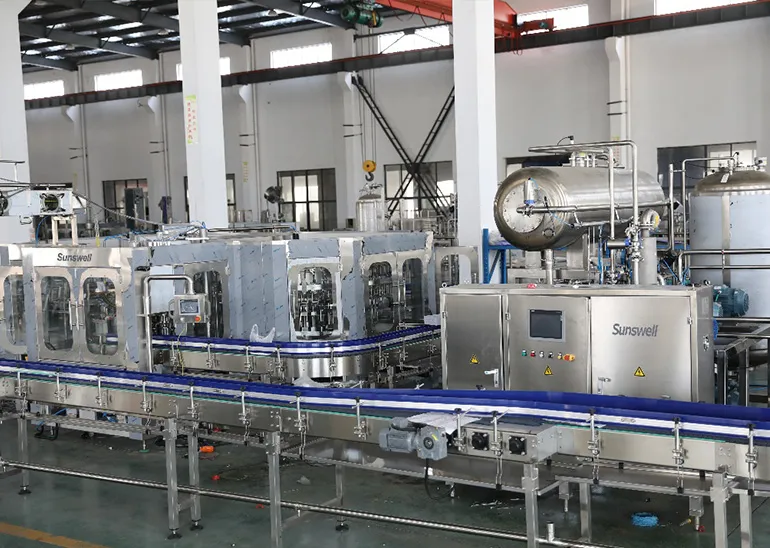
Line configuration · Energy drinks
Energy & Functional Drinks — Line Configuration Options and Investment Levels
Energy drinks configure around two decisions: carbonated or still, and cans or bottles — because each sets the filler discharge and the gas plant. Within that, the investment levels follow batching automation and output. This page compares the configurations.
444+
Lines delivered
71+
Countries exported
24,000
CPH canning case
20,000
m² workshop
2011
Sunswell founded
Short answer: Energy drink configurations: a still line (simple filler, hot-fill or pasteurising), a carbonated line (isobaric filler plus cooler and carbonator), and can vs bottle discharges (seamer vs capper, with nitrogen dosing for cans). Batching automation is the third axis — from manual tank dosing to inline metering with verification. The product's gas level and package are decided first; the investment follows.
🎯 Key takeaways
- Carbonated or still is the first decision — it sets the filler and the gas plant.
- Cans use a seamer and often a nitrogen doser; bottles use a capper.
- Batching automation (manual to inline dosing) is the accuracy axis — and the brand's legal claims live there.
- Heat treatment (pasteurising or hot-fill) follows the product and pack.
- Size to year-one sales; the levels are an efficiency ladder.
On this page
1. The two axes
Energy drinks configure along two axes: the product's gas level (still or carbonated) and the package (cans or bottles). The gas level decides the filler — isobaric with a cooler and carbonator for carbonated, a simple still valve for still — and the package decides the discharge — seamer for cans, capper for bottles. A third axis, batching automation, sets the accuracy and the cost.
| Decision | Option A | Option B |
|---|---|---|
| Gas level | Still — simple filler | Carbonated — isobaric + gas plant |
| Package | Bottles — capper | Cans — seamer + N₂ option |
| Batching | Manual tank dosing | Inline metering with verification |
Set the axes first; the line quote follows the decisions, not the brochure.
2. Still configuration
A still energy drink fills on a simple valve set — gravity or volumetric for thin product — with preservation by heat treatment: pasteurising for cans, or hot-fill into a heat-rated bottle. The line is compact and the front end (batching, deaeration, heat treatment) dominates the engineering.
Still product is the cheaper configuration and the one where batching accuracy matters most — the functional claims are the brand.
3. Carbonated configuration
A carbonated energy drink adds the CSD front end: plate cooler, carbonator and an isobaric counter-pressure filler. The drink is cooled, carbonated and filled under pressure so the gas stays in solution — the same discipline as CSD, with the recipe side of an energy drink on top.
Carbonation raises the investment (gas plant, cooler, isobaric filler) and the running cost (CO2), which is why the gas level is a market decision, not a preference.
4. Cans vs bottles
Cans dominate energy drinks: a canning line counts in cans per hour, seams the lid at the filler discharge, and often adds a nitrogen doser for rigidity without full carbonation. Bottles (PET or glass) run a capper with the same recipe. The package sets the discharge and the downstream — tray and wrap for cans, shrink or carton for bottles.
Many plants run both: a can line for the core brand and a bottle line for retail formats. The hall and utilities plan should anticipate the second line.
5. The batching axis
Batching runs from manual tank dosing (weigh and add, low cost) to inline metering with pumps, flow control and verification (higher cost, tighter accuracy). Because caffeine, vitamins and flavours are declared on the label, the batching accuracy is a compliance feature, not a luxury — the verification step is where the brand's legal exposure lives.
Choose the batching level on the market's labelling rules and the brand's tolerance. Export markets with strict declaration rules justify the automated tier.
6. Investment levels
| Level | Configuration | Best fit |
|---|---|---|
| Entry | Still, bottles, manual batching | Small plant, local market |
| Standard | Still or carbonated, automated batching | Regional brand, one package |
| Volume | Carbonated, can + bottle lines, inline dosing | National brand, multi-market |
The levels stack: entry covers a compact still line; volume covers carbonation, canning and verified batching. Move up only when the market pays for it.
7. Matching to product
Match the configuration to three facts: the product's gas level (tested with consumers, not assumed), the lead package (cans for on-the-go, bottles for retail), and the export ambition (which decides batching verification and documentation). The CSD filling machine and juice filling machine ranges show the two parent families; the energy line is the hybrid.
Frequently asked questions
Carbonated or still energy drink?
It is a market decision, not a preference — carbonated needs an isobaric filler and a gas plant, still runs a simple filler. Both preserve by heat treatment.
Cans or bottles?
Cans dominate with a seamer and often a nitrogen doser; bottles run a capper. Many plants run both lines.
What sets the investment?
The gas level, the package and the batching automation — in that order. Verified inline dosing is the accuracy axis and the compliance feature.
Why does batching matter so much?
Caffeine, vitamins and flavours are declared on the label — the doses are legal claims, verified batch by batch.
What output band fits a first plant?
Entry lines cover small plants; volume means carbonation and canning. Size to year-one sales and the export plan.
Can Sunswell supply both still and carbonated energy lines?
Yes — Sunswell supplies still and isobaric fillers, canning with a seamer and nitrogen dosing, and automated batching for functional drinks.
About the author
Written by the Sunswell engineering team — led by Howie SUN, Founder & CEO, with 14 years in filling and blow-moulding equipment R&D and turnkey project delivery across 71+ countries.
Last reviewed: 2026-08-28 · Reviewed by Sunswell engineering team
Ask our engineering team →
Have a specific project in mind?
Tell us product, target BPH, bottle sizes and market. We reply with a draft layout, equipment list and lead time estimate.
Fill the inquiry form ↑