


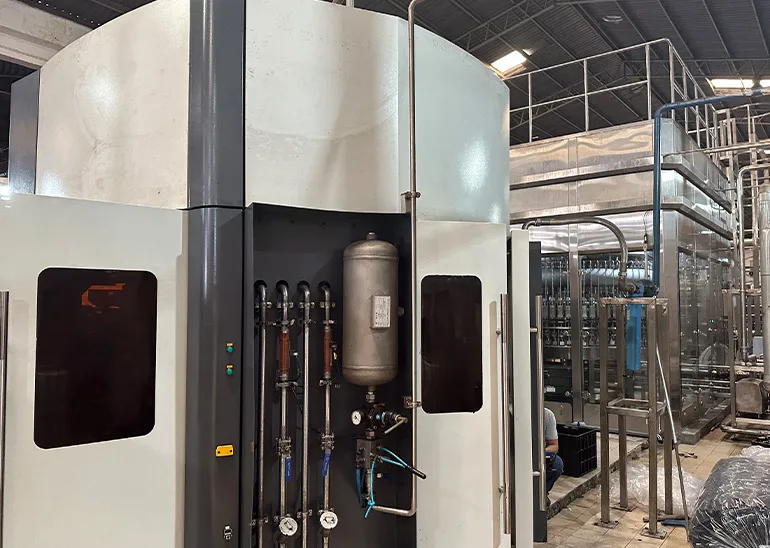
Production line · CSD
Carbonated Soft Drinks Production Line — Complete Process and Equipment List
A CSD line is a water plant, a syrup room, a carbonation system and an isobaric filler connected in a strict sequence. The filler gets the attention, but the water treatment and deaeration decide whether the drink tastes right. This page walks the whole line, machine by machine.
12,000–24,000
BPH CSD line range
24,000
CPH canning case
CO₂
Counter-pressure filling
444+
Lines delivered
71+
Countries exported
Short answer: The CSD process runs: water treatment → deaeration → syrup preparation → proportioning (water + syrup + CO₂) → cooling → isobaric counter-pressure filling → capping → labelling → packing → palletising. The isobaric filler equalises the bottle with the tank pressure before opening the valve, so the carbonation stays in solution. Equipment choice is driven by output: 12,000–24,000 BPH is the common band for PET CSD, with canning lines counted in cans per hour.
🎯 Key takeaways
- Water treatment comes first: deaerated, mineral-balanced water is the base of every CSD.
- The syrup room and proportioner decide taste consistency, bottle after bottle.
- Isobaric counter-pressure filling is the non-negotiable technology for carbonated product.
- Cooling before filling keeps CO₂ in solution and controls foam at the valve.
- Output bands: 12,000–24,000 BPH is the standard PET CSD range; cans are counted per hour.
On this page
1. The complete process
The line is a sequence of stations, each with one job: water treatment makes process water; deaeration strips dissolved oxygen; the syrup room prepares concentrate; the proportioner blends water, syrup and CO₂ to the recipe; cooling brings the mix to filling temperature; the isobaric filler fills under counter-pressure; then capping, labelling, packing and palletising finish the bottle. Skip or weaken any station and the drink changes.
The sequence is the same from 6,000 to 48,000 BPH — only the scale and the automation change. That is why a CSD project is specified as a line, not as a filler with accessories.
2. Water treatment and deaeration
CSD process water must be consistent: filtered, softened or demineralised to a defined mineral profile, and deaerated. Dissolved oxygen in the water reacts with flavours and accelerates carbonation loss — deaeration is not an option, it is a quality step. The water plant is sized on the line output and the incoming water quality.
Send the incoming water analysis with the enquiry. The water plant spec follows the water, not the brochure — hard water and well water need different treatment.
Mineral dosing may follow for taste consistency, and a polishing filter protects the filler from particles. The water plant is usually the first station installed and the last one you think about when it works.
3. Syrup room and proportioning
The syrup room prepares the concentrate: sugar or sweetener dissolved and filtered, flavours and acids added, and the batch checked for brix. The proportioner then blends water, syrup and CO₂ inline to the recipe and feeds the filler. Proportioning accuracy is what makes every bottle taste the same — an error here is a batch of inconsistent drinks, not a mechanical failure.
Decide the sweetener system (liquid sugar, HFCS, dry sugar) before the line is designed — it changes the syrup room and the proportioner spec. The room also needs CIP connections and hygienic stainless throughout.
4. Cooling and carbonation
CO₂ dissolves better in cold liquid, and a cold, carbonated product fills with less foam. The plate cooler brings the blended drink to filling temperature before carbonation; the carbonator injects CO₂ to the target volumes. Gas losses are a running cost, so the carbonation system and its pressure control are worth specifying properly.
CO₂ supply (bulk tank vs cylinders) is a site decision that affects the layout and the running cost. Ask the supplier to size the system on the recipe and the output, not on a generic formula.
5. The isobaric filler
The filler is isobaric by necessity: it pressurises the bottle with CO₂ to the tank pressure before the valve opens, so the drink enters a bottle at equilibrium and the gas stays in solution. Mechanical isobaric valves are the cost-effective norm; semi-electric valves add metering consistency for higher-speed lines; a full CSD combiblock integrates blow-fill-cap into one machine.
| Valve type | Where it fits | Notes |
|---|---|---|
| Mechanical isobaric | Standard CSD | Proven, cheapest, level-based |
| Semi-electric | Higher speed / consistency | Adds flow metering to the isobaric path |
| Combiblock BFC | Self-contained PET plants | Blow-fill-cap in one carousel |
The choice depends on output, bottle and budget — not on fashion. A mechanical isobaric filler is still the majority of the world's CSD.
6. Downstream: capping to palletising
After filling, the line caps (screw cap for PET, crown or roll-on for glass, seamer for cans), labels, packs and palletises. CSD bottles are pressurised, so the capper must seat the closure without gas loss and the conveyor must handle a bottle under internal pressure — no sharp handling, no excessive heat.
Downstream choice is packaging-driven: shrink or carton for PET, wrap-around for cans, and a palletiser at the end. The downstream stations are shared with water and juice lines — the CSD-specific investment is upstream of the capper.
7. Equipment list by output band
| Station | 6,000–12,000 BPH | 12,000–24,000 BPH |
|---|---|---|
| Water treatment | Compact skid | Full skid + deaeration + dosing |
| Syrup room | Manual batch | Automated proportioning |
| Carbonation | In-line carbonator | Plate cooler + carbonator |
| Filler | Mechanical isobaric | Semi-electric or combiblock |
| Capper | In-line capper | Monobloc capper |
| Packing | Shrink wrapper | Shrink + cartoner + palletiser |
Scale the line to the product you can sell in year one. A CSD filling machine at 12,000 BPH running one shift beats a 24,000 BPH line running at half speed.
Frequently asked questions
Why is CSD filled under counter-pressure?
Because carbonated liquid foams when it meets air. The isobaric filler pressurises the bottle with CO₂ first, so the drink enters at equilibrium and the gas stays in solution.
What output should a new CSD plant choose?
12,000–24,000 BPH is the standard PET band. Size to year-one sales; a smaller line running full beats a bigger one running idle.
Do I need a full water treatment plant for CSD?
Yes. Consistent, deaerated water is the base of the drink. The plant is sized on the line output and your incoming water quality.
Mechanical or semi-electric isobaric valves?
Mechanical is the proven, cost-effective norm. Semi-electric adds metering consistency for higher speed or stricter fill tolerances.
Can a combiblock run CSD?
Yes — a blow-fill-cap combiblock with isobaric or semi-electric valves is a standard configuration for CSD plants that blow their own PET.
Does Sunswell supply complete CSD lines?
Yes — from water treatment to palletising, including combiblocks and standalone isobaric fillers. Delivered CSD projects include a 12,000 BPH line in Kazakhstan and a 24,000 CPH canning line.
About the author
Written by the Sunswell engineering team — led by Howie SUN, Founder & CEO, with 14 years in filling and blow-moulding equipment R&D and turnkey project delivery across 71+ countries.
Last reviewed: 2026-08-28 · Reviewed by Sunswell engineering team
Ask our engineering team →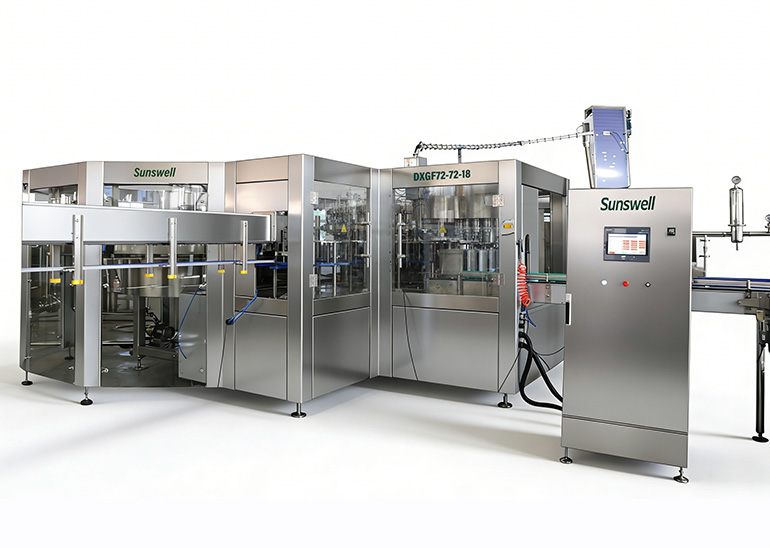
Project references
-

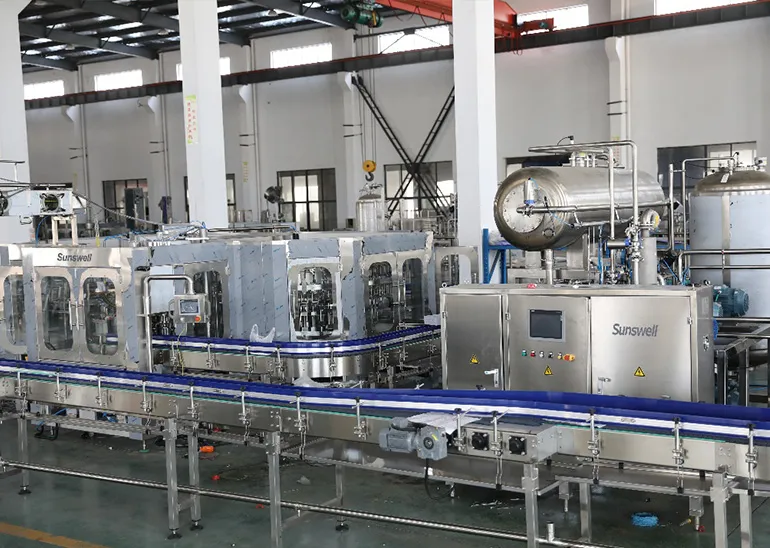
Vizit, 12,000BPH 1L Bottling Line with Combiblock for CSD, Kazakhstan
Country: Kazakhstan
Product: PET Bottled Carbonated Soft Drinks
Capacity: 12000BPH (1L)
Solution:Carbonated Drinks Production Line
Read More + -
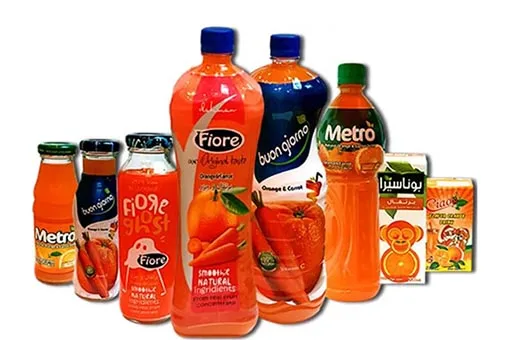
Dahman, 24,000CPH Canning Line for CSD, Syria
Country: Syria
Product: Aluminum Canned Carbonated Soft Drinks
Capacity: 24000CPH (250ml)
Solution:Carbonated Drinks Production Line
Read More +
Have a specific project in mind?
Tell us product, target BPH, bottle sizes and market. We reply with a draft layout, equipment list and lead time estimate.
Fill the inquiry form ↑