| Volumetric dosing | Volume fixed by chamber, piston or flow meter |
| Gravimetric dosing | Net weight measured by load cell per filling head |
| Speed | Volumetric faster per head; gravimetric needs settle time |
| Best fit | Volumetric: water, CSD, thin liquids. Gravimetric: oil, paste, high-value fills |
| Main failure mode | Volumetric: drift with temperature and wear. Gravimetric: vibration and foam on the load cell |
| Calibration | Volumetric by volume check; gravimetric by certified test weights |
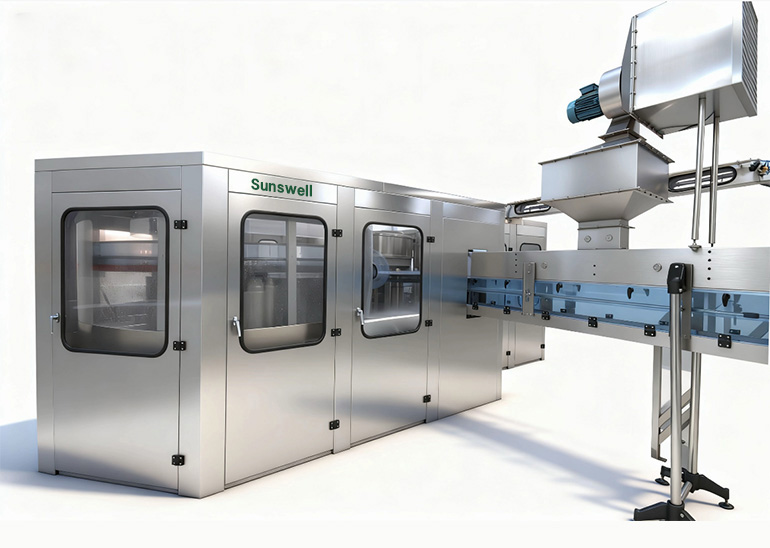
Volumetric. A chamber of known size fills with product, then discharges into the bottle. The chamber can be a piston cylinder, a measuring cup in a rotary valve, or a flow meter that counts pulses and closes a valve. What leaves the chamber is a volume. The weight that arrives in the bottle depends on density. Where density is constant, as on a still water line, this is why the volumetric filling machine stays the standard choice.
Gravimetric. The bottle sits on a load cell. The valve opens, product flows, and the valve closes when the target weight is reached, with compensation for the product still in flight. What leaves the valve is decided by a measurement, not by a chamber size. The clearest production example is the load cell combiblock built for edible oil, where density moves with every temperature swing.
| Aspect | Volumetric | Gravimetric |
|---|---|---|
| What is controlled | Volume | Net weight |
| Sensitive to density change | Yes, directly | No |
| Sensitive to viscosity | Yes, affects drain-out | Only through flow rate, not the final weight |
| Sensitive to vibration | No | Yes, during settle time |
| Cycle time per head | Shorter | Longer, by the settle window |
| Valve wear effect | Slow dose drift | Reduced, because the target is re-measured each cycle |
Both lose accuracy, just at different points. Knowing the failure mode matters more than the catalogue tolerance.
| Condition | Volumetric behaviour | Gravimetric behaviour |
|---|---|---|
| Product temperature swings between shifts | Dose weight changes with density, even though volume is correct | Unaffected — the target is weight |
| Product foams during filling | Foam occupies chamber volume, so the bottle short-fills | Foam sits on the product; the weight still reads correctly |
| Air bubbles entrained in the product | Bubbles take chamber space, causing underfill | Bubbles reduce measured weight, so the filler tops up — which is more accurate but slower |
| Filler mounted on a vibrating mezzanine | No effect | Reading noise; settle time increases |
| Long production run, worn seals | Gradual drift that operators compensate by hand | Drift is visible in the weight trend and corrected automatically |
| Product | Usual choice | Reason |
|---|---|---|
| Still water, 200 ml–2 L | Volumetric valve or gravity | Constant density, high speed, low unit value |
| Carbonated soft drinks | Isobaric volumetric | Counter-pressure protects CO₂; volume dosing is fast enough |
| Hot-fill juice and tea | Volumetric hot fill | Temperature is controlled by the process, so density is stable |
| Edible oil | Gravimetric (load cell) | Density moves with temperature; label states a weight |
| Sauces, pulp juice, paste | Gravimetric, or a piston filler with weight check | Viscosity varies batch to batch; foam and lumps disturb volume dosing |
| High-value small bottles (shots, spirits) | Gravimetric | Overfill cost per bottle is high enough to justify the slower cycle |
Three operating differences show up after commissioning, and none of them appear in the quotation:
Ask for a test run on your product and check four things, in this order:
No. It is more accurate when the product's density changes or when foam and bubbles disturb a volume measurement. On a stable, thin liquid running at high speed, a well-maintained volumetric filler holds its dose reliably and does it faster.
Every cycle needs a settle window before the load cell reading is stable enough to close the valve. That window is fixed by the mechanical response of the weighing system, so it cannot be shortened by running the line harder.
Usually not in place. The filling heads, the weighing platform and the control logic are different. Treat it as a new monoblock rather than an upgrade kit.
Volumetric has fewer sensors and cheaper spare parts, but wears seals and drifts. Gravimetric has load cells and calibration cost, but corrects drift automatically. Over several years of production the difference is usually smaller than the difference in operator discipline.
Yes. Large formats such as 5 L give the gravimetric head more time to settle inside the same fill, so the speed penalty shrinks. Small formats such as 2 oz shots make the penalty proportionally larger.
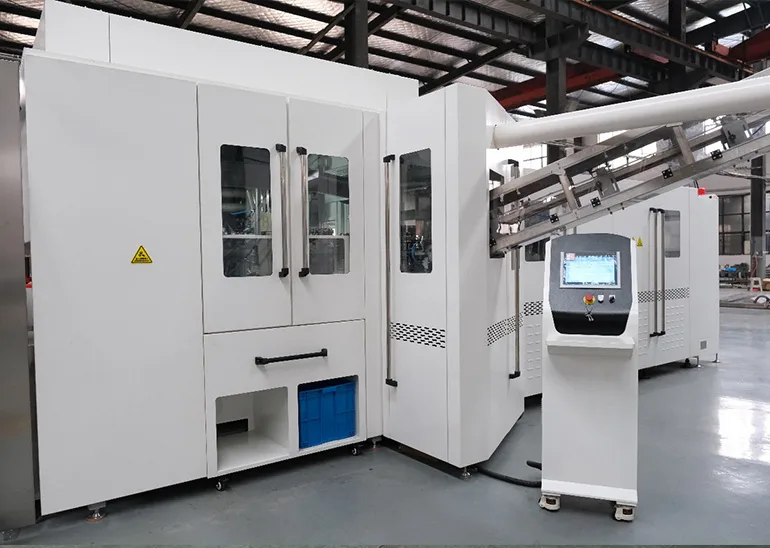
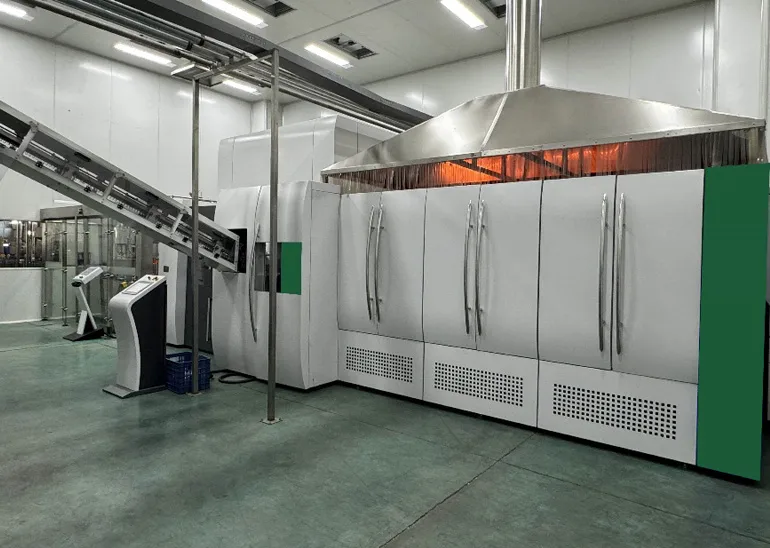
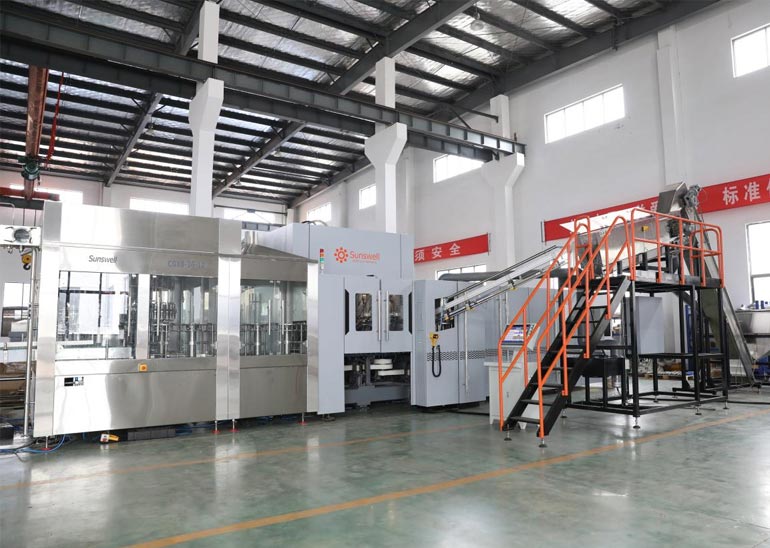
Country:Kazakhstan
Product: PET Bottled Sparkling Water, Canned Soft Drink, Canned Tea
Capacity: 25000CPH (250ml)
Solution:Three Lines,7000BPH(1.5L), 15000CPH(330ml),15000CPH(450ml)



 +86 13921964455
 [email protected]

A2 Dongjiu Industrial Park, 30 East Jintang Road, Tangshi, Zhangjiagang, Jiangsu 215600, China