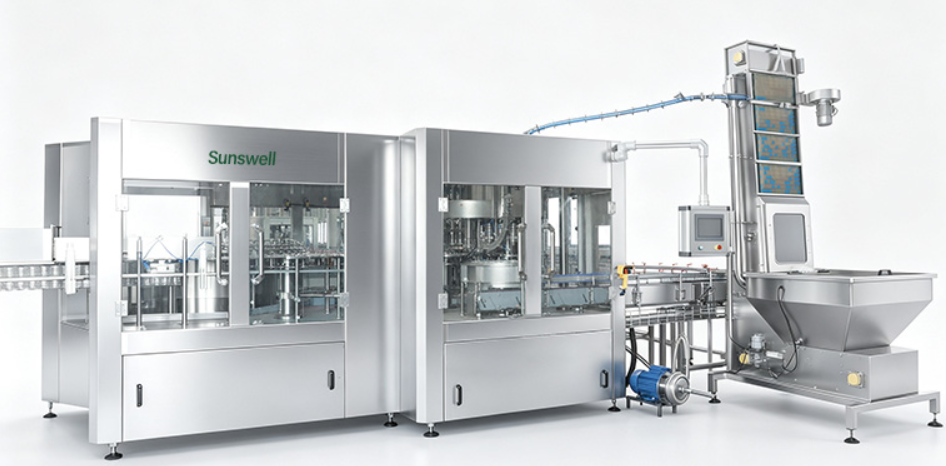
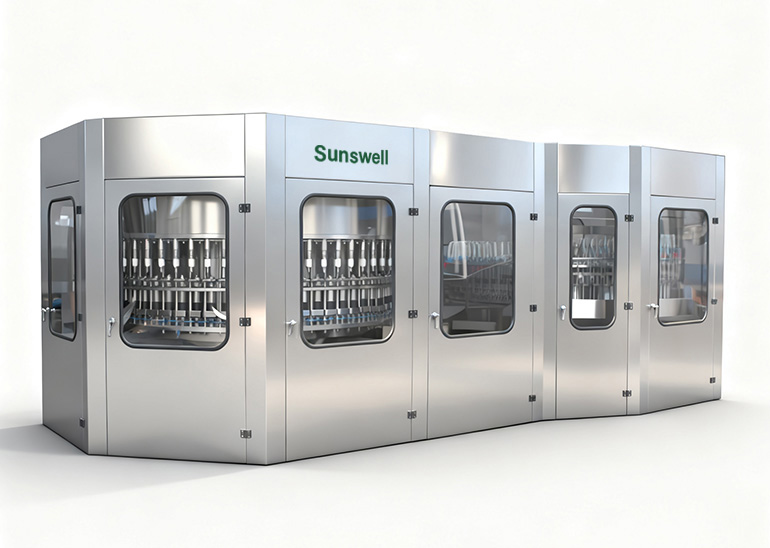
| Application | Still water, RO water, mineral water |
| Filling principle | Gravity or volumetric valve |
| Capacity | 5,000-48,000 BPH at 500 ml |
| Bottle sizes | 200 ml to 16 L, by configuration |
| Contact material | SUS 304 product contact, CIP-ready |
| Line scope | Treatment, blowing, filling, capping, labelling, packing |
A water line stands or falls on three inputs: raw water analysis, neck finish, and how well filler and capper are matched. BPH takes the meeting; the neck finish and the capper match get the last five minutes. Change the thread by a millimetre and the rinser clamp and capping head have to change with it.
Discuss the water treatment system using the source analysis, outlet specification, temperature range and operating calendar.
Work backwards from cases per day. Divide bottles per day by productive hours, then divide again by a production factor of 0.65-0.85. The factor covers changeover, CIP, label roll changes and downstream stops. Sizing at 1.0 is the most common and most expensive mistake in a water project, because the shortfall only appears once the line is running.
For an illustrative sizing exercise, assume confirmed demand of 360,000 bottles per month, 20 operating days, eight scheduled hours daily and a 60% combined production factor.
| Filling principle | Best for | Watch out for |
|---|---|---|
| Gravity | Still water, one rigid bottle size | Thin-wall bottles deform under head pressure |
| Volumetric valve | 3-15 L and mixed formats | Valve wear shows as slow drift, not a sudden error |
| Isobaric | Carbonated water only | Needs counter-pressure, so slower per valve |
| Load cell | Oil and high-value liquid | Slower cycle, higher cost per valve |
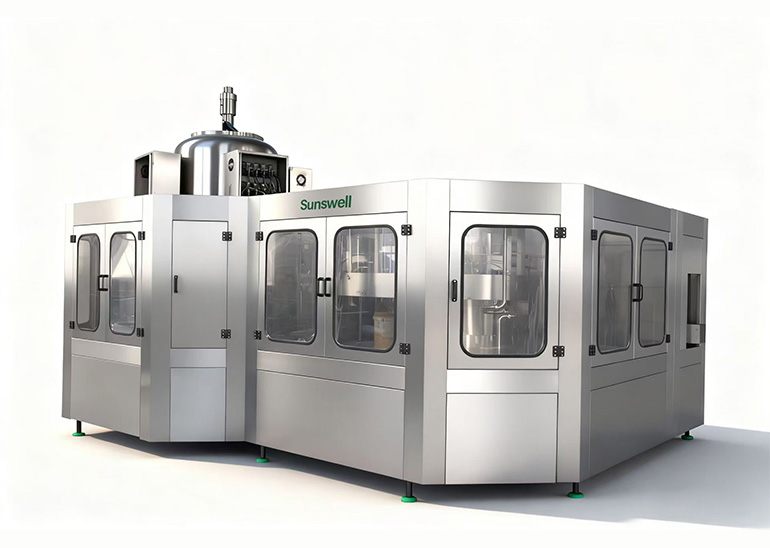
The Gravity Filling Machine for Still Water is the matching unit when this becomes a line project.
Ask for the rated capacity of the slowest station, the changeover checklist, the CIP cycle time, and the water and power consumption per 1,000 bottles. Those four numbers decide the real cost per bottle. A quotation that lists only the filler capacity and a total price leaves the buyer comparing incomparable offers.
Where this becomes a line rather than a single machine, the Volumetric Filling Machine for Still Water is the starting point.
A small line gives up automation, not quality. Manual or semi-automatic packing, fewer accumulation buffers, and a simpler CIP usually follow. What it should not give up is the filling valve and the capping head, because those two decide whether the product is saleable.
Where products may encounter freezing or low temperatures, establish acceptable conditions and test the actual package rather than relying on appearance after a short indoor trial.
The same question is worked through from another angle in Key Features of Volumetric Still Water Filling Machines.
A monoblock carries the rinser, the filler and the capper on one frame with one drive. It removes two transfers, the floor space between them and the bottle handling at each. Three separate machines are easier to replace one at a time and easier to run at different rates.
It follows the raw water analysis, not a standard package. Surface water usually needs multi-media filtration, RO and UV or ozone. Low-hardness municipal water may need only carbon filtration and disinfection.
Plan for 380 V three-phase power, 0.6-0.8 MPa compressed air, and a chiller if blow molding runs in-house. Exact consumption belongs in the utility schedule of the quotation, not in a rule of thumb.
For a complete line with blowing, filling, labelling and packing, plan several weeks on site after arrival, plus operator training. Civil work and utility readiness are the usual delay, not the machinery.
Not on the same filler. Carbonation needs isobaric valves, a CO2 dosing and mixing unit, and a different bowl. A combiblock can carry both valve sets, but they are separate specifications, not a field conversion.
Commercial practice is a stated band per bottle size, typically checked by weight at the filler outlet. The band belongs in the acceptance protocol. A line without a written tolerance will argue about it at commissioning.
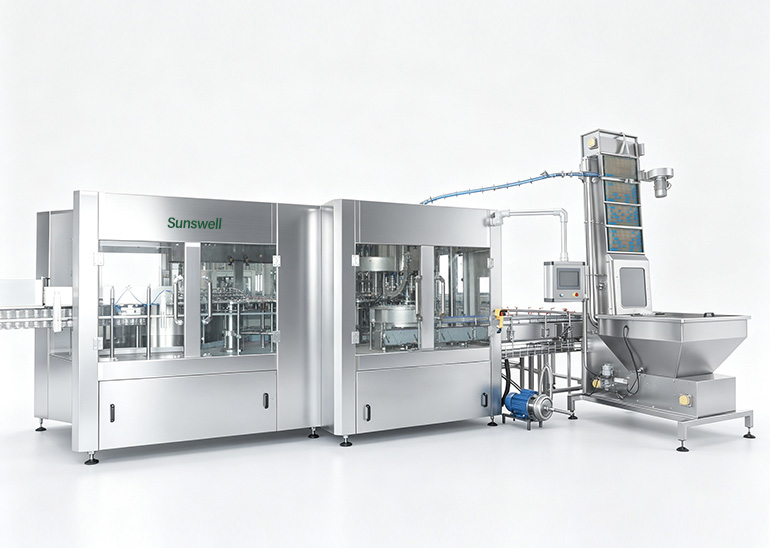

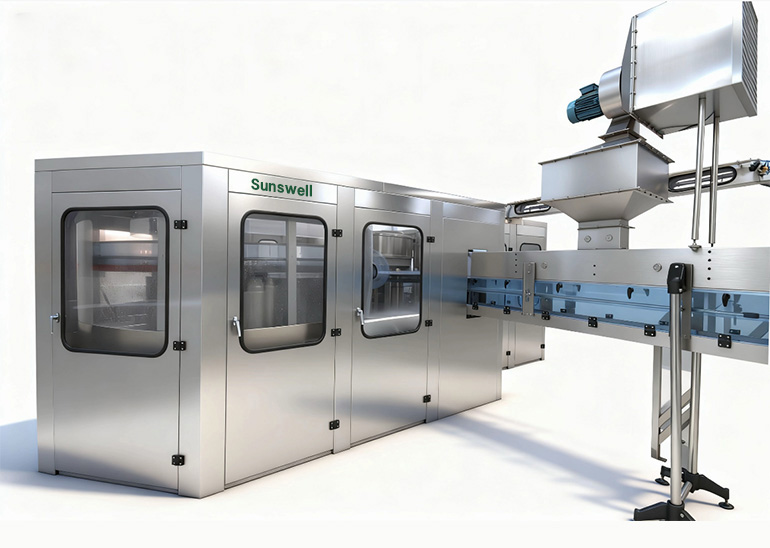
Country: Maldives
Product: PET Bottled Mineralized Water
Capacity: 24,000BPH (500ml); 2 Lines
Solution:Water Production Line
Country:Kazakhstan
Product: PET Bottled Sparkling Water, Canned Soft Drink, Canned Tea
Capacity: 25000CPH (250ml)
Solution:Three Lines,7000BPH(1.5L), 15000CPH(330ml),15000CPH(450ml)



 +86 13921964455
 [email protected]

A2 Dongjiu Industrial Park, 30 East Jintang Road, Tangshi, Zhangjiagang, Jiangsu 215600, China