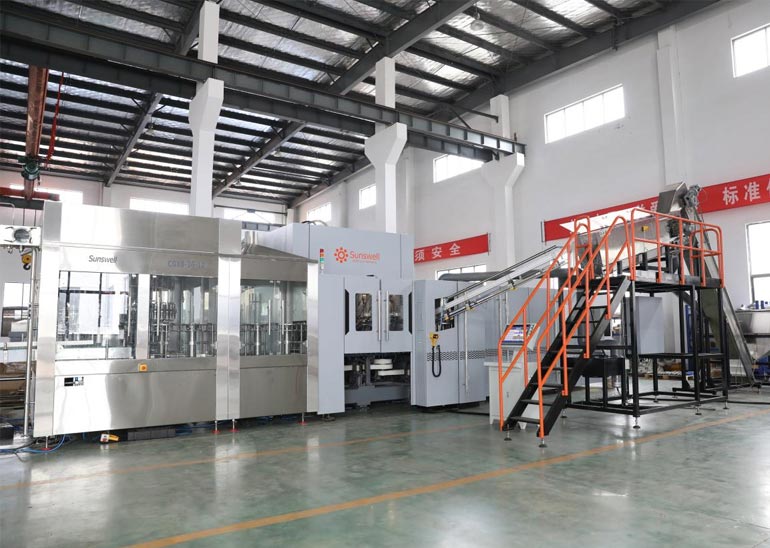
| Supply scope | Air conveyor, roller conveyor, depalletizer, palletizer |
| Function | Move bottles and cases without damage, stack outbound pallets |
| Key control | Accumulation pressure, guide rail gap, pattern repeatability |
| Types | Semi-automatic and automatic palletizing |
| Key decision | Manual, semi-automatic or robotic palletizing |
| Automation | Manual, semi-automatic or robotic |
The conveyor is the only part of the line that touches every bottle. Guide rail gaps, transfer plate height and accumulation pressure decide whether bottles jam, scuff or fall. Most unexplained short stops on a mature line trace back to a transfer that was set for one bottle format and never re-set.
Floor loading for a full pallet stack, clear height for the mast or robot envelope, and a pallet dispenser within reach of the operator. These are building decisions taken before the machine is ordered, and changing them later costs more than the palletizer.
| Function | Manual | Automatic |
|---|---|---|
| Depalletizing empty bottles | Rack or hand stack | Layer depalletizer |
| Case palletizing | Operator with pattern sheet | Layer or robotic palletizer |
| Pallet wrapping | Hand wrapper | In-line stretch wrapper |
| Accumulation | None, line stops together | Buffer sized to longest stop |
The specification sheet for the Depalletizing & Palletizing carries the figures quoted here.
A guide rail gap set for a different diameter, a transfer plate at the wrong height, or too much back pressure behind the jam. All three are mechanical settings and all three drift when a second format is introduced.
Reference unit for this duty: the Conveying.
Square pallets, consistent layer sheets and a stable stack. Empty bottles are light, so a leaning pallet becomes a fallen layer at the depalletizer. The machine can only work with the stack it is given.
The same question is worked through from another angle in The Complete Bottling Process: From Source Water to Palletized.
A depalletizer unloads empty bottles or full cases from a pallet at the start of a line. A palletizer stacks finished cases onto a pallet at the end. They are separate machines with separate footprints.
Guide rail gap and transfer plate height. Both are set for one bottle diameter and both drift when a second format is introduced. Re-set them at every changeover, not once at installation.
A robot is more flexible across patterns and gentler on the pack; a layer palletizer is faster for a single stable pattern. The choice follows the pattern mix, not the technology.
Low air pressure, a worn layer clamp, or a pallet that is not square. Empty bottle layers are light, so small errors become fallen bottles at the infeed.
Country:Kazakhstan
Product: PET Bottled Sparkling Water, Canned Soft Drink, Canned Tea
Capacity: 25000CPH (250ml)
Solution:Three Lines,7000BPH(1.5L), 15000CPH(330ml),15000CPH(450ml)



 +86 13921964455
 [email protected]

A2 Dongjiu Industrial Park, 30 East Jintang Road, Tangshi, Zhangjiagang, Jiangsu 215600, China