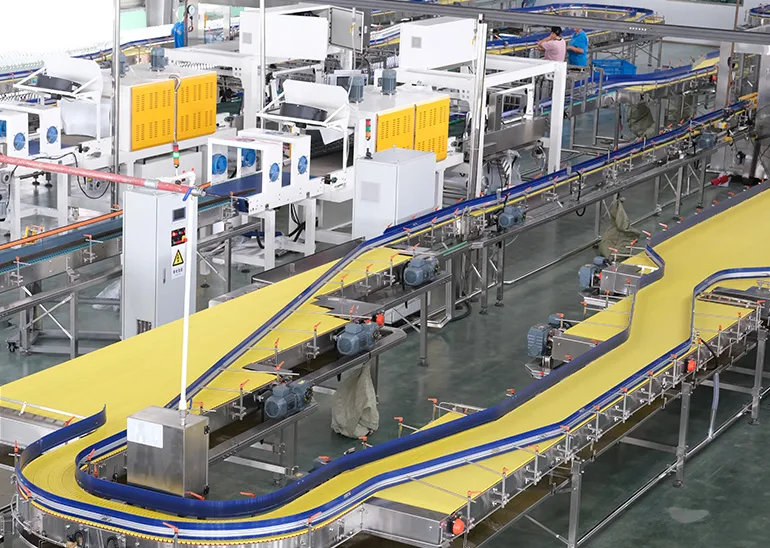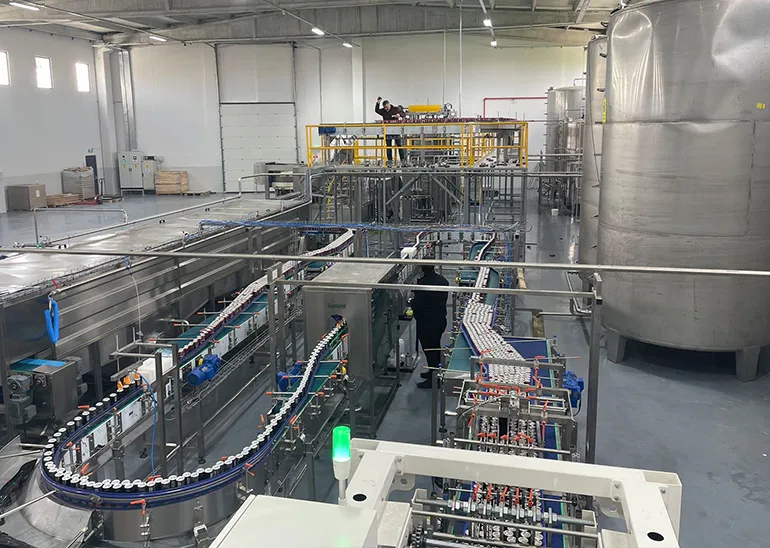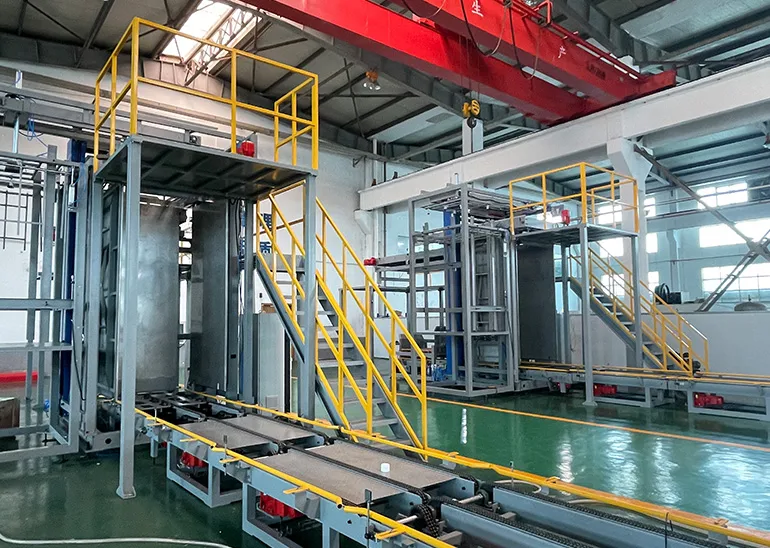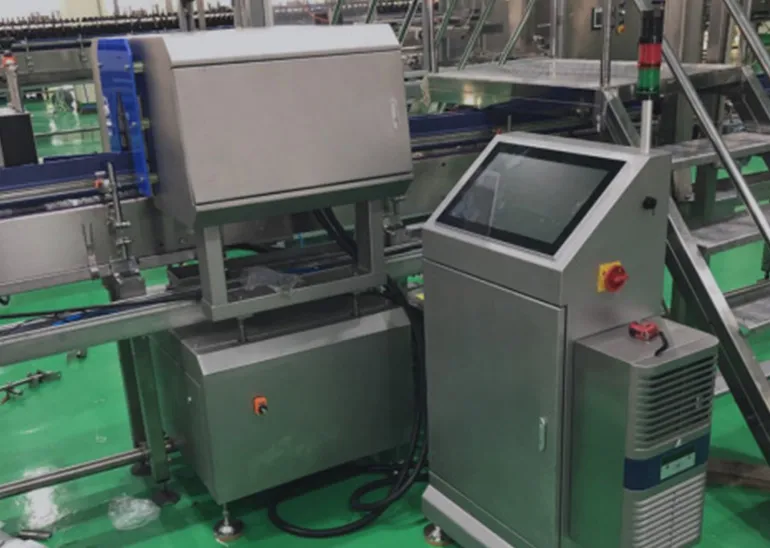
| What is included | Air conveyor, roller conveyor, depalletizer, palletizer |
| Function | Move bottles and cases without damage, stack outbound pallets |
| Key control | Accumulation pressure, guide rail gap, pattern repeatability |
| Types | Semi-automatic and automatic palletizing |
| Key decision | Manual, semi-automatic or robotic palletizing |
| Automation | Manual, semi-automatic or robotic |
The conveyor is the only part of the line that touches every bottle. Guide rail gaps, transfer plate height and accumulation pressure decide whether bottles jam, scuff or fall. Most unexplained short stops on a mature line trace back to a transfer that was set for one bottle format and never re-set.
Automatic palletizing pays when the labour it replaces is continuous and the pattern is stable. A plant running two shifts at high case rates reaches payback faster than a single-shift plant with mixed patterns, because a robot needs the pattern defined before it can be programmed.
| Function | Manual | Automatic |
|---|---|---|
| Depalletizing empty bottles | Rack or hand stack | Layer depalletizer |
| Case palletizing | Operator with pattern sheet | Layer or robotic palletizer |
| Pallet wrapping | Hand wrapper | In-line stretch wrapper |
| Accumulation | None, line stops together | Buffer sized to longest stop |
The specification sheet for the Conveying carries the figures quoted here.
A guide rail gap set for a different diameter, a transfer plate at the wrong height, or too much back pressure behind the jam. All three are mechanical settings and all three drift when a second format is introduced.
Throughput and change-part lists are on the Depalletizing & Palletizing page rather than in this note.
When the pattern mix is wide and the pack is fragile. A layer palletizer is faster on one stable pattern; a robot changes pattern by program. Most plants with more than three patterns choose the robot for that reason alone.
The same question is worked through from another angle in Palletizer Payback: When Automatic Palletizing Pays.
Square pallets, consistent layer sheets and a stable stack. Empty bottles are light, so a leaning pallet becomes a fallen layer at the depalletizer. The machine can only work with the stack it is given.
It is rated in cases or layers per hour and must exceed the packer output with margin. The number to compare is the pattern-adjusted rate, not the headline figure at one layer size.
Guide rail gap and transfer plate height. Both are set for one bottle diameter and both drift when a second format is introduced. Re-set them at every changeover, not once at installation.
A robot is more flexible across patterns and gentler on the pack; a layer palletizer is faster for a single stable pattern. The choice follows the pattern mix, not the technology.
It is rated in cycles per hour and depends on the layer pattern and the stack height. Compare the pattern-adjusted rate, not the headline figure.
Low air pressure, a worn layer clamp, or a pallet that is not square. Empty bottle layers are light, so small errors become fallen bottles at the infeed.
Country:Kazakhstan
Product: PET Bottled Sparkling Water, Canned Soft Drink, Canned Tea
Capacity: 25000CPH (250ml)
Solution:Three Lines,7000BPH(1.5L), 15000CPH(330ml),15000CPH(450ml)



 +86 13921964455
 [email protected]

A2 Dongjiu Industrial Park, 30 East Jintang Road, Tangshi, Zhangjiagang, Jiangsu 215600, China