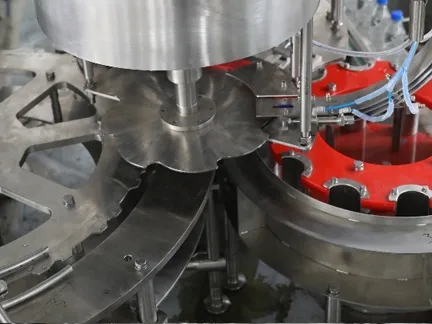
| Stages | Pre-treatment, RO, disinfection |
| Pre-treatment | Multi-media filter, carbon filter, softener |
| RO | Reverse osmosis with a storage and buffer tank |
| Disinfection | UV, ozone, or both |
| Key control | Raw water analysis, recovery rate, conductivity |
| Key decision | Which stages the raw water actually needs |
The raw water analysis decides it. Surface water usually needs multi-media filtration, carbon and RO; hard well water needs softening before the RO; low-hardness municipal water may only need carbon and disinfection. A package bought without an analysis is either oversized or short of a stage.
UV leaves no residue and acts instantly, but it has no residual effect in the bottle. Ozone leaves a residual that protects the water in storage, and it needs a destruction step before filling. Many plants run both: ozone for storage, UV as a final barrier.
| Stage | Removes | Driven by |
|---|---|---|
| Multi-media filter | Suspended solids | Turbidity of raw water |
| Carbon filter | Chlorine and organics | Municipal dosing and taste |
| Softener | Hardness | Calcium and magnesium in the analysis |
| RO | Dissolved salts | Conductivity target of the product |
| UV or ozone | Micro-organisms | Storage time and final barrier |
Site requirements, air and power consumption sit with the Water Treatment.
The RO membrane, mainly. Hardness scales the membrane surface, which raises pressure and cuts recovery. A softener upstream is cheaper than a membrane replacement and is sized on the hardness in the water analysis.
Reference unit for this duty: the Pre-treatment.
Conductivity at the RO outlet, turbidity before and after the filters, and a microbial sample on a fixed schedule. Continuous sensors catch drift; the microbial sample catches what the sensors cannot see.
The same question is worked through from another angle in CIP order from Saudi Arabia clients.
Pre-treatment removes suspended solids, chlorine and hardness that would foul or damage the membrane. RO removes dissolved salts. RO without correct pre-treatment fails early and expensively.
RO removes minerals as well as contaminants, and very low-mineral water tastes flat. Some plants blend or re-mineralise. The target is a specification set with the product, not the lowest possible conductivity.
It is a controlled circuit that circulates cleaning solution at a set flow, temperature, concentration and time. Any line filling a product other than water needs one, and its capacity follows the largest circuit.
On chlorine breakthrough and on the supplier recommendation, not on a fixed calendar. A carbon bed that is exhausted lets chlorine reach the RO membrane.
Country: Maldives
Product: PET Bottled Mineralized Water
Capacity: 24,000BPH (500ml); 2 Lines
Solution:Water Production Line
Country:Kazakhstan
Product: PET Bottled Sparkling Water, Canned Soft Drink, Canned Tea
Capacity: 25000CPH (250ml)
Solution:Three Lines,7000BPH(1.5L), 15000CPH(330ml),15000CPH(450ml)



 +86 13921964455
 [email protected]

A2 Dongjiu Industrial Park, 30 East Jintang Road, Tangshi, Zhangjiagang, Jiangsu 215600, China