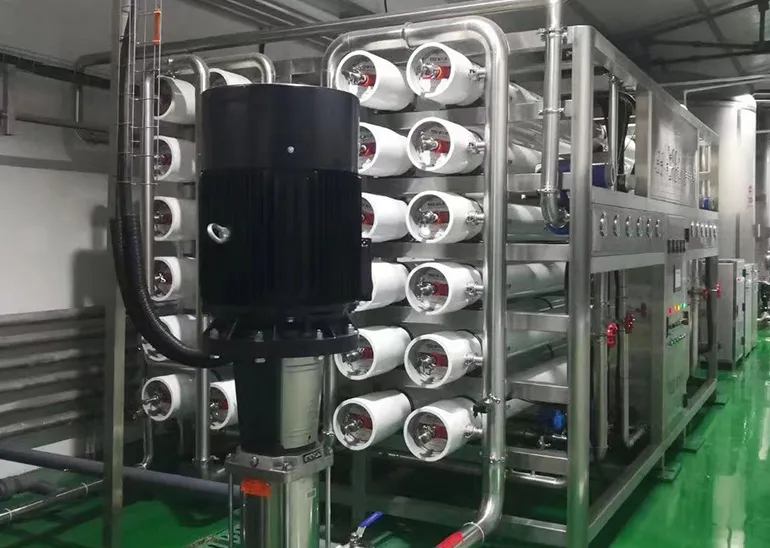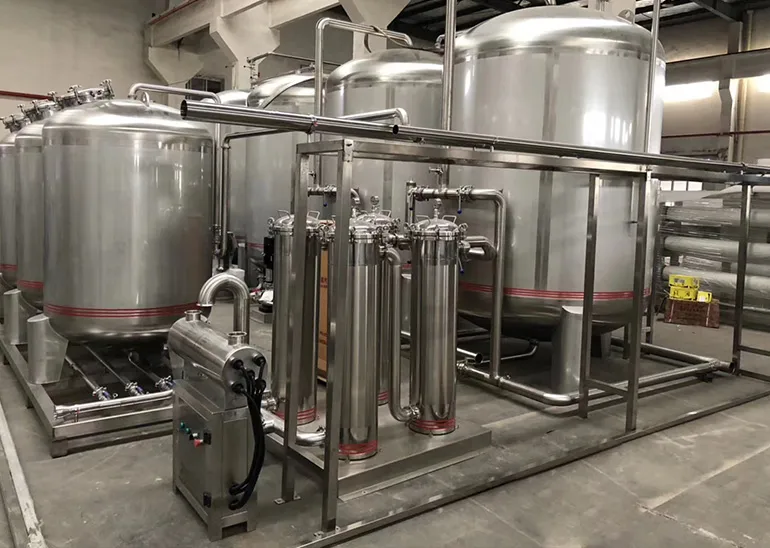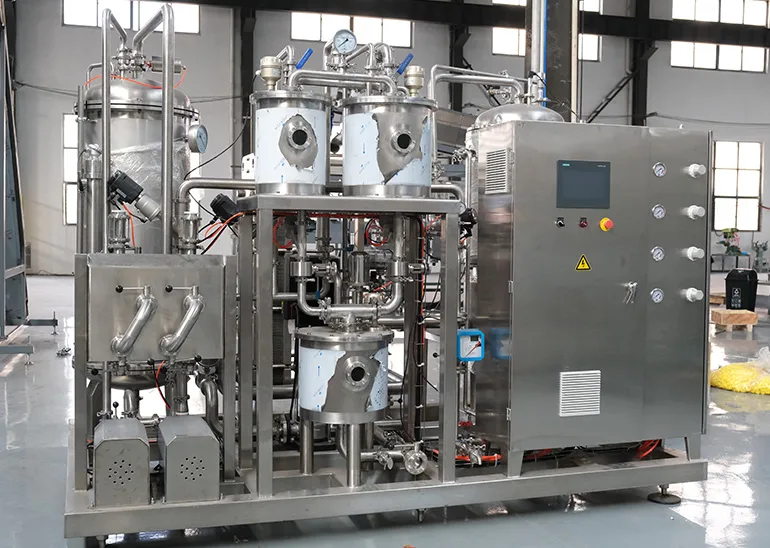
| Stages | Pre-treatment, RO, disinfection |
| Pre-treatment | Multi-media filter, carbon filter, softener |
| RO | Reverse osmosis with a storage and buffer tank |
| Disinfection | UV, ozone, or both |
| Key control | Raw water analysis, recovery rate, conductivity |
| Key decision | Which stages the raw water actually needs |
The raw water analysis decides it. Surface water usually needs multi-media filtration, carbon and RO; hard well water needs softening before the RO; low-hardness municipal water may only need carbon and disinfection. A package bought without an analysis is either oversized or short of a stage.
Reverse osmosis is a powerful water purification technique that effectively removes contaminants and impurities from water by applying pressure to push it through a semi-permeable membrane.
RO produces permeate and rejects concentrate. The recovery rate sets how much of the feed becomes product water, and the buffer tank size sets how long the line can run when the RO is in flush or maintenance. A filler that outruns the RO starves at shift start, which looks like a filler problem and is not.
| Stage | Removes | Driven by |
|---|---|---|
| Multi-media filter | Suspended solids | Turbidity of raw water |
| Carbon filter | Chlorine and organics | Municipal dosing and taste |
| Softener | Hardness | Calcium and magnesium in the analysis |
| RO | Dissolved salts | Conductivity target of the product |
| UV or ozone | Micro-organisms | Storage time and final barrier |
Throughput and change-part lists are on the Water Treatment page rather than in this note.
UV leaves no residue and acts instantly, but it has no residual effect in the bottle. Ozone leaves a residual that protects the water in storage, and it needs a destruction step before filling. Many plants run both: ozone for storage, UV as a final barrier.
Reference unit for this duty: the Pre-treatment.
By permeate flow against filler demand plus the buffer tank volume. The tank covers the RO flush and any short stop; without it, the filler waits on the membrane. Sizing the RO at exactly the filler rate is a common design error.
The same question is worked through from another angle in Integrating Water Treatment Systems in Bottling Lines.
On condition, not on a calendar. Track permeate conductivity, pressure drop and recovery; replacement follows a trend, and a sudden change usually means a pre-treatment failure rather than membrane age.
RO removes minerals as well as contaminants, and very low-mineral water tastes flat. Some plants blend or re-mineralise. The target is a specification set with the product, not the lowest possible conductivity.
It depends on the recovery rate set for the feed water. The reject stream is a design output and should be metered, because it is the number that moves when recovery is improved.
It is a controlled circuit that circulates cleaning solution at a set flow, temperature, concentration and time. Any line filling a product other than water needs one, and its capacity follows the largest circuit.
Country: Maldives
Product: PET Bottled Mineralized Water
Capacity: 24,000BPH (500ml); 2 Lines
Solution:Water Production Line
Country:Kazakhstan
Product: PET Bottled Sparkling Water, Canned Soft Drink, Canned Tea
Capacity: 25000CPH (250ml)
Solution:Three Lines,7000BPH(1.5L), 15000CPH(330ml),15000CPH(450ml)



 +86 13921964455
 [email protected]

A2 Dongjiu Industrial Park, 30 East Jintang Road, Tangshi, Zhangjiagang, Jiangsu 215600, China