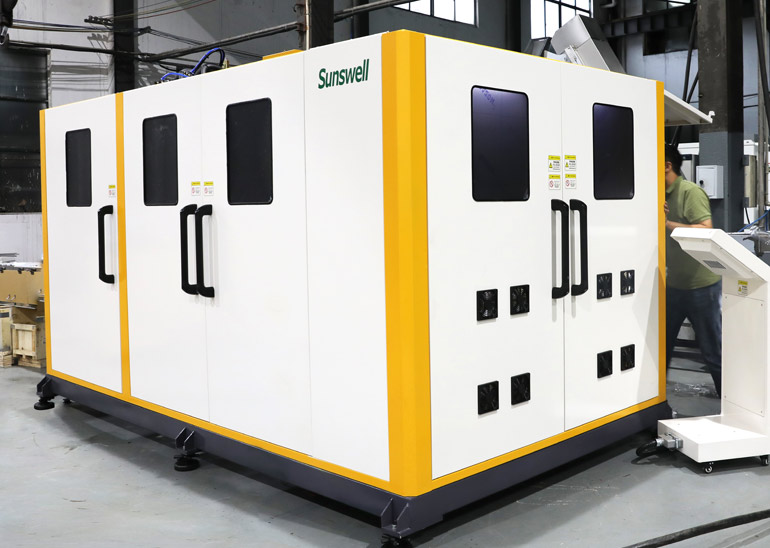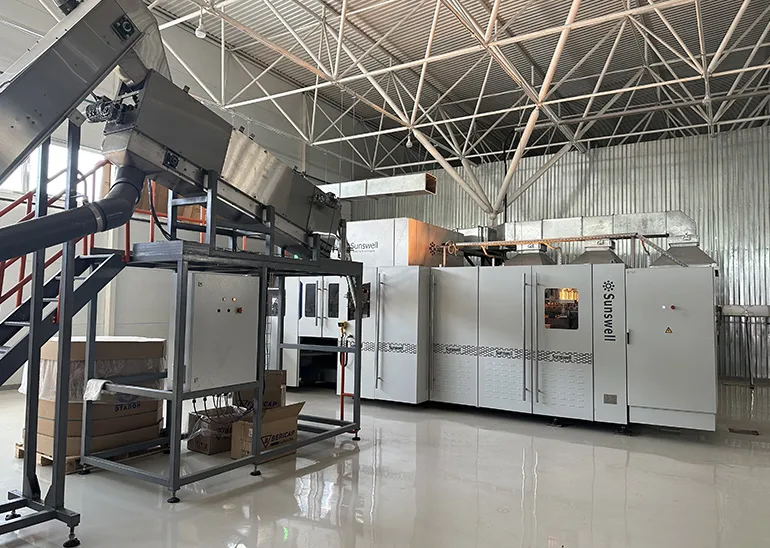
| Types | Linear and rotary blow moulding |
| Input | PET preform, heated in an oven before blowing |
| Output | Bottle matched to the filler neck and format |
| Key control | Preform temperature profile, mould cooling, stretch ratio |
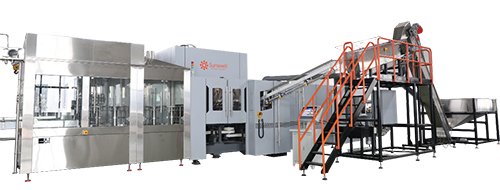
| Integration | Stand-alone, or inside a combiblock |
| Key decision | Blow in-house or buy bottles |
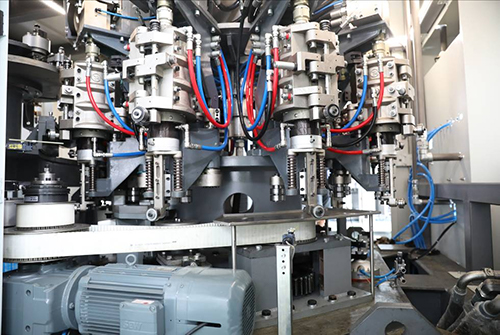
The preform temperature profile decides where the material goes. Too cold and the base is thin; too hot and the wall stretches unevenly. The mould cools the bottle into shape, and the stretch ratio set by the rod and the mould height fixes the wall distribution.
Blowing in-house saves the bottle price and the transport of empty bottles, but adds preform purchasing, a mould per format, compressed air and a skilled operator. Below a certain annual volume the mould cost per format outweighs the saving, which is why small plants buy bottles and large plants blow.
| Machine | Output pattern | Format changes |
|---|---|---|
| Linear | Lower output, more formats | Frequent, shorter changeover |
| Rotary | High output, fewer formats | Longer changeover, more cavities |
| Two-stage on site | Preform bought in | Mould per format still required |
| Combiblock integrated | Linked to filler | Changeover stops the whole block |
Sizing for this duty runs through the Linear Blow Molding, where the valve count is set out.
A mould change is a mechanical operation: mould halves, bottom insert, stretch rod height, oven recipe and gripper settings. On a linear machine it is a scheduled stop measured in tens of minutes; on a rotary machine it is longer because there are more cavities to set.
The Rotary Blow Molding is the matching unit when this becomes a line project.
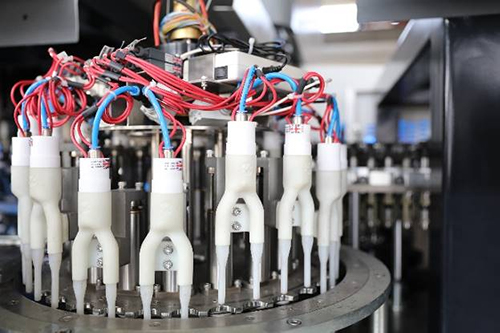
Blowing needs high-pressure air, and producing it is the largest single energy cost in a PET line. Recovery of blowing air, correct nozzle sizing and leak maintenance on the high-pressure circuit are the three measures that move the number, and none of them is visible in a machine quotation.
The same question is worked through from another angle in PET Bottle Blowing Machines: Integration with Your Water Filling.
Yes, with a mould set per format and an oven recipe per preform. Changeover time, not capability, is the limit, and it is why plants with many formats often keep a separate small machine.
High-pressure air, typically in the range set by the machine builder for the bottle size. The exact figure and the consumption belong in the utility schedule; it is the largest energy item on a PET line.
It follows the bottle design and the shelf life requirement, and it is set with the preform supplier. Lighter preforms save material and reduce the process window, so the blowing recipe has to be re-validated.
Usually a cold base or an uneven stretch. The base is the last area to reach blowing temperature, and a short oven or a fast cycle leaves it under-stretched.
Country:Kazakhstan
Product: PET Bottled Sparkling Water, Canned Soft Drink, Canned Tea
Capacity: 25000CPH (250ml)
Solution:Three Lines,7000BPH(1.5L), 15000CPH(330ml),15000CPH(450ml)



 +86 13921964455
 [email protected]

A2 Dongjiu Industrial Park, 30 East Jintang Road, Tangshi, Zhangjiagang, Jiangsu 215600, China