
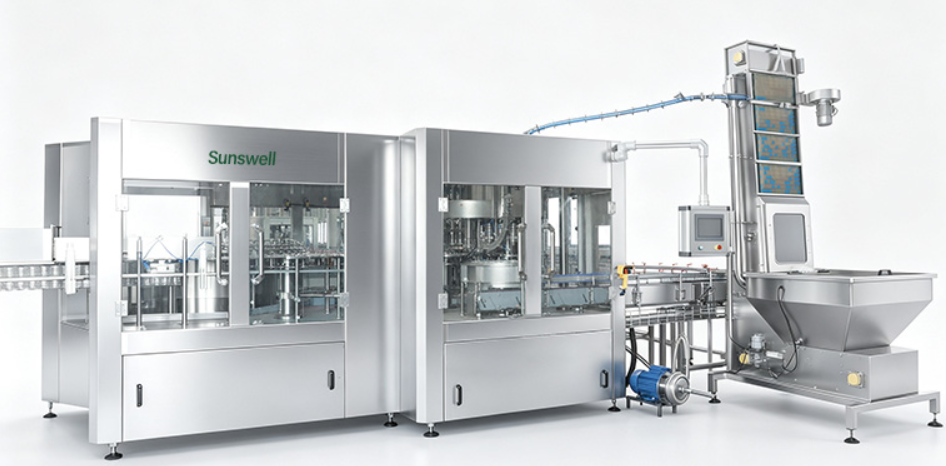
| Scope | Filling, capping, labelling and packing equipment |
| Sizing basis | Demand in units per day, divided by productive hours and a production factor |
| Production factor | 0.65-0.85 depending on formats and changeovers |
| Key control | Fill accuracy, closure integrity, changeover time |
| Key decision | One flexible line or two dedicated lines |
| Acceptance | Output, accuracy, closure and changeover, measured |
Settle the product and the package before the machine. Product viscosity, acidity, carbonation and particle size decide the filling principle; the bottle neck finish decides the capping head and the change parts. A machine chosen before those two are fixed is chosen twice.
Compare the lowest rated station, the changeover time, the CIP time and the consumable cost per 1,000 units. A lower price with a slower packer or a longer CIP is not a lower cost. Ask both suppliers for the same four numbers in writing.
| Decision | What it fixes | What it does not fix |
|---|---|---|
| Filling principle | Product and accuracy | Downstream capacity |
| Valve count | Rated BPH | Changeover and CIP time |
| Automation level | Labour per shift | Product quality |
| Line layout | Floor space and flow | Throughput of the slowest station |
The Gravity Filling Machine for Still Water is the reference unit for this configuration.
It proves the machine meets the written specification on the agreed product, at the agreed format, in the builder workshop. It does not prove the line will run in your building. Both tests are needed, and the second one is where most disputes start.
Larger bottles need different material, handling and pack-stability checks, and the line may run at a different BPH.
Throughput and change-part lists are on the Volumetric Filling Machine for Still Water page rather than in this note.
Capacity is what the machine can do at steady state in one format. Throughput is what the plant gets across a week of changeovers, cleaning and stops. Plans built on capacity alone are the reason new lines look slow in their first month.
The same question is worked through from another angle in How to Prevent Electrostatic Discharge in PET Bottling Lines.
On the same five numbers: the slowest station rating, the changeover time, the CIP time, the consumable cost per 1,000 units, and the spare parts lead time. A quotation that does not state all five cannot be compared with one that does.
BPH is bottles per hour; divide by 60 for bottles per minute. A 12,000 BPH line runs at 200 bottles per minute, and every downstream machine has to carry that rate.
Capacity is usually added by a second line or by a downstream upgrade, not by speeding up the filler. The filler, the capper and the packer are matched, so raising one alone moves the bottleneck.
A monoblock combines rinse, fill and cap on one frame. A full line adds treatment, blowing, labelling, packing and palletizing around it. The monoblock is one station in a longer chain.
Valve count, automation level, material of construction, whether blowing is included, and the packing format. Price follows the specification, so two quotes are only comparable when the specifications match.
Between 0.65 and 0.85. A single-format line on one shift sits near 0.85; a line with four formats and two changeovers per shift sits near 0.65.
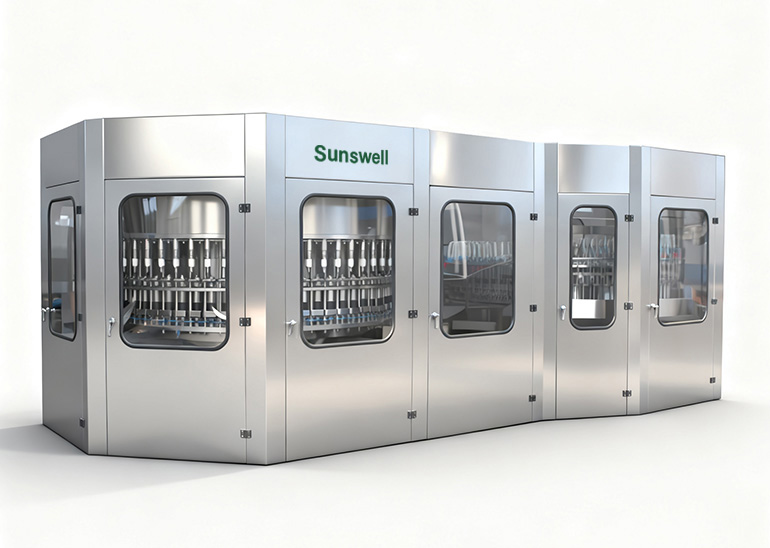
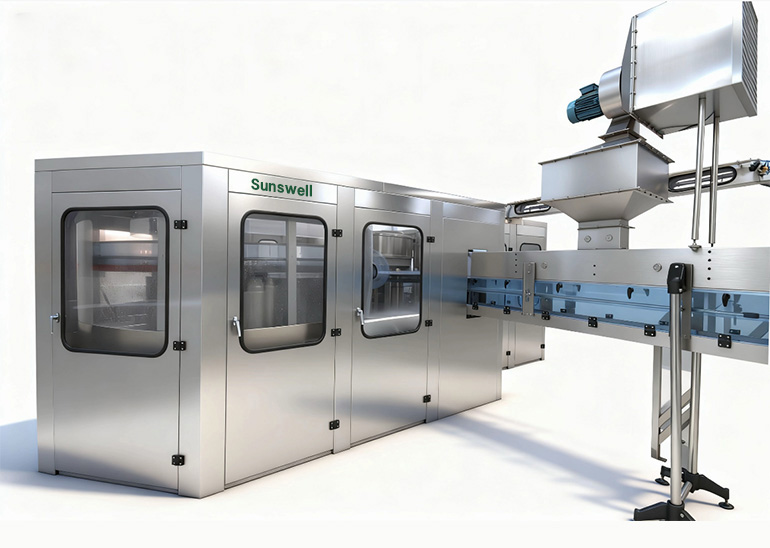
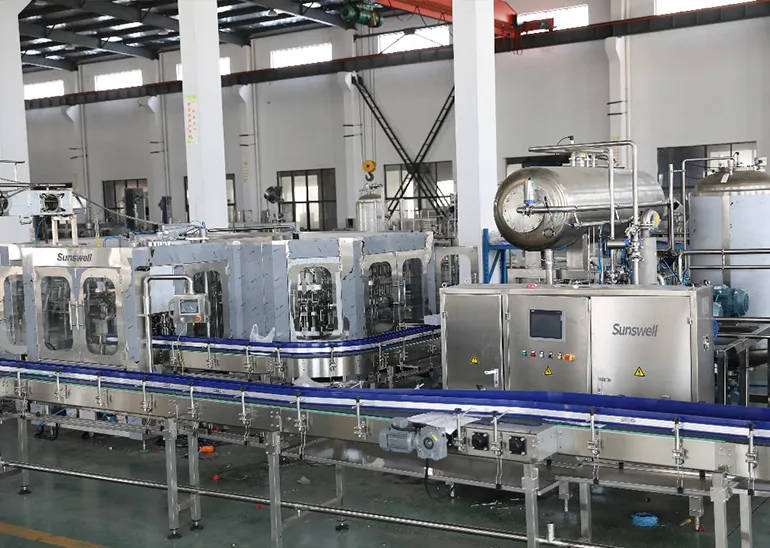
Country:Kazakhstan
Product: PET Bottled Sparkling Water, Canned Soft Drink, Canned Tea
Capacity: 25000CPH (250ml)
Solution:Three Lines,7000BPH(1.5L), 15000CPH(330ml),15000CPH(450ml)



 +86 13921964455
 [email protected]

A2 Dongjiu Industrial Park, 30 East Jintang Road, Tangshi, Zhangjiagang, Jiangsu 215600, China


