


Technology Guide · Combiblock Series
What Is a Blow-Fill-Cap Combiblock? A Complete Technology Guide
One block. One operator. 0 air conveyor.
20,000 m²
Manufacturing facility
444+
Lines delivered
71+
Countries exported
ISO/CE
Certified · SGS audited
80+
Staff · in-house R&D
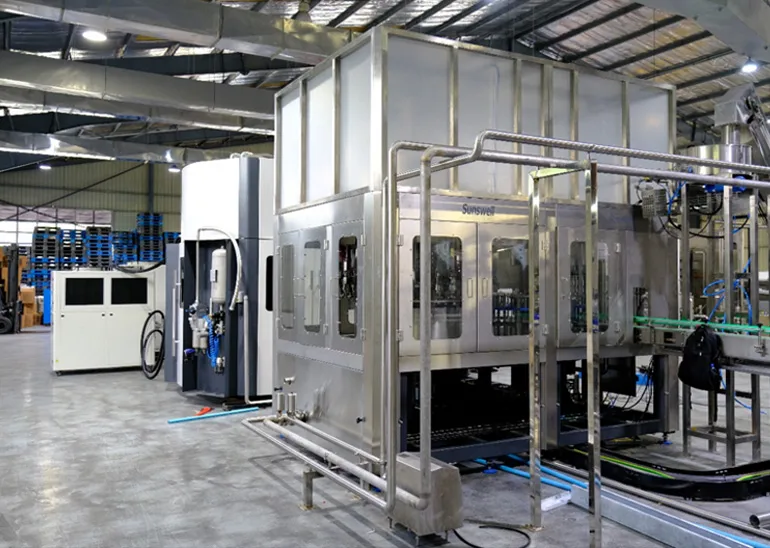
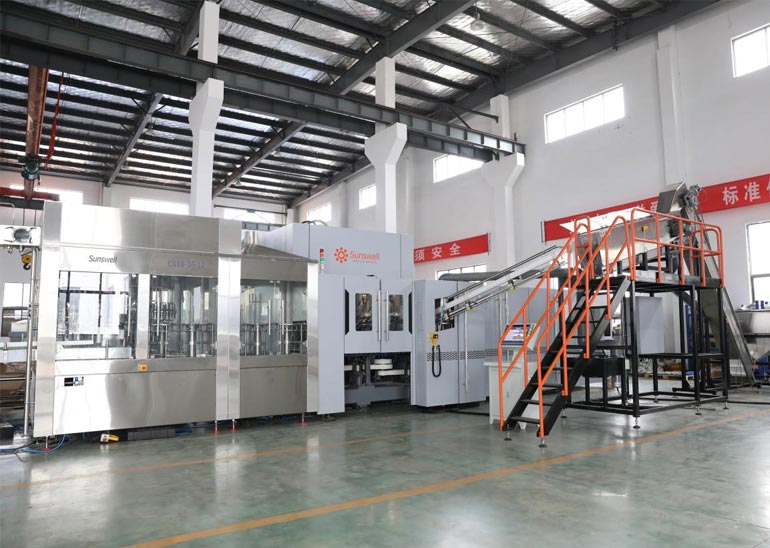
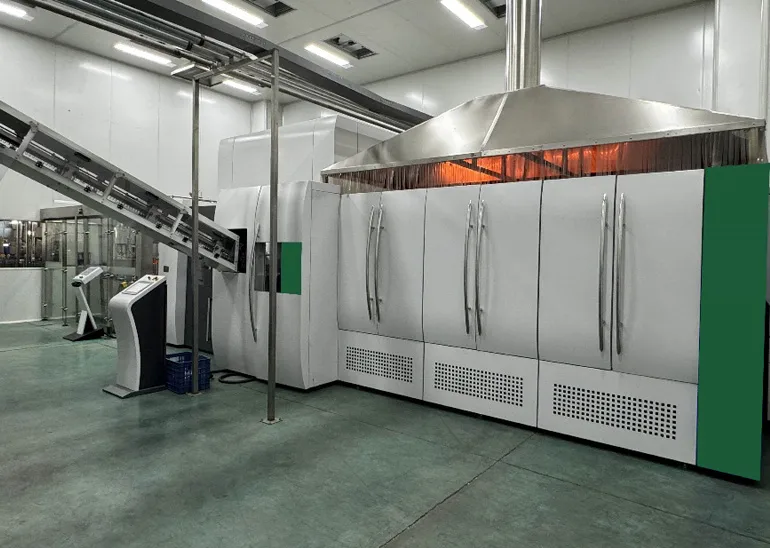
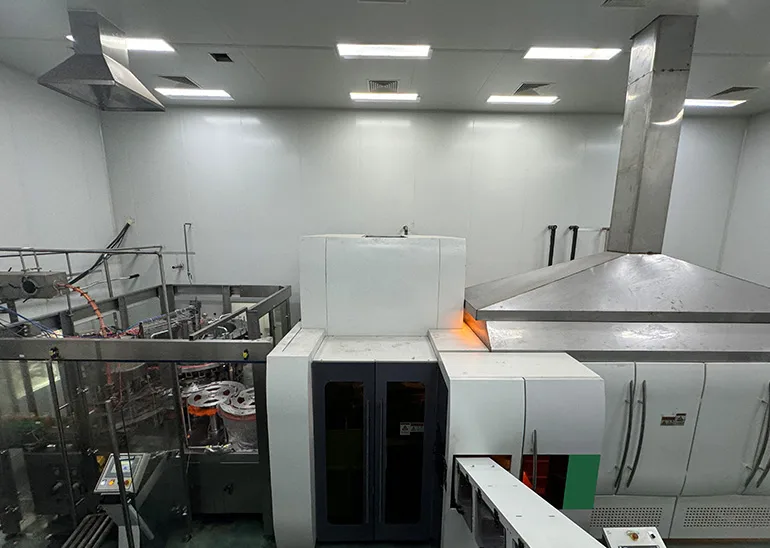
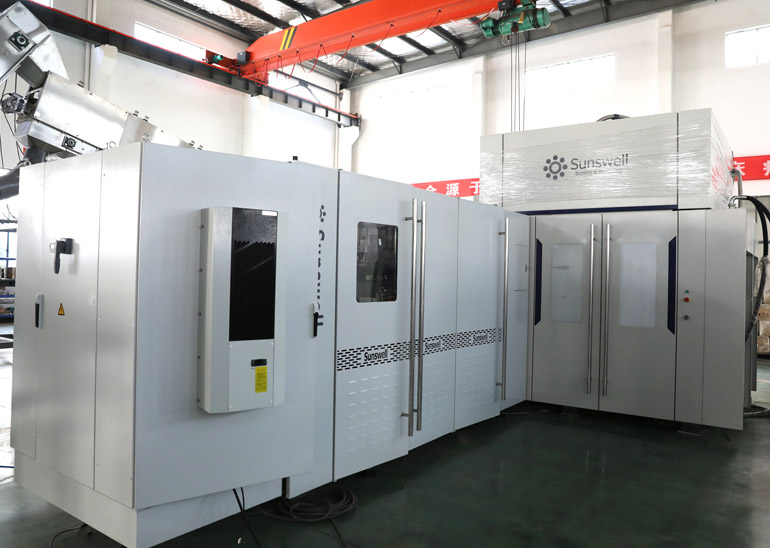
Short answer: A blow-fill-cap combiblock is a single machine that joins three normally separate operations — PET bottle blow moulding, liquid filling and capping — onto one common frame with one drive and one control system. Bottles transfer by neck-handling starwheels, never touching a rail. Sunswell builds combiblocks from 2,000 BPH to 48,000 BPH for still water, CSD, hot-fill juice & tea, edible oil and home-care liquids.
🎯 Key takeaways
- 2,000–48,000 BPH — single-operator 3-in-1 block: blow, fill, cap on one frame
- Cuts 2 operators per shift vs separate blowing + filling lines
- Saves ~48 tonnes of PET resin per year by eliminating bottle weight safety margin for air conveyors
- ~30% less floor space — no air conveyor between machines
- Not recommended below ~8,000 BPH or when you also sell empty bottles separately
On this page
1. How a combiblock actually works, step by step
On a conventional line, a blow moulding machine produces empty bottles, an air conveyor floats them across the room, and a separate rinser-filler-capper monoblock fills them. A combiblock deletes the middle step. The blow moulder and the filler sit on one base frame and share one transfer path — an empty bottle goes from mould to filling valve in seconds without ever entering an air conveyor.
The sequence inside a Sunswell combiblock:
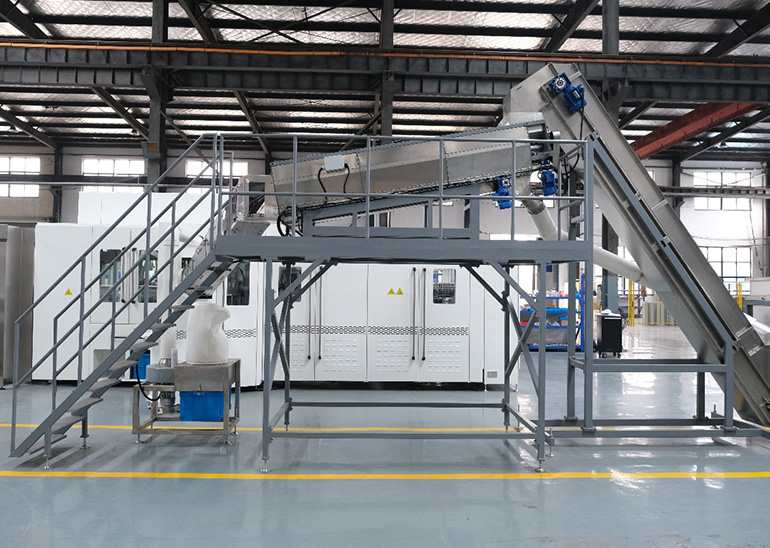
- Preform feeding. Preforms are tipped into an unscrambler, oriented neck-up and fed into the heating furnace on a chain.
- Heating. Infrared lamps heat the preform body. Ceramic reflectors behind each lamp are individually adjustable to preform length — this controls wall-thickness distribution in the finished bottle.
- Stretch blow moulding. A stretch rod pulls the heated preform axially while low-pressure air initiates expansion; high-pressure air then forces the material against the mould wall.
- Neck transfer. The bottle leaves the mould gripped by the neck ring via a transfer starwheel. It never rides on its base and never rubs against a conveyor rail.
- Filling. The bottle is handed to the filler carousel. Depending on valve type, product is dosed by weight, volume, gravity or isobaric counter-pressure.
- Capping. Caps feed from a hopper and elevator, sorted, and applied by a rotary capping head with controlled torque.
- Discharge. The sealed bottle exits on a chain conveyor towards labelling and packing.
2. The three modules inside the block
2.1 Blow moulding module
A rotary stretch blow moulder built into the block. The commercially relevant features are the individually adjustable ceramic reflectors and the air-recovery circuit that reclaims part of the high-pressure blowing air. Blowing air is typically the single largest utility cost in PET bottle production, so recovery directly affects per-bottle cost.
2.2 Filling module
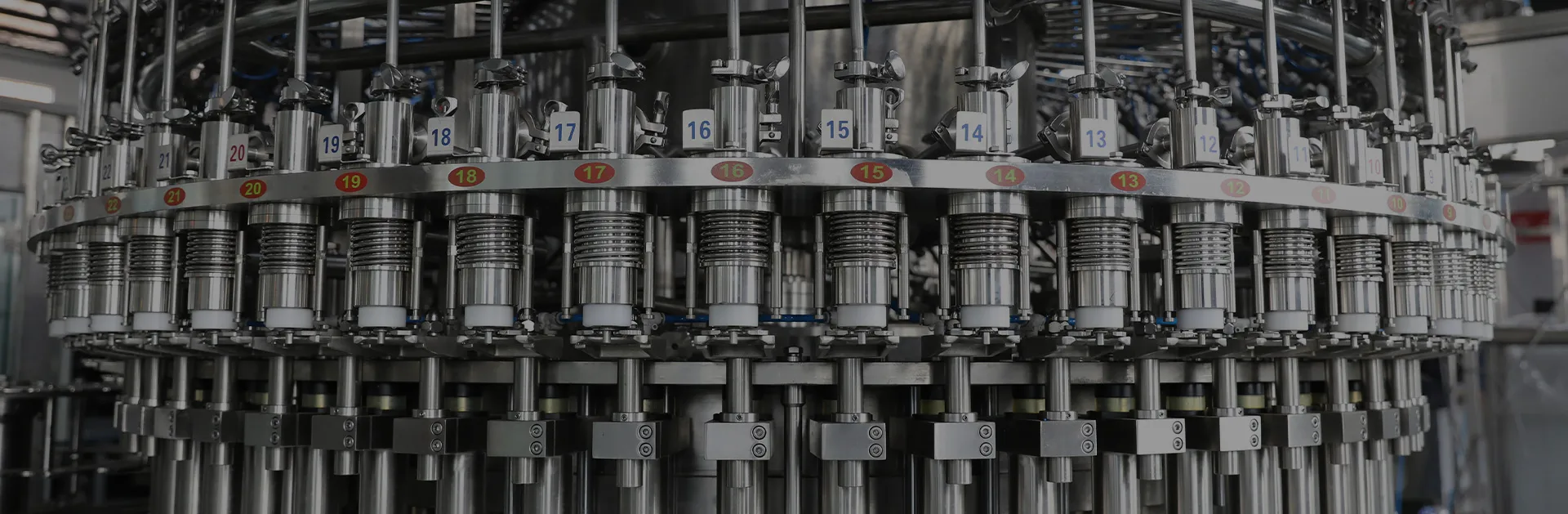
A rotary carousel in SUS 304 stainless steel, with valve count scaled to output. For carbonated products the carousel becomes a pressurised isobaric filler: CO₂ pre-pressurisation equalises bottle and tank pressure before the liquid valve opens, and displaced CO₂ returns to the tank — no venting, no foaming. CIP-ready as standard.
2.3 Capping module
Cap hopper, elevator, chute and rotary capping turret, all on the same frame and same mechanical drive. Because the capper shares the drive with the filler, it can never fall out of phase — a common downtime trigger when three independent machines are synchronised electrically across a plant.
Engineering note. Sunswell combiblocks use a uniform drive control, uniform lubrication and uniform safety concept across all three modules, with central energy and media supply. That is the real definition of a "combi": not three machines bolted together, but one machine with three functions sharing a single backbone.
3. Capacity ranges by product and bottle size
Output depends on preform design, bottle volume, wall thickness and product temperature. The table below shows the working envelope for Sunswell combiblocks:
| Product | Bottle size | Capacity range |
|---|---|---|
| Non-carbonated water | 0.2 – 2 L | 12,000 – 48,000 BPH |
| 3 – 7 L | 3,000 – 12,000 BPH | |
| 7 – 16 L | 2,000 – 6,000 BPH | |
| Hot-fill (juice, tea) | 0.2 – 2 L | 6,000 – 36,000 BPH |
| Carbonated (CSD, sparkling) | 0.2 – 2 L | 12,000 – 36,000 BPH |
| Edible oil | 0.2 – 2 L | 12,000 – 36,000 BPH |
| Daily care / home care | 0.2 – 2 L | 12,000 – 36,000 BPH |
Capacity confirmed after preform and bottle drawings are reviewed. Higher-output configurations beyond 36,000 BPH are available on request for dedicated water lines.
4. Choosing the filling valve
The valve is the decision that most affects accuracy, cleaning and capital cost. Four configurations:
| Valve type | Dosing principle | Best suited to | Trade-off |
|---|---|---|---|
|
Load cell net weight |
Each bottle sits on a weighing cell; valve closes at target weight | Edible oil, high-value liquids, products sold by weight, large 5 L formats | Highest accuracy, highest cost; cells need periodic calibration |
| Volumetric | Flow meter measures a set volume per bottle | Water, juice, tea — where fill volume is the declared quantity | Accurate, easy recipe change; more electronics than mechanical |
| Mechanical | Gravity or level-controlled fill, mechanically actuated | Plain still water, simple CSD at lowest capital cost | Cheapest and most robust; recipe changes are manual |
| Semi-electric | Mechanical valve body with electric open/close control | Plants wanting faster changeover without full electronic filler | Middle ground on price and flexibility |
A practical rule: if the label declares litres, start from volumetric; if it declares kilograms or the product is expensive per litre, start from load cell; if you are filling plain water at the lowest possible capex, mechanical is still the right answer.
5. Where the savings really come from
Ranked by financial impact:
- Lighter bottles. On a separate line the bottle must survive the air conveyor — pushed by air, guided by rails, with a safety margin built into the design weight. Inside a combiblock the bottle is only held by its neck ring, so the body can be designed for the product rather than the conveyor. Preform resin is the largest recurring cost in PET bottling — every gram removed goes straight to gross margin, permanently.
- No air conveyor. You delete the conveyor, blowers, filtration, cleaning routine and electricity. On a wide plant the air conveyor can be tens of metres of ducting running 24/7.
- Labour. One control system, one HMI, one set of alarms. The block is designed for a single operator instead of one per machine — a real saving of 2 operators per shift vs a conventional 3-machine setup.
- Floor space and building cost. Expect ~30% less floor area vs separate machines. Most relevant when constructing a new plant or retrofitting into a building you cannot extend.
📊 Example comparison — 24,000 BPH still water, 500 ml PET:
| Metric | Combiblock | Separate line | Delta |
| Floor space | ~180 m² | ~280 m² | −100 m² |
| Operators/shift | 1 | 3 | −2 |
| Bottle weight | ~12.5 g | ~14.5 g | −2 g/bottle |
| Annual resin saving* | ~48 tonnes (at 24,000 BPH × 16 h × 300 d) | ||
* Estimates based on typical industry benchmarks. Actual figures depend on preform supplier, bottle design and operating conditions.
6. When a combiblock is the wrong choice
A combiblock is not the right answer when:
- You already own a good blow moulder. If your blower has years of life left, a separate filler is cheaper than replacing both.
- You sell empty bottles as a separate business. A combiblock has no bottle-only output — every bottle it makes gets filled immediately.
- You run extremely high SKU variety. Frequent changeovers across many bottle families favour decoupled machines with a buffer between them.
- You need a large accumulation buffer. A separate line's air conveyor doubles as several minutes of buffer. A combi has none — a stop in one module stops the other. Reliability engineering manages this, not inventory.
- Glass, cans or non-PET. A blow-fill-cap block only makes sense for PET. Glass and aluminium need conventional rinser-filler-capper monoblocks.
Full trade-off analysis in Combiblock vs separate blowing and filling line.
7. How to specify one: a checklist
Bring these eight items to a first technical call:
| 1. Product | Still water / CSD / juice / tea / edible oil / home care; viscosity; pulp content |
| 2. Target output | BPH, and shifts per day |
| 3. Bottle sizes | All SKUs, with drawings if available |
| 4. Preform | Weight, neck finish standard, supplier |
| 5. Cap | Type, diameter, sample if possible |
| 6. Utilities available | Voltage & frequency, compressed air, chilled water, steam |
| 7. Building constraints | Usable L × W × clear height, door size for installation |
| 8. Destination market | Determines certification: CE, EAC/EAEU, SASO, FDA |
Frequently asked questions
What does "3-in-1 combiblock" mean?
Blow moulding, filling and capping inside one machine on one frame, with one drive system and one control system. The bottle transfers by neck-handling starwheels and never leaves the block until capped.
Can a combiblock fill carbonated drinks?
Yes — isobaric filler configuration. CO₂ pre-pressurises the bottle to tank pressure, the liquid valve opens, and displaced CO₂ returns to the tank. No venting, no foaming. Sunswell supplies CSD combiblocks from 12,000 to 36,000 BPH in 0.2–2 L.
Can you hot-fill juice in a combiblock?
Yes, hot-fill configuration, 6,000–36,000 BPH for 0.2–2 L. Requires heat-resistant bottle geometry — preform and mould design are agreed together with the machine specification.
How many people run a combiblock?
The block itself: one operator. Additional staff needed for downstream labelling, packing, palletising and material handling.
What's the largest bottle a combiblock handles?
Up to 16 L PET. Output drops as volume rises: 3–7 L runs 3,000–12,000 BPH; 7–16 L runs 2,000–6,000 BPH for non-carbonated water.
Combiblock vs separate blower + filler — cost difference?
Purchase price is usually close to the combined price of the two machines — the air conveyor, its blowers and installation are no longer needed. The real difference appears in running cost: lighter bottles, lower electricity, fewer operators. See Combiblock vs separate line.
Which filling valve should I choose?
Load cell for weight-dosed or high-value products (edible oil); volumetric for water, juice, tea where declared volume must be exact; mechanical for plain water at lowest capex; semi-electric as a middle option. See section 4 above.
About the author
Written by the Sunswell engineering team — led by Howie SUN, Founder & CEO, with 14 years in filling and blow-moulding equipment R&D and turnkey project delivery across 71+ countries.
Last reviewed: 2026-08-06 · Reviewed by Sunswell engineering team
Ask our engineering team →Recommend Products
Project references
-

Vizit, 12,000BPH 1L Bottling Line with Combiblock for CSD, Kazakhstan
Country: Kazakhstan
Product: PET Bottled Carbonated Soft Drinks
Capacity: 12000BPH (1L)
Solution:Carbonated Drinks Production Line
Read More + -
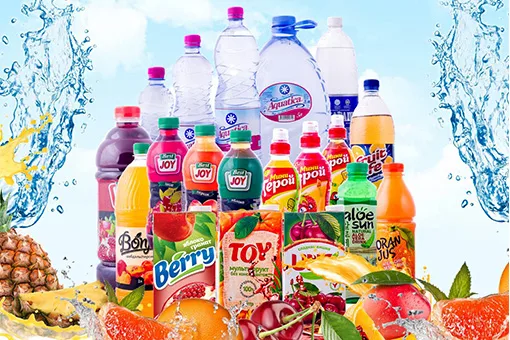
Rauan, 8 Sets of Bottlingand Canning Lines from 12,000-24,000BPH for Water, CSD and Juice, Kazakhstan
Country:Kazakhstan
Product: PET Bottled Sparkling Water, Canned Soft Drink, Canned Tea
Capacity: 25000CPH (250ml)
Solution:Three Lines,7000BPH(1.5L), 15000CPH(330ml),15000CPH(450ml)
Read More +
Have a specific project in mind?
Tell us product, target BPH, bottle sizes and market. We reply with a draft layout, equipment list and lead time estimate.
Fill the inquiry form ↑