


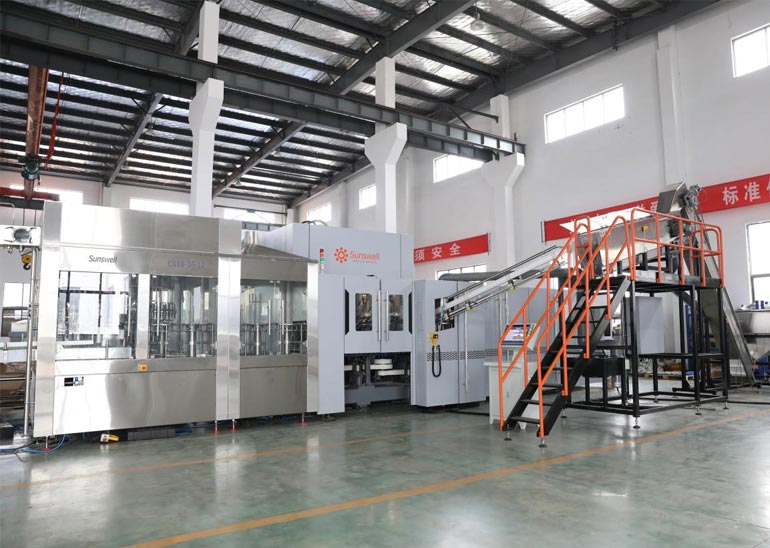
Line configuration · Water
Mineral & Purified Water — Line Configuration Options and Investment Levels
A water line can be configured at three investment levels — starter, standard and full combiblock — and the right level is set by output, format flexibility and bottle strategy, not by budget alone. This page compares what each level includes and where the trade-offs land.
2,000–48,000
BPH range
3
Configuration levels
444+
Lines delivered
71+
Countries exported
20,000
m² workshop
Short answer: Three levels cover most water projects: a starter line (standalone gravity or volumetric filler with simple rinsing and capping) for low output and flexibility; a standard line (separate blow moulder, filler, capper with conveyor) for mid output and bought-in bottle flexibility; and a full combiblock (blow-fill-cap in one block) for volume, lightweight bottles and the lowest footprint. Investment rises with output and automation; the level that fits is the one that matches year-one sales and bottle strategy.
🎯 Key takeaways
- Starter lines suit low output and budget; flexibility is their real advantage.
- Standard lines keep the option of bought-in bottles and flexible formats.
- Combiblocks win on volume, bottle weight and footprint above roughly 8,000 BPH.
- The valve (gravity vs volumetric) sets accuracy and cost within any level.
- Investment level follows year-one sales, not ambition.
On this page
1. The three levels
Water lines configure into three recognisable levels: starter (standalone filler with minimal front end), standard (separate blowing, filling, capping machines linked by conveyor), and full combiblock (blow-fill-cap in one carousel). The levels differ in output, footprint, bottle weight and flexibility — and the differences are engineering realities, not marketing tiers.
| Level | Configuration | Best fit |
|---|---|---|
| Starter | Rinser/filler/capper, standalone | Low output, flexible, bought-in bottles |
| Standard | Blow moulder + filler + capper, separate | Mid output, mixed formats |
| Combiblock | Blow-fill-cap in one block | Volume, light bottle, small footprint |
Investment rises across the levels, but so do the savings they unlock — the comparison is about where the payback is, not which level is 'better'.
2. Starter level
A starter line runs a rinser, a gravity or volumetric filler and a capper as standalone machines. It handles bought-in bottles, changes formats with change parts, and matches a small plant's real demand — typically well below 8,000 BPH. Its advantages are the lowest investment and full format flexibility; its cost is more labour and a bigger footprint per bottle.
For a first plant, a starter line is often the honest answer: it runs at capacity, earns revenue, and the upgrade path is clear.
Below roughly 2,000 BPH, ask for semi-automatic options too — a full monobloc is overkill for a very small plant, and the semi-automatic price is a different world.
The starter level still needs the same discipline: bottle drawing, water analysis and utilities confirmed before order.
3. Standard level
A standard line links a blow moulder, a filler and a capper with conveyors, with buffer and handling in between. It runs its own bottles from preforms and keeps the option of bought-in bottles — the plant is not locked to one supply route. Output reaches the mid band, and the footprint and labour are higher than a combiblock of equal output.
The standard level suits plants that want volume flexibility — several formats, seasonal products, or a mix of own-blown and purchased bottles.
4. Full combiblock
A blow-fill-cap combiblock forms the bottle, fills it and caps it in one carousel. The bottle is blown metres before it is filled, so it can be lighter — the grammage saving repeats on every bottle for the line's life — and the footprint and labour drop versus separate machines. Above roughly 8,000 BPH, those savings compound and the combiblock is usually the lower-cost answer.
The trade is format lock-in: the block is set up around the main format, and changeovers are change-part events, not instant switches. A plant with one or two stable formats is the natural home for a combiblock.
5. The valve decision
Within any level, the valve sets accuracy and cost: gravity is cheapest and adequate where level tolerance is loose; volumetric meters by chamber and tightens volume repeatability for declared-content markets. The valve is chosen with the product and the legal tolerance — and it is fixed at specification, not upgraded later.
On still water sold by the bottle, a gravity valve on a starter line is not a compromise; it is the correct engineering. Paying for volumetric or load-cell accuracy you cannot monetise is waste.
6. Matching level to strategy
Match the level to three facts: year-one sales (output), format stability (how many formats the line must run), and bottle strategy (own-blown light bottles vs bought-in flexibility). A plant that changes formats weekly does not want a combiblock; a plant that runs one format at volume does not want the flexibility it will never use.
| Your situation | Level that fits |
|---|---|
| Small output, bought-in bottles | Starter |
| Mid output, mixed formats | Standard |
| Volume, own preforms, light bottle | Combiblock |
Be honest about the format list — the most common misconfiguration is buying flexibility that the market never asks for.
7. The upgrade path
The levels are a ladder, not a trap: a starter line earns revenue while demand grows, and the next step is a second line or a combiblock sized on the proven demand — not a rebuild of the first. Plan the hall from day one so the second line fits, and the upgrade is an addition, not a relocation.
The full picture across packages and speeds is in the water filling machine range and the combiblock range.
Frequently asked questions
Which level is best for a new water plant?
The one that matches year-one sales and format stability. A starter line for small output and flexibility; a combiblock for volume with stable formats.
What output suits a combiblock?
Roughly 8,000 BPH and above, where footprint and bottle-weight savings compound. Below that, separate or starter configurations are usually cheaper.
Can I use bought-in bottles on a combiblock?
No — a combiblock blows its own bottles from preforms. If you need bought-in bottle flexibility, choose the standard configuration.
Gravity or volumetric valve?
Gravity is cheapest and adequate where level tolerance is loose; volumetric tightens volume repeatability for declared-content markets.
Can I upgrade later without rebuilding?
Yes — the levels are a ladder. A second line sized on proven demand is usually the step, and a hall planned for it makes the upgrade an addition.
What investment range should I plan?
Investment follows the level and output; the honest way to budget is to send your product, output and bottle drawing to suppliers and compare package quotes.
About the author
Written by the Sunswell engineering team — led by Howie SUN, Founder & CEO, with 14 years in filling and blow-moulding equipment R&D and turnkey project delivery across 71+ countries.
Last reviewed: 2026-08-28 · Reviewed by Sunswell engineering team
Ask our engineering team →Recommend Products
Have a specific project in mind?
Tell us product, target BPH, bottle sizes and market. We reply with a draft layout, equipment list and lead time estimate.
Fill the inquiry form ↑