


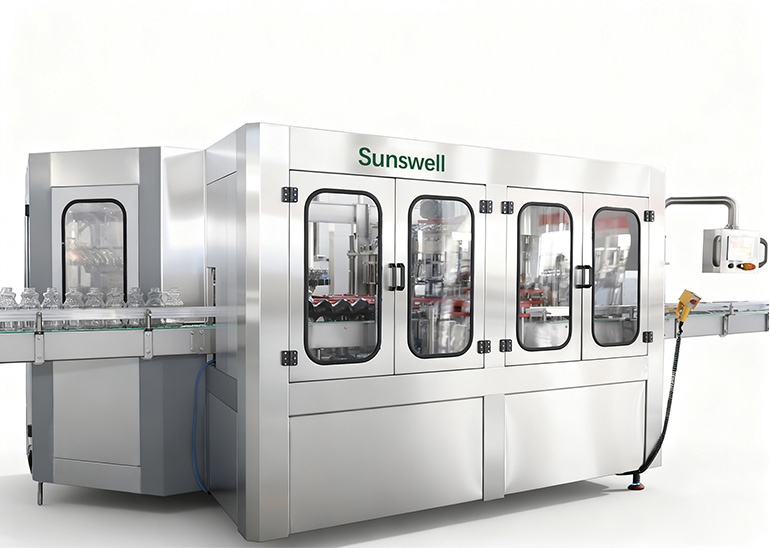
Production line · Liquor & spirits
Liquor & Spirits Production Line
Spirits are the gentlest liquid a line will ever run — no gas, no heat, no pulp — but the package is demanding: glass, precise fill levels, tamper-evident closures and strict excise compliance. This page walks the spirits bottling line and where its money is actually spent.
444+
Lines delivered
71+
Countries exported
20,000
m² workshop
80+
Staff
2011
Sunswell founded
Short answer: A spirits line runs: bottle handling → rinsing → filling (gravity or piston — no counter-pressure needed) → capping with a tamper-evident closure → labelling → packing. The product is simple to fill; the package, the fill-level accuracy and the excise compliance are where the line's complexity lives. Glass dominates, and the filler is chosen on fill accuracy and the bottle, not on the liquid.
🎯 Key takeaways
- Spirits fill by gravity or piston — no gas, no heat, so the filling principle is the simple half.
- Fill-level accuracy is the cost driver — overfill on spirits is giveaway of expensive liquid.
- Glass handling and tamper-evident closures set the capping and infeed spec.
- Excise compliance means accurate records of fill, loss and packaging — the line should support them.
- The bottle and cap drawing decide the filler — send them with the enquiry.
On this page
1. The complete process
The line: depalletising or hand feed → bottle handling and rinsing → filling → capping → labelling → packing → palletising. Spirits need no counter-pressure, no heat treatment and no deaeration — the process is deliberately simple, which is why the line's real engineering is in the glass handling, the fill accuracy and the closure.
Because the liquid is expensive and the brand is upmarket, the line is judged on accuracy and gentle handling, not on speed alone.
2. Gravity and piston filling
Spirits fill by gravity (a level-based fill for standard bottles) or by piston (a measured-volume fill for accuracy and viscous products such as liqueurs). Neither needs counter-pressure — the liquid is still, and the bottle simply fills from the tank. The choice is accuracy versus simplicity, set by the brand's fill tolerance and the product's viscosity.
Load-cell weighing is the next tier where declared fill accuracy is audited strictly — each bottle weighed at the fill, with the giveaway cost traded against the weighing hardware.
3. Fill accuracy
On spirits, overfill is expensive: every millilitre of giveaway multiplied by the bottle's price is real money, and underfill is an excise and compliance risk. The filler's accuracy — gravity level control, piston volume, or load-cell weighing — is chosen on the tolerance the brand must hold, and it is the difference between a line that leaks profit and one that does not.
State the fill tolerance and the declared volume in the spec. The filler that holds ±2 g costs more than the one that holds ±5 g — and on spirits the accuracy pays for itself.
Accuracy is a specification, not a feature — it is quoted, tested at FAT and verified in production.
4. Glass handling
Glass is heavy, brittle and expensive to damage. The line handles it gently: soft infeed, no harsh transfers, and protection between stations. The infeed and the conveyor are specified around the bottle — a heavy decanter needs different handling than a standard 700 ml bottle — and the rinser, where fitted, is sized to the glass.
Glass breakage is downtime and lost product; the handling design is where the line's real reliability lives.
5. Capping and sealing
Spirits closures are tamper-evident by law and brand: screw caps with tamper rings, roll-on closures, corks, or aluminium seals. The capper is specified around the closure — torque control for screw caps, pressure for roll-on, insertion for corks — and the tamper feature is verified in line. The closure is part of the brand, so it is not a commodity buy.
Confirm the closure and its tolerance with the supplier before the capper is quoted — a cap that cannot hold torque is a recall waiting to happen.
6. Labelling and decoration
Spirits carry body, back and neck labels, sometimes foil and decoration — the labelling section is a visible cost centre. Self-adhesive, cold-glue and wrap-around systems each suit a brand and speed; the label spec (material, adhesive, shape) is part of the line spec, not an afterthought.
Decorative labelling (foil, embossing, special labels) needs careful machine selection — ask the supplier to quote the labelling section on your actual label set.
7. Excise and compliance
Alcohol production is excise-controlled in most markets: fill records, losses, packaging counts and traceability are audited. The line should support the records — accurate count, fill data and batch traceability — and the plant should run the controls. The machine cannot do compliance alone, but it can make the records honest.
Ask what data the line can log: counts, rejects, fill parameters per batch. That log is the excise file's backbone.
Frequently asked questions
Does spirits filling need counter-pressure?
No — spirits are still liquids. Gravity or piston filling is standard; counter-pressure is for carbonated products.
Which filler gives the best accuracy?
Piston for measured volume, load-cell for weighed fill — the choice depends on the tolerance the brand must hold and the giveaway cost of the product.
Why is glass handling important?
Glass is heavy and brittle; damage is downtime and lost product. The infeed and conveyors are specified around the bottle.
What closures are standard?
Screw caps with tamper rings, roll-on closures, corks and aluminium seals — the capper follows the closure, which follows the brand.
Is excise compliance the line's job?
Partly — the line should log counts, fill data and rejects per batch; the plant runs the controls. The two together pass the audit.
Can Sunswell supply a spirits line?
Yes — gravity, piston and load-cell fillers for glass, with capping, labelling and packing as a complete line.
About the author
Written by the Sunswell engineering team — led by Howie SUN, Founder & CEO, with 14 years in filling and blow-moulding equipment R&D and turnkey project delivery across 71+ countries.
Last reviewed: 2026-08-28 · Reviewed by Sunswell engineering team
Ask our engineering team →
Have a specific project in mind?
Tell us product, target BPH, bottle sizes and market. We reply with a draft layout, equipment list and lead time estimate.
Fill the inquiry form ↑