


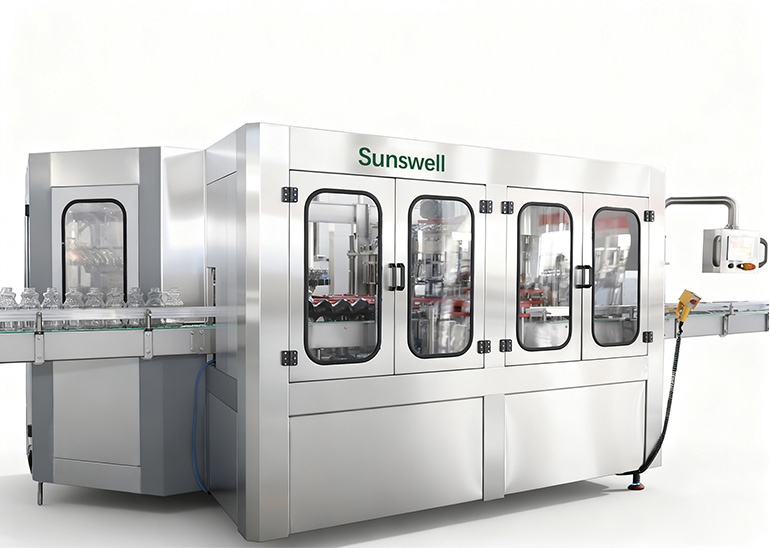
Line configuration · Liquor & spirits
Liquor & Spirits — Line Configuration Options and Investment Levels
Spirits lines configure along one axis that matters — fill accuracy — with gravity, piston and load-cell tiers, and a second axis in the closure (screw, roll-on, cork, aluminium seal). The product is simple to fill; the accuracy and the package set the investment.
444+
Lines delivered
71+
Countries exported
20,000
m² workshop
80+
Staff
2011
Sunswell founded
Short answer: Liquor configurations run three filler tiers: gravity (level-based, cheapest, adequate where tolerance is loose), piston (measured volume, for accuracy and liqueurs) and load-cell (weighed fill, for declared-weight markets and expensive product). The closure axis adds a capper per closure type — screw with tamper ring, roll-on, cork or aluminium seal. Accuracy is the profit axis; the closure is the brand axis.
🎯 Key takeaways
- Gravity is the entry tier; piston and load-cell add accuracy at rising cost.
- Fill accuracy is the profit axis — giveaway on spirits is expensive liquid.
- The closure sets the capper: screw, roll-on, cork and aluminium seal are different specs.
- Glass handling and gentle infeed are part of every configuration.
- The brand's fill tolerance and closure decide the level — not the brochure.
On this page
1. The two axes
Liquor lines configure along two axes: fill accuracy (gravity, piston, load-cell) and closure (screw, roll-on, cork, aluminium seal). The product is the easiest liquid a filler will see — no gas, no heat, no pulp — so the accuracy axis is the profit axis and the closure axis is the brand axis. Both are set by the brand's tolerance and package, then the line follows.
| Tier | Principle | Best for |
|---|---|---|
| Gravity | Level-based fill | Loose tolerance, entry |
| Piston | Measured volume | Accuracy, liqueurs |
| Load cell | Weighed fill | Declared weight, expensive |
The tiers stack in accuracy and cost; the product and the market choose the tier.
2. Gravity tier
A gravity filler opens a valve and fills to a level — the simplest, cheapest tier, adequate where the fill tolerance is loose and the bottle is standard. It suits entry configurations and markets that do not audit declared fill strictly. The trade is scatter: level-based fill varies with bottle shape and posture.
Gravity is not a compromise when the tolerance allows it — it is the correct engineering for a standard bottle at a loose tolerance.
3. Piston tier
A piston filler meters a measured volume per stroke — tighter accuracy than gravity, reliable for liqueurs and viscous spirits, and immune to bottle-posture variation. The accuracy is set by the cylinder and the product's consistency, and it is the standard tier for mid-market spirits where the brand wants repeatable fill without weighing every bottle.
Piston fillers handle the product gently and dose consistently — the common choice for the bulk of the spirits market.
4. Load-cell tier
A load-cell filler weighs each bottle and fills to a target weight, compensating for bottle and density variation in real time — the accuracy tier for declared-weight markets and expensive or gift-pack products. The giveaway saving pays for the weighing hardware on high-value liquid, and the tolerance is verified at FAT.
For declared-weight markets or higher-value gift packs, load cell is the honest tier: the accuracy is auditable and the giveaway saving is real.
Load cell is the slowest per station and the most expensive — reserve it for where the product or the law pays for it.
5. The closure axis
The closure sets the capper: screw caps with tamper rings need torque-controlled capping; roll-on closures need pressure and profile tooling; corks need insertion and, for some products, a capsule; aluminium seals need a separate applicator. The capper is built around the closure — and the closure is part of the brand, so it is specified, not substituted.
Confirm the closure and its tolerance before the capper is quoted — a cap that cannot hold torque is a recall waiting to happen.
6. Investment levels
| Level | Filler tier | Closure | Best fit |
|---|---|---|---|
| Entry | Gravity | Screw cap | Small distillery, loose tolerance |
| Standard | Piston | Screw / roll-on | Regional brand, repeatable fill |
| Top | Load cell | Any, incl. cork & foil | Declared weight, gift packs |
The levels follow the brand's tolerance and package — a small distillery with a gift-pack line may buy the top tier without volume, because the product justifies it.
7. Matching to brand
Match the configuration to the brand's two facts: the fill tolerance it must hold (set by the market's rules and the product's price) and the closure it uses (set by the brand image). A standard screw-cap spirit at a loose tolerance is an entry-tier line; a declared-weight high-value product is a load-cell line. The filling machine range shows the same tiers across products.
Frequently asked questions
Which filler tier do I need?
It follows the fill tolerance you must hold: gravity for loose, piston for repeatable volume, load-cell for declared weight or expensive product.
Why is fill accuracy the profit axis?
Spirits are expensive — overfill is giveaway multiplied by the bottle price, and underfill is a compliance risk. Accuracy is a business decision, made consciously.
Does the closure matter for the line?
Yes — the capper is built around the closure: screw needs torque control, roll-on needs pressure tooling, cork needs insertion, aluminium seal needs an applicator.
Can a small distillery afford a load-cell line?
If the product is expensive or declared-weight, yes — the giveaway saving pays for the hardware. Accuracy is justified by the product, not the volume.
What speed do spirits lines run?
Speed follows the filler tier — load-cell is slowest per station. Size the line on the accuracy tier the brand needs, not on a speed target alone.
Can Sunswell supply a spirits configuration?
Yes — gravity, piston and load-cell fillers with screw, roll-on, cork and aluminium-seal capping, plus glass handling and labelling.
About the author
Written by the Sunswell engineering team — led by Howie SUN, Founder & CEO, with 14 years in filling and blow-moulding equipment R&D and turnkey project delivery across 71+ countries.
Last reviewed: 2026-08-28 · Reviewed by Sunswell engineering team
Ask our engineering team →

Have a specific project in mind?
Tell us product, target BPH, bottle sizes and market. We reply with a draft layout, equipment list and lead time estimate.
Fill the inquiry form ↑