


Water · 19 L returned bottle
19 L / 5-Gallon Water Filling Line for Kazakhstan
In Kazakhstan, 19 L returned bottles are an everyday purchase for homes, offices and schools, and the line that fills them is different from a PET-bottle line. It washes returned bottles, fills them with a valve sized for large volumes, caps and labels — and it pays for itself on predictable daily demand.
19
L returned bottle
120–600
Bottles/hour typical
3–15
L machine range
444+
Lines delivered
71+
Countries exported
Short answer: A 19 L water line starts with an external washer for returned bottles, then a multi-station filler (mechanical or volumetric valve), a capper, and a labeller. Output for a small city plant is typically 120–300 bottles/hour on a compact monobloc; larger dairies run 600+. Because the bottle is returned and reused, the line must handle washing, inspection and a tougher bottle — the machine design differs from single-use PET filling.
🎯 Key takeaways
- 19 L returned-bottle water is routine demand in Kazakhstan; the line is a standard, proven machine.
- The line is a washer + filler + capper + labeller; the washer is the part PET lines do not have.
- Small plants run 120–300 bottles/hour on a monobloc; 600+ is possible with a larger turret.
- Mechanical valves are the cost-effective norm; volumetric suits declared-content markets.
- Confirm bottle neck finish and cap with the supplier before quotation — they set the machine.
On this page
1. Why the 19 L format works
Nineteen-litre returned bottles are a daily-purchase format across Kazakhstan: offices, schools, gyms and homes take the big bottle because it costs less per litre than small PET and the logistics of daily delivery are established. Demand is predictable, which makes it the safest first line for a new water producer.
The trade is a heavier machine and a washing stage. The filler itself is not complex — the bottle is filled with still water — but the returned bottle must be cleaned and inspected, so the line is longer than a PET line for the same output.
2. The process: wash, fill, cap, label
The line runs: returned bottles in → external washer → (inverted) internal rinse → inspection → filling → capping → labelling → shrink or no packaging → palletising. The washer is the critical station: it removes labels and dirt, and the internal rinse must leave no residue in a bottle that will hold drinking water.
Filling uses a simple still-water valve set. Because the bottle is large, fill time per station is longer than small PET, which is why output is counted in bottles per hour rather than the thousands per hour of a PET line.
3. Valve type and output bands
| Output band | Typical configuration | Valve |
|---|---|---|
| 120–200 b/h | Compact monobloc, 2–4 heads | Mechanical (gravity) |
| 200–400 b/h | Monobloc, 4–6 heads | Mechanical or volumetric |
| 400–600 b/h | Larger turret, 6–10 heads | Volumetric |
Mechanical valves are cheapest and adequate where volume tolerance is loose — the norm for 19 L water sold by the bottle. Volumetric valves add measured-volume accuracy for declared-content markets or where the plant is audited on fill quantity.
For a first line, do not oversize. A 120–300 b/h monobloc fills a small plant's demand; the next step is a second shift, not a bigger machine.
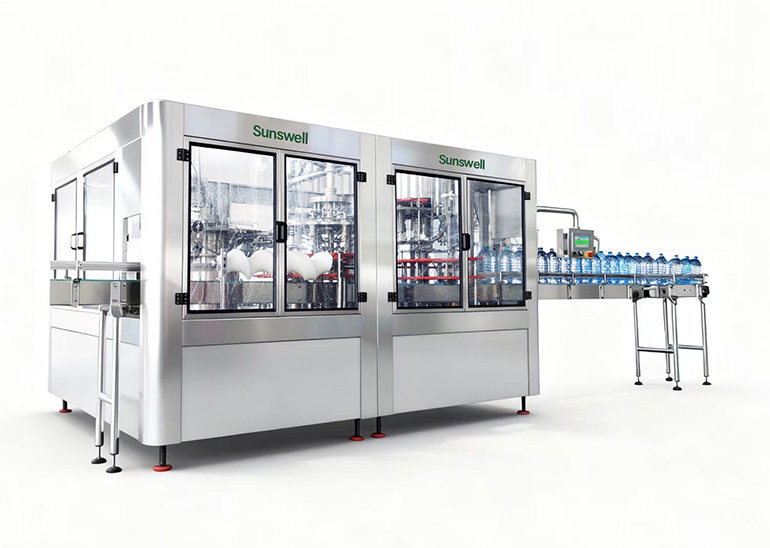
Sunswell's large-bottle water machines cover the 3–15 L range, and the same valve and washer logic scales to the 19 L format — confirm the exact bottle drawing with the engineering team.
4. How it differs from a PET-bottle line
A PET-bottle line blows, fills and caps single-use bottles at thousands per hour. A 19 L line has no blow moulder — the bottle comes back — and it runs at hundreds per hour, because the bottle is bigger, the fill is slower, and the washer adds a station. The two lines share the filler logic but little else.
Buyers who run both keep them separate: a PET line for retail small formats, a 19 L line for delivery. Mixing formats on one line is possible but forces changeover losses that cancel the convenience.
5. Handling returned bottles
Returned bottles arrive dirty, labelled and sometimes damaged. The line must strip labels, wash outside, rinse inside, and reject damaged necks and caps before filling. Inspection is a station, not a wish: a leak in a 19 L bottle is an expensive delivery failure.
Agree a bottle-condition standard with your supplier — the machine is designed around the worst bottle you will accept, and that standard decides the washer spec and the reject rate.
6. EAC, delivery and installation
Like any imported machinery, the line needs EAC certification for Kazakhstan, and the supplier should provide it before shipment. Delivery by rail or truck from China is routine and typically measured in weeks once the line is built. Installation is a one-to-two-week activity with the supplier's technician, including operator training and a starter spare-parts kit.
Plan water supply and drainage for the washer — it is the station with the highest water and waste demand, and a plant that undersizes utilities here delays commissioning.
7. Project checklist
Six items settle the quote: bottle drawing (neck finish and cap), target output in bottles/hour, return rate and bottle-condition standard, water quality, hall space for washer + filler + labeller, and certification scope. Send these to suppliers and ask for a layout drawing — the layout will expose which supplier has actually built this line before.
The surrounding equipment — labelling, packaging and palletising — is the same family as a water filling machine line; the front end is what differs.
Frequently asked questions
Is a 19 L line the same as a normal water filling line?
No. It replaces the blow moulder with a returned-bottle washer and runs at hundreds of bottles per hour instead of thousands. The filler logic is the same; the machine is not.
What output should a small city plant choose?
120–300 bottles/hour on a compact monobloc covers a small plant with one shift. Add a second shift before buying a bigger machine.
Mechanical or volumetric valve for 19 L water?
Mechanical is the cost-effective norm when the bottle is sold by the bottle. Choose volumetric if your market audits declared content.
How are returned bottles cleaned?
An external washer strips labels and dirt, then an internal rinse cleans the bottle before filling. Inspection rejects damaged bottles before they are filled.
Does the line need EAC certification?
Yes, like any imported machinery for Kazakhstan. Confirm the certificate covers your exact model before shipment.
Can Sunswell deliver a 19 L line to Kazakhstan?
Sunswell's large-bottle water machines cover 3–15 L, and the washer-filler-capper logic scales to 19 L. Send the bottle drawing and target output for a spec.
About the author
Written by the Sunswell engineering team — led by Howie SUN, Founder & CEO, with 14 years in filling and blow-moulding equipment R&D and turnkey project delivery across 71+ countries.
Last reviewed: 2026-08-28 · Reviewed by Sunswell engineering team
Ask our engineering team →
Have a specific project in mind?
Tell us product, target BPH, bottle sizes and market. We reply with a draft layout, equipment list and lead time estimate.
Fill the inquiry form ↑