


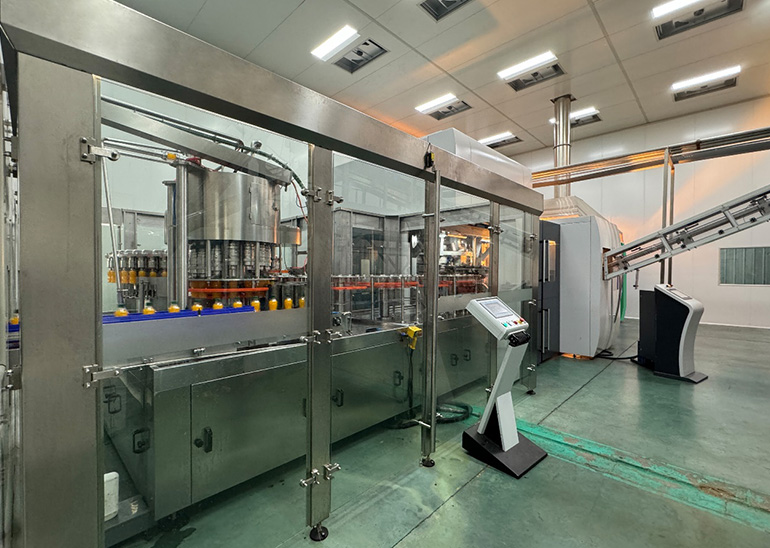
Production line · Juice & nectar
Fruit Juice & Nectar Production Line — Complete Process and Equipment List
Juice is the drink that punishes shortcuts: the fruit flavour is delicate, the pH is low, and the filling method decides shelf life. This page walks the full line — batching, deaeration, homogenising, heat treatment, hot-fill, cooling and packing — and explains the one decision that shapes everything: how you preserve the juice.
2×18,000
BPH juice case, Turkey
18,000
BPH hot-fill scale
444+
Lines delivered
71+
Countries exported
20,000
m² workshop
Short answer: The juice line runs: concentrate or fruit → batching with water and sugar → deaeration → homogenising (for pulp and cloudy product) → heat treatment → hot-fill into a heat-rated bottle → capping → cool-down → labelling and packing. Hot-fill preserves by temperature: the product fills hot, the bottle is capped, and the package itself becomes the sterilisation step. The alternatives are cold filling with preservatives (contact Sunswell for the cold-fill route) — hot-fill is the mainstream for nectar and pulp products.
🎯 Key takeaways
- Hot-fill preserves by temperature: fill hot, cap, and let the package hold the heat.
- Deaeration protects flavour and colour; oxygen is the enemy of juice.
- Homogenising is the step that keeps pulp and cloudy juice stable in the bottle.
- The bottle must be heat-rated; a PET line and a hot-fill line are different specs.
- Scale by year-one sales: 6,000–18,000 BPH is the common juice band.
On this page
1. The complete process
The line: concentrate or fruit pulp → batching with water and sweetener → deaeration → homogenising for pulp and cloudy products → heat treatment → hot-fill → capping → bottle cool-down → labelling → packing. The sequence is strict because each step protects the one after it: deaerated juice tastes better, homogenised pulp stays suspended, and the hot-fill step is only effective if the bottle and cap are heat-rated.
For clear juices the homogeniser is not needed; for nectar and cloudy drinks it is the difference between a stable bottle and one that separates on the shelf. Specify the line on the product, not on a generic layout.
2. Batching and deaeration
Batching blends concentrate or fruit, water, sugar and acid to the recipe. Accuracy here sets the taste of every bottle. Deaeration strips dissolved oxygen from the mix — oxygen oxidises flavour and darkens colour, so the deaerator is a quality station, not a courtesy.
The batching tank farm and the deaerator are sized on the line output and the recipe frequency. Products that change often (seasonal flavours) need a faster cleaning and changeover path between batches.
3. Homogenising
Cloudy juice and nectar contain pulp and fibre that settle or separate without treatment. The homogeniser breaks the particles to a consistent size so they stay suspended in the bottle — the visual difference is a uniform cloudy drink instead of a clear layer over a pulp layer.
If the product is cloudy or pulpy, put the homogeniser in the spec from day one. Adding it later means re-piping the line.
Clear juices (apple, grape) skip this step. Decide the product range before the line is designed and the homogeniser decision is free; decide it later and it is expensive.
4. Heat treatment and hot-fill
Heat treatment raises the product to a temperature that reduces the microbial load, and hot-fill preserves by temperature: the product fills hot into a heat-rated bottle, the bottle is capped, and the heat held in the package completes the preservation. No preservatives are needed for the mainstream high-acid products this route serves.
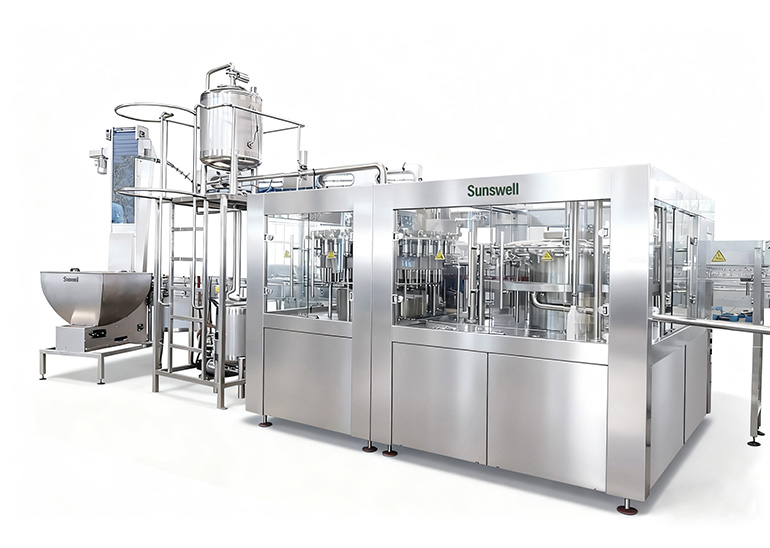
Hot-fill product needs a heat-rated bottle (PET hot-fill grade, or glass) and a filler with a hot product path — the valve and the piping are specified for temperature, not just for liquid. That is the single biggest difference between a juice line and a cold water line.
5. The heat-rated bottle
Hot-fill PET is a different bottle from cold-fill PET: it is designed to survive the fill temperature and the vacuum that forms as the product cools, so it is heavier and often has a special panel design. Glass is the alternative where the brand wants weight and feel.
Send the bottle drawing and the cap to the supplier with the enquiry. The filler, the capper and the cooling tunnel are all specified around the bottle's heat behaviour, and guessing means a line that fills a bottle it cannot cool.
6. Cooling, labelling, packing
After capping, the bottle cools, either in a cooling tunnel or by ambient flow. Cooling must be controlled: too fast and the bottle distorts from vacuum stress; too slow and the line becomes the bottleneck. The labeller and packer then finish the bottle — shrink or carton for PET, wrap for multipacks.
The cooling tunnel is a line station, not an accessory — it sets the rate at which bottles leave the filler, and the filler is rated on the cooled bottle, not the hot one.
7. Equipment list by output
| Station | 6,000–12,000 BPH | 12,000–18,000 BPH |
|---|---|---|
| Batching | Tank farm, manual control | Automated batching + CIP |
| Deaeration | Compact deaerator | Full deaeration + dosing |
| Homogenising | Single-stage | Two-stage for pulp |
| Heat treatment | Plate heat exchanger | PHE + hot-fill loop |
| Filler | Hot-fill mechanical valve | Hot-fill volumetric valve |
| Cooling | Cooling tunnel | Tunnel + ambient flow |
Juice fills a profitable niche for plants that already run water or CSD: the process differs, but the juice filling machine shares the same downstream as the rest of the hall.
Frequently asked questions
What is the difference between hot-fill and cold fill for juice?
Hot-fill preserves by temperature — fill hot, cap, and let the package hold the heat. Cold filling needs preservatives or another preservation route; contact Sunswell for the cold-fill option.
Does cloudy juice need a homogeniser?
Yes, if you want the pulp to stay suspended. Without homogenising, cloudy juice separates into layers on the shelf.
Can I use the same PET bottle as for cold water?
No. Hot-fill needs a heat-rated bottle with a heavier design and vacuum panels. The bottle spec is part of the line spec.
Is hot-fill enough to preserve the juice?
For mainstream high-acid nectar and juice products, yes — the heat held in the sealed bottle completes the preservation without preservatives.
What output should a juice line run?
6,000–18,000 BPH is the common band. Size to year-one sales and the recipe changeover schedule.
Has Sunswell delivered juice lines?
Yes — including two 18,000 BPH juice lines delivered to a producer in Turkey, plus hot-fill machines for glass and PET.
About the author
Written by the Sunswell engineering team — led by Howie SUN, Founder & CEO, with 14 years in filling and blow-moulding equipment R&D and turnkey project delivery across 71+ countries.
Last reviewed: 2026-08-28 · Reviewed by Sunswell engineering team
Ask our engineering team →
Have a specific project in mind?
Tell us product, target BPH, bottle sizes and market. We reply with a draft layout, equipment list and lead time estimate.
Fill the inquiry form ↑