


Engineering · Energy
Energy-saving Design in Modern Filling Lines
A filling line's energy bill is concentrated in four places: the blow moulder's compressed air, the heating and cooling of product, the motors and drives, and the plant's air and water handling. Modern design attacks all four — not with exotic technology, but with recovery, variable drives and honest sizing. This page explains where the kilowatt-hours go and what actually saves them.
444+
Lines delivered
71+
Countries exported
20,000
m² workshop
80+
Staff
2011
Sunswell founded
Short answer: Energy in a filling line goes mainly to compressed air for blowing, heating and cooling of the product, the motors and drives, and plant utilities. The savings that matter are design decisions, not tweaks: air recovery and efficient blowing, heat recovery from hot-fill and pasteurising, variable-speed drives sized to real load, and a layout that shortens conveyors. Each is specified at order, and each pays back over the line's life.
🎯 Key takeaways
- Compressed air for blowing is the biggest single energy use on a PET line.
- Heat recovery from hot-fill, pasteurising and compressors cuts the heating bill.
- Variable-speed drives match motors to real load — not nameplate worst case.
- Short conveyors and efficient layout save both energy and handling damage.
- Energy design is a specification, not a retrofit — it is decided at order.
On this page
1. The energy map
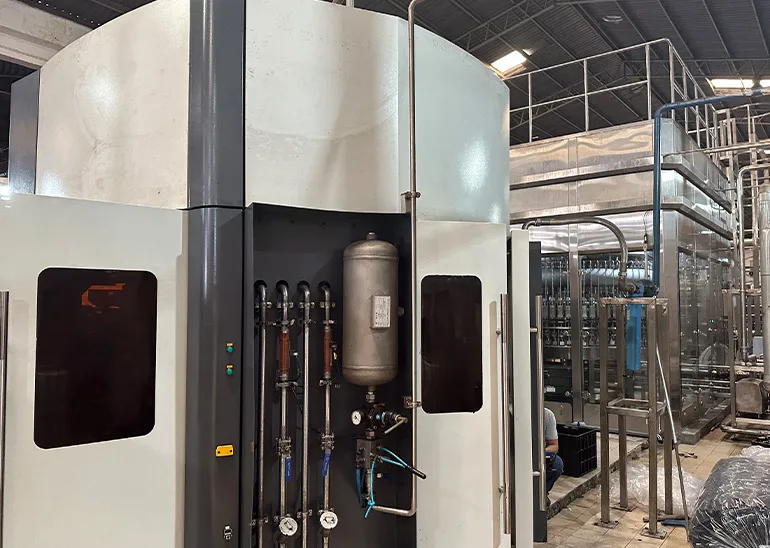
Before saving energy, find it: on a PET filling line, the energy splits roughly between the blow moulder's compressed air (the largest single consumer), the heating and cooling of product and bottles, the motors and drives across the line, and the plant's air and water handling. The split shifts with the process — a hot-fill juice line spends more on heat, a water combiblock more on air — and the saving strategy follows the map.
Ask the supplier for the line's energy breakdown with the proposal. A supplier who can show where the energy goes is a supplier who can design it out.
2. Compressed air and blowing
The blow moulder reheats preforms and blows them with compressed air, and the air system is the line's biggest energy user. The design levers are real: an efficient compressor package with air recovery, blow pressure set to the lightest bottle that still fills correctly, and a distribution system without leaks. Air is expensive to make — every cubic metre of leakage is paid for twice, once to compress and once to lose.
Ask for the compressed-air demand in the spec and the recovery options. Air recovery on the blow moulder can reclaim a meaningful share of the compression energy.
The compressor room is part of the line design, not an afterthought — right-sizing it at order beats adding capacity later.
3. Heating and cooling
Hot-fill and pasteurising lines heat the product, then cool it — and both sides cost energy. The design levers are the heat exchanger's efficiency, the insulation of tanks and pipes, and matching the heating and cooling duty to the real recipe rather than a worst-case guess. A line that heats more than the recipe needs pays for it on every batch.
Cooling loads in hot climates add to the bill — the plant's chilled-water system is sized on the real duty, and its efficiency is part of the design.
4. Heat recovery
Heat recovery is the saving that keeps paying: the warm water or air from cooling, pasteurising and compressors can pre-heat process water or the building. The economics depend on the climate and the process, and the recovery loop is designed in at order — retrofitting a heat exchanger into a finished line is expensive and rarely done. Ask the supplier what recovery the configuration includes.
Recovery is not free: the heat exchangers, pumps and controls cost money, so the design matches the recovery to the plant's actual heating demand — not to a maximum.
5. Motors and drives
Motors run the conveyors, pumps, fillers and packaging machines — and most run below their nameplate most of the time. Variable-speed drives match the motor to the real load, and modern motors are more efficient at partial load. The saving is real but modest per motor; across a line it compounds, and the drives also improve control and reduce mechanical wear.
Specify drives where the load varies — conveyors, pumps and the filler's infeed — and let the supplier justify the rest. Drive retrofit is possible later; specifying them at order is cheaper.
6. Layout and utilities
The layout is an energy decision: shorter conveyors mean less running load and less handling damage; a logical product flow means fewer transfers and less cooling loss. The plant's utilities — compressed air, chilled water, HVAC — are sized on the line's real demand, with the climate included. A hall planned around the line, not the other way around, is a hall that uses less energy.
Lighting, air handling and the office load are the plant's own; the line design sets the baseline the whole plant is sized on.
7. Specifying for energy
Energy design is a specification, not a retrofit: the air recovery, heat recovery, drives and layout are all decided at order, and they are priced into the proposal. Ask for the line's energy data with the quotation — the compressor package, the recovery options, the drive spec and the layout drawing — and compare suppliers on the energy story, not just the machine price. The combiblock range is where the air-and-blow savings live; the line design carries the rest.
Frequently asked questions
What uses the most energy on a filling line?
Compressed air for the blow moulder is the largest single consumer on a PET line; heating and cooling dominate hot-fill and pasteurising lines.
What actually saves energy?
Air recovery, heat recovery, variable-speed drives and a short, logical layout — design decisions made at order, not tweaks after.
Can heat be recovered?
Yes — cooling, pasteurising and compressor heat can pre-heat process water or the building. The recovery loop is designed in at order.
Are variable-speed drives worth it?
On variable loads — conveyors, pumps, infeed — yes: they match the motor to real load and compound across the line.
Is energy design a retrofit?
No — the savings are specified at order and priced into the proposal. Retrofitting recovery and drives later is costlier.
Can Sunswell provide the energy data?
Yes — ask for the energy breakdown with the proposal: compressor package, recovery options, drive spec and layout.
About the author
Written by the Sunswell engineering team — led by Howie SUN, Founder & CEO, with 14 years in filling and blow-moulding equipment R&D and turnkey project delivery across 71+ countries.
Last reviewed: 2026-08-28 · Reviewed by Sunswell engineering team
Ask our engineering team →
Have a specific project in mind?
Tell us product, target BPH, bottle sizes and market. We reply with a draft layout, equipment list and lead time estimate.
Fill the inquiry form ↑